AP Music Theory
99 study materials · 59 sections
AP Music Theory students working the current College Board Course and Exam Description, including first-time students with no prior background, plus teachers reviewing the page for CED alignment.; Teach every official CED unit and every numbered topic at topic granularity.; Develop every AP skill / science-practice code explicitly and by name.; Replace description with teaching: worked contextual examples, named misconceptions, and in-flow retrieval checks.; Build an exam-practice unit covering every task type on the current exam.
Course Sections
Course Framework, Skills and Reasoning Processes
Key concepts: AP Music Theory course framework · College-level curriculum alignment · Instructional model and unit sequencing · Essential questions and conceptual understandings · Content and skill development · Aural analysis and listening practice · Score analysis of notated music · Sight-singing and dictation · Composition and production of music · Progress monitoring and actionable assessment feedback
Music becomes theory when a listener can move fluently among four actions: hearing a musical event, seeing it notated, explaining how it works, and creating or completing music that follows its logic.
1.1 Pitch and notation
Key concepts: Reading and interpreting pitch notation · Bass clef fluency · Key signatures and tonality · Pitch accuracy and interval recognition · Rhythmic accuracy and subdivisions · Time signatures and meter · Tempo, dynamics, and phrasing · Singing from visual notation · Scalar, leap, and chromatic motion · Starting pitch and tonal context
A written melody becomes performable when three coordinates agree: where the pitch sits, which tonal collection governs it, and when the sound occurs. In a bass-clef melody marked with three flats, for example, the performer must read the staff, preserve the key of E-flat major, and keep every note aligned with the…
1.2 Rhythmic values
Key concepts: Rhythmic accuracy · Quarter-note values · Beamed eighth-note values · Dotted-quarter-note values · 4/4 meter · Maintaining continuity while performing rhythms
Rhythmic accuracy means placing every sound and silence at the correct moment while keeping the beat moving steadily. In $4/4$ meter, the quarter note is the basic beat: four quarter-note beats fill one measure, so the performer must hear the measure as a continuous cycle rather than as four unrelated events.
1.3 Half steps and whole steps
Key concepts: Half steps as the smallest interval between two pitches · Whole steps as intervals equal to two half steps · Identifying half-step and whole-step relationships in performed and notated music · Pitch patterns made up of half and whole steps · Major and minor scales as ordered pitch patterns · Ascending and descending scale motion · Accidentals used when a pitch requires notation outside the naturals · Conjunct melodic motion as stepwise movement · Disjunct melodic motion as movement by leaps
A half step is the smallest possible distance between two pitches in the standard pitch system; a whole step is exactly two half steps. These two distances are the musical “atoms” from which scales and many melodic patterns are built.
1.4 Major scales and scale degrees
Key concepts: Major scales · Minor scales · Scale degrees · Tonic and pitch function · Major pentatonic scales · Major and minor keys · Tonic progressions · Cadences · Melodic dictation · Sight-singing stepwise melodies
A scale degree is a pitch understood by its function relative to a tonic, the pitch that acts as the tonal center of a major or minor scale.
1.5 Major keys and key signatures
Key concepts: Major keys · Major scales · Key signatures · Tonic or central pitch · D major · Identifying keys in notated music · Representing scale pitches with a key signature · Major and minor scales · Clefs and notated music
A key signature tells you which pitches belong to a scale, but it does not by itself tell you whether the music is major or minor.
1.6 Simple and compound beat division
Key concepts: Rhythm · Meter · Beat · Beat division · Measure · Simple meter · Compound meter · Rhythmic values · Rhythmic patterns · Triplets
Rhythm is music organized in time: long and short sounds, separated by silences, unfold against a pulse that listeners can feel even when no instrument states it directly.
1.7 Meter and time signatures
Key concepts: Simple and compound meter · Time signatures and their upper and lower numbers · Beat division and pulse levels · Triple meter · Compound triple meter · Asymmetrical or irregular meter · Unequal beat groupings · Changing or mixed meter · Identifying irregular beat division · Identifying irregular beat grouping in performed and notated music
A time signature is a compact map of musical time: its upper number tells you how many beats or pulse levels occupy a measure, while its lower number identifies the note value used as the beat or division.
1.8 Rhythmic patterns and devices
Key concepts: Rhythm · Meter · Note values · Rhythmic patterns · Rhythmic devices · Steady beat · Stressed beats · Augmentation · Diminution · Dotted rhythms
Rhythm is the temporal organization of music: long and short sounds, rests, and accents arranged across time. Against the meter established earlier, rhythm gives a passage its recognizable motion—like the difference between footsteps, a skipping gait, and a sudden pause in a conversation.
1.9 Tempo
Key concepts: Tempo · Steady tempo · Accurate rhythm · Singing pitches · Performance of given exercises
Tempo is the speed of the underlying beat, but successful performance requires more than starting at the right speed: the beat must remain stable while pitch and rhythm continue accurately.
1.10 Dynamics and articulation
Key concepts: Dynamics · Articulation · Tempo · Tempo markings · Moderato · Forte (f) · Relative speed of music · Dynamic level · Sight-singing performance assessment · Musical notation stimulus
A melody can have the correct notes and rhythm yet still sound musically incomplete if it ignores dynamics and articulation. Dynamics shape loudness; articulation shapes how one sound connects to the next.
2.1 Minor scales: natural, harmonic, and melodic
Key concepts: Natural minor scale · Harmonic minor scale · Melodic minor scale · Major and minor scales · Altered forms of scales · Pitch patterns · Modes in relation to major and minor scales · Locrian mode · Key signatures · Chromatic alterations
A minor scale is not one fixed staircase of pitches: it can change its upper degrees depending on whether the music needs a darker color, a stronger pull toward the tonic, or a smoother melodic line.
2.2 Relative keys: determining relative minor keys and notating key signatures
Key concepts: Minor keys · Relative major and relative minor keys · Key signatures · Modes: major and minor · Parallel major and minor keys · Notation of minor keys
A major key and its relative minor key use the same key signature because they draw their notes from the same seven pitches. The difference is not the collection of notes but the tonal center—the pitch that feels like “home.”
2.3 Key relationships: parallel, closely related, and distantly related keys
Key concepts: Parallel keys · Closely related keys · Distantly related keys · Relative major and minor keys · Key signatures and accidentals · Major and minor keys with one additional or fewer sharp/flat · Diatonic major and minor triads · Key relationships as a basis for musical expression
A key relationship describes how one tonal center connects to another through tonic, mode, key signature, or diatonic harmony. These relationships help explain why a passage can sound like it has moved naturally, suddenly, brightly, or darkly—even when the music remains connected.
2.4 Chromatic, whole-tone, and pentatonic scales
Key concepts: Chromatic scales · Whole-tone scales · Pentatonic scales · Identifying scales in performed music · Identifying scales in notated music · Melodic passages using non-diatonic scales · Major pentatonic scale degrees · Pitch fundamentals and successive pitches · Listening for pentatonic scales in American folksongs, spirituals, and popular music · Singing chromatic and whole-tone scales by rote
A scale is an organized succession of pitches, and its pattern of steps can make a melody sound tense, floating, open, or familiar before you identify a single chord.
2.5 Interval size and quality
Key concepts: Interval size · Interval quality · Intervals in performed music · Intervals in notated music · Pitch as a feature of performed music · Melodic intervals (successive pitches) · Harmonic intervals (simultaneous pitches) · Pitch and intervals as elements of musical expression
An interval is the distance between two pitches, and a complete interval name tells you both how far apart the pitches are and what precise pitch relationship they form.
2.6 Interval inversion and compound intervals
Key concepts: Interval inversion · Compound intervals · Interval size and quality · Perfect intervals · Major and minor intervals · Diminished and augmented intervals · Performed music · Notated music
An interval inversion changes the register of an interval without changing its two pitch classes: move the lower note up one octave, and the interval turns “inside out.” A small interval becomes its complementary large interval, while its quality follows a fixed transformation.
2.7 Transposing instruments
Key concepts: Transposing instruments · Identifying transposing instruments · Transposing musical exercises · Specified levels of transposition · AP Music Theory Exam presentation of transposing-instrument exercises
A transposing instrument is an instrument whose written, or notated, pitch differs from the pitch that actually sounds. The notation tells the performer which fingering or key to use; the resulting sound may be higher or lower than the written note.
2.8 Timbre
Two instruments can play the same pitch at the same loudness and still sound unmistakably different because timbre is the quality of sound that lets us identify its source.
2.9 Melodic features
Key concepts: Melodic features · Features of melody · Motives · Timbre · Texture · Meter · Treble clef · Bass clef · Musical fluency
A melody becomes recognizable not from its pitches alone, but from the way those pitches move, repeat, and occupy musical time. The same sequence of notes can sound completely different when performed by a different voice or instrument, placed in a new texture, or reorganized by the meter.
2.10 Melodic transposition
Key concepts: Melodic transposition
A melody can be moved to a new key without changing its musical identity: its interval pattern stays the same while every pitch shifts by the same amount.
2.11 Texture and texture types
Key concepts: Texture · Monophony · Homophony · Chordal homophony · Melody with accompaniment · Polyphony · Timbre · Pitch density and spacing · Pitch range · Performed and notated music
Texture is the way musical components combine simultaneously to create the listener’s overall sound. A solo singer, a melody supported by chords, and several independent melodies can use the same notes yet produce radically different musical experiences because their textures differ.
2.12 Texture devices
Key concepts: Texture devices · Rhythm · Musical design
A texture device is a compositional procedure that organizes how musical parts interact over time. Building on the texture type already identified, the device names the procedure organizing the parts—such as imitation, call and response, or ostinato.
2.13 Rhythmic devices
A rhythm can become more than a sequence of durations when it creates expectation, interruption, or competing patterns. A rhythmic device is a recurring or distinctive way of organizing beats and durations that shapes a passage’s energy, groove, and musical design.
3.1 Triad and chord qualities
Key concepts: Chord definition and perception · Triads as three distinct pitches stacked in thirds · Seventh chords as four distinct pitches stacked in thirds · Triad qualities determined by major and minor thirds · Major, minor, diminished, and augmented triad qualities · Recognizing chord quality in performed music · Recognizing chord quality in notated music · Root position and inversions of triads · Chord-quality examples in harmonic analysis · Arpeggiation as a way of perceiving a chord
A chord is a group of three or more pitches heard simultaneously—or perceived as a single grouping when the pitches are sounded successively through arpeggiation, a broken-chord performance.
3.2 Diatonic chords and Roman numerals
Key concepts: Diatonic chords · Roman-numeral analysis · Scale-degree identification of chord roots · Chord quality notation · Uppercase and lowercase Roman numerals · Arabic numerals for chord inversions · Figured-bass notation · Harmonic function in chord progressions · Outer-voice notation and analysis · 18th-century voice leading
A Roman numeral turns a chord into a map coordinate: it tells you which scale degree supplies the root and, through capitalization, what quality the chord has.
3.3 Chord inversions and figured bass
Key concepts: Chord inversions · Root position, first inversion, and second inversion · Figured-bass notation · Arabic numerals for chord inversions · Roman-numeral harmonic analysis · Distinguishing chord changes from bass changes · Four-voice realization from figured bass · Chord members appearing in the bass · Major and minor triad notation · Harmonic function in performed and notated progressions
A chord’s identity and its lowest note are related but not identical: when the bass changes, the harmony may change—or the same harmony may simply appear in a different inversion.
3.4 Seventh-chord qualities
Key concepts: Seventh-chord qualities · Chord definitions · Triads and seventh chords as structures built in thirds · Fully diminished seventh chord (viid7) · Minor seventh chord (ii7 or vi7) · Dominant seventh chord (V7) · Cadential 6/4 chord · Voice-leading before resolution · Contextual listening · Harmony as relationships among chords within a musical style
A seventh chord contains four distinct pitches arranged as a triad plus an added seventh, so its sound depends not only on the chord’s root but also on the precise sizes of its third, fifth, and seventh.
3.5 Seventh-chord inversions and figures
Key concepts: Seventh-chord inversions · Figured-bass notation for seventh chords · Dominant seventh arpeggios in all inversions · Identifying seventh-chord inversions from the bass note · Roman-numeral analysis of seventh chords · Third-related dissonance in seventh chords · Melodic dictation with tonic and dominant triad arpeggios · Compound meter in melodic dictation
A seventh chord can keep exactly the same four pitches while its bass changes, so the ear may hear a new bass line without hearing a new harmony.
4.1 Soprano-bass counterpoint
Key concepts: Soprano-bass counterpoint · SATB voice leading · Parallel perfect intervals · Beat-to-beat parallels · Hidden (covered) perfect intervals · Direct perfect intervals · Overlapping voices · Phrase structure and phrase relationships · Roman-numeral harmonic analysis · Common-practice period part-writing
A convincing bass line does more than supply low notes: it forms a second melody that must cooperate with the soprano at every moment. Soprano-bass counterpoint is the practice of completing a bass beneath a given soprano while controlling harmonic function, melodic direction, phrase shape, and the intervals formed…
4.2 SATB voice leading
Key concepts: SATB four-voice writing and spacing · Eighteenth-century voice-leading procedures · Harmonic intervals between voices · Similar and contrary motion · Direct (hidden) fifths and octaves · Stepwise motion in the upper voice · Leading-tone resolution · Note-against-note dissonance · Roman-numeral harmonic progressions · Score analysis and contextual listening
SATB writing arranges four voices from highest to lowest as soprano, alto, tenor, bass. The challenge is not merely to spell each chord correctly: every voice must form a singable line while the vertical intervals between voices remain clear and stylistically controlled.
4.3 Harmonic progression and function
Key concepts: Harmonic function and progression in performed and notated music · Harmony as successively and simultaneously produced pitches forming chords that relate within a musical style · Harmonic rhythm: the rate at which chords change and its effect on musical pace · Chord roles and functional areas: tonic, predominant, dominant, and tonic · The tonic–predominant–dominant–tonic functional progression · Predominant harmonies, especially subdominant IV or iv and supertonic ii or ii° · Inconclusive and conclusive cadences · Perfect authentic cadence (PAC) and imperfect authentic cadence (IAC) · Second-inversion triads (6/4 chords) and their permitted contexts · Cadential, neighboring or pedal, passing, and arpeggiated 6/4 patterns
A chord progression is not merely a chain of sonorities: each chord creates an expectation about what may come next. In tonal music, a tonic chord can feel like home, a dominant chord can create pressure to return home, and a predominant chord can prepare that pressure.
4.4 Cadences and phrases
A cadence is a musical punctuation point: a pattern of harmony and melody that creates closure, continuation, or surprise. A phrase is a complete musical thought, often ending at a cadence.
4.5 Voice leading with seventh chords
Key concepts: Voice leading as the coordinated motion and interaction of individual voices · 18th-century Western European voice-leading practices · Linear smoothness in voice leading · Independence of individual voices · Four types of voice motion: parallel, oblique, similar, and contrary · Voice leading in four voices · Voice leading with seventh chords · Seventh-chord inversions and figured-bass figures · Leading-tone resolution in voice leading · Avoidance of repeated perfect octaves or perfect unisons
A seventh chord is not four unrelated notes stacked vertically: it is four individual voices moving through time. Voice leading is the coordinated movement of those voices as a harmonic progression advances, and good voice leading makes the progression sound both connected and intelligible.
4.6 Voice leading with inverted seventh chords
Key concepts: Voice leading with inverted seventh chords · Stepwise bass motion in extended progressions · Smooth voice leading with minimal leaps · Spacing between the bass and its nearest upper voice · Complete spelling of inverted seventh chords · Approach and resolution of chordal sevenths · Descending-step resolution of chordal sevenths · Approaching chordal sevenths by step or leap · Inverted diminished seventh chords in tonicization · Secondary dominant and leading-tone seventh-chord voice leading
An inverted seventh chord can make a bass line sound like a melody rather than a sequence of harmonic leaps. In an extended progression, its bass note often moves by step while the upper voices shift as little as possible—a compact musical “hinge” between larger harmonic goals.
5.1 Adding predominant-function IV (iv) and ii (ii°) to a melodic phrase
Key concepts: Predominant function · IV chord · iv chord · ii° chord · Tonic–predominant–dominant–tonic functional order · Harmonic progression · Melodic phrase · Normative chord successions · Harmonic function · Roman-numeral chord notation
A melody can sound as though it is heading somewhere before the dominant chord arrives. That sense of direction often comes from a predominant-function chord: a harmony whose contextual role is to move away from tonic and prepare the dominant.
5.2 The vi (VI) chord
Key concepts: The vi (VI) chord · Chord progressions · Notated melodies · AP Music Theory harmony questions · Melody playback and listening responses · Exam question timing and pauses
A melody can sound as if it is moving away from home without actually leaving the key: in a major key, the vi chord provides that change of color by beginning on scale degree $6$ while remaining entirely diatonic.
5.3 Predominant seventh chords
Key concepts: common-practice techniques · converting between performed and another representation
A predominant seventh chord prepares the dominant by adding a fourth chord member to a predominant triad, creating a stronger directed motion toward $V$ or $V^7$.
5.4 The iii (III) chord
Key concepts: The iii (III) chord · Chord-quality abbreviations in chord symbols · Minor triad notation such as Cm · Lead-sheet chord symbols · Roman-numeral chord labels · Neighboring or pedal six-four chords · Plagal cadences · Passing six-four chords · Cadential six-four chords · Avoiding poor chord successions
The iii chord is the diatonic triad built on scale degree $\hat{3}$: in a major key it is a minor triad, while in a minor key its quality is typically represented as a major triad, written $\mathrm{III}$.
5.5 Cadences and predominant function
A cadence is a point of musical punctuation: the harmony and melody create enough closure—or enough interruption—to make a phrase sound finished, paused, or redirected.
5.6 Cadential six-four chords
Key concepts: Cadential six-four chord as a second-inversion tonic triad · Dominant function of the cadential 6/4 despite its tonic-triad pitches · Resolution of the cadential 6/4 to V · Strong-beat placement and phrase-final cadential context · Voice-leading retardations: 6–5 and 4–3 above the bass · Distinction between cadential, passing, pedal, neighboring, and arpeggiated 6/4 chords · Bass motion and stability in identifying six-four chord types · Alternative analysis of a cadential 6/4 as a decorated dominant chord
A cadential six-four chord contains the pitches of the tonic triad but functions as a dominant embellishment immediately before $V$.
5.7 Additional six-four chords
Key concepts: Additional six-four chords · Roman numeral analysis · Second-inversion dominant seventh chords · Tonic and scale-degree notation · Harmonic progression notation · Regular scoring by segments · Holistic alternate scoring · Pitch and rhythm accuracy · Flow-point scoring · Scoring rules for restarts and transposition
An additional six-four chord is a second-inversion triad whose meaning comes from its harmonic surroundings rather than from a single fixed function. Roman-numeral analysis therefore reads a progression such as
6.1 Passing tones and neighbor tones
Key concepts: Embellishing tones · Nonharmonic tones · Passing tones · Accented passing tones · Unaccented passing tones · Neighbor tones · Upper neighbor tones · Lower neighbor tones · Identifying passing and neighbor tones · Writing passing and neighbor tones
A melody can become expressive without changing its underlying harmony: a note may briefly step away from a chord tone, create motion, and return or continue smoothly.
6.2 Writing passing and neighbor tones
Key concepts: Writing unaccented passing tones · Writing unaccented neighbor tones · Stepwise melodic motion · Harmonic-context analysis of melodies · Part-writing passing 6/4 chords · Part-writing pedal (neighboring) 6/4 chords · Doubling the fifth in a passing 6/4 chord · Stationary bass in a pedal or neighboring 6/4 chord
A passing or neighbor tone earns its label not merely from its pitch, but from where it occurs in the meter, how it moves, and what harmony surrounds it.
6.3 Other embellishing tones
Key concepts: Embellishing tones · Upper-neighbor tones · Passing tones · Identifying embellishing tones in a musical score · Marking the score with color coding
An embellishing tone is easiest to recognize when you stop asking only, “What chord is sounding?” and ask instead, “How does this note behave between the surrounding stable notes?” In a score, the answer is often visible as a small melodic detour: a note leaves a stable pitch and returns, or it fills the space…
6.4 Suspensions
Key concepts: Suspensions
A suspension is a nonharmonic tone that is prepared as a consonance, held while the harmony changes, becomes dissonant against the new harmony, and then resolves by step—normally downward—to a consonant chord tone.
7.1 Tonicization through secondary dominant chords
Key concepts: Tonicization · Secondary dominant (applied dominant) chords · Roman-numeral slash notation · Temporary tonicization of non-tonic major or minor triads · V/V (the dominant of the dominant) · V/ii and V/IV · Resolution of secondary dominants · Chromatic accidentals in secondary dominants · Dominant seventh (major-minor seventh) chords · Identifying tonicization in performed and notated music
A tonicization makes a chord other than the home-key tonic sound temporarily like a tonic, usually by placing that chord after its own dominant. The effect is a brief musical spotlight: the overall key remains stable, but one local chord suddenly feels like “home.”
7.2 Part writing of secondary dominant chords
Key concepts: Tonicization · Secondary dominant chords · Secondary leading-tone chords · Part writing · Voice leading · Accidentals and chromatic pitches · Harmonic function and key relationships · Chord inversions and seventh chords · Normative harmonic procedures of 18th-century music · Analysis and composition of secondary-function chords
Apply the dominant-chord voice-leading rules from 7.1 to secondary dominants: preserve normal doubling, spacing, and resolution practices while accounting for their chromatic pitches. The challenge is not to invent a new set of rules, but to hear the temporary target, spell the applied chord correctly, and connect…
7.3 Tonicization through secondary leading-tone chords
Key concepts: Tonicization as a temporary local emphasis of a chord other than the primary tonic · Secondary dominant (applied dominant) chords · Secondary leading-tone chords, also called applied leading-tone or applied diminished seventh chords · Chromatic alteration and accidentals used to tonicize a target chord · Roman-numeral and Arabic-numeral analysis of applied chords · Inversion and notation of secondary leading-tone triads and seventh chords · Resolution of chromatically altered tones · Common-practice voice leading in secondary-function harmony
A chord can briefly behave like a destination without becoming the permanent home key: tonicization is the local emphasis of a diatonic chord other than the primary tonic, making that chord sound like a temporary tonic.
7.4 Part writing of secondary leading-tone chords
Key concepts: Part writing of secondary leading-tone chords · Secondary functions in harmony · Spelling secondary leading-tone chords · 18th-century common-practice voice-leading procedures · Voice leading in up to four voices · Chordal seventh resolution · Score analysis of voice leading · Error detection in part writing · Harmonic dictation of secondary leading-tone chords · Converting between performed and notated music
A secondary leading-tone chord must be written as if it were a normal leading-tone chord aimed at a temporary target: its leading tone rises by step to the target chord’s root, while any chordal seventh falls by step.
8.1 Modes
A mode is a seven-note pitch collection organized around a particular tonic, or tonal center. The same white-key collection can sound completely different depending on which note feels like “home”: C–D–E–F–G–A–B centered on C is Ionian, but the same pitches centered on D produce Dorian.
8.2 Phrase relationships
A phrase is a coherent musical idea that usually ends with a cadence, and a phrase relationship describes how one phrase answers, repeats, contrasts with, or develops another.
8.3 Common formal sections
Key concepts: Musical form · Hierarchy of constituent parts in composition · Relationships among musical parts · Contrast and development as formal processes · Formal types and functions · Established melodic-harmonic patterns · Phrase relationships · Modes · Common formal sections · Form as the structural aspect of music
Form is the structural organization of a musical composition: the way its parts are arranged, related, contrasted, and developed. Like language, music has hierarchy—small units combine into larger units, and those larger units create the composition’s recognizable shape.
AP Practice 1
Key concepts: AP Music Theory Course and Exam Description updates effective Fall 2026 · Retardation and upward-resolving suspension as the same musical concept · Texture terminology clarification: removal of “technical” and “casual” descriptors · AP Exams, qualifying scores, college credit, and course placement · AP’s emphasis on evidence, scientific reasoning, and independent thinking · AP’s opposition to censorship and support for respectful debate · Access, opportunity, and readiness for students enrolling in AP courses · My AP activation and access to AP resources · Aural skills, listening, harmony, and sight-singing in AP Music Theory · Diverse musical repertoire in AP Music Theory
A strong AP Music Theory answer begins with evidence: what is heard, what is notated, and which musical process best explains it. This original practice set uses multiple-choice reasoning to rehearse the exam’s terminology updates, course purpose, and academic expectations while keeping the central habit of mind…
AP Practice 2
Key concepts: Upward-resolving suspension (retardation) · Suspension, including rearticulated suspension and chain of suspensions · Texture terminology · Pitch and pitch notation · Rhythm, meter, and beat division · Syncopation and rhythmic patterns · Dynamics, articulation, and tempo · Instrument families and standard instruments · Tonic, dominant, and predominant harmonic functions · Recomposing a well-known tonal melody
A harmonic dictation task asks you to turn a heard musical event into a precise notated and analytical account: What pitches and rhythms occurred, what harmonies changed, and how did those harmonies function?
AP Practice 3
A sight-singing response is judged by what remains audible when the melody becomes difficult: rhythmic accuracy, relative pitch accuracy, and continuity. The task is not to sing with a beautiful operatic tone; it is to keep the musical line moving accurately and steadily while reading unfamiliar notation.
AP Practice 4
A sight-singing response turns silent notation into a continuous musical performance: the score gives pitch and rhythm, but the singer must supply accurate execution under severe time pressure.
AP Practice 5
A harmonization task asks you to turn a single melody into a convincing musical conversation: the melody supplies the visible clues, while your chords must explain its motion, support cadences, and follow eighteenth-century stylistic norms.
AP Practice 6
Sight-singing rewards a performer who keeps the musical line moving while controlling two separate problems: rhythmic accuracy and relative pitch accuracy. In the AP Music Theory sight-singing task, each melody receives a short preparation period of approximately $1$ minute and $15$ seconds, followed by a…
Source Materials
- Learn More (.pdf)
- AP Music Theory Course and Exam Description
- AP Music Theory Course Overview
- AP Music Theory Course at a Glance
- AP Music Theory Course at a Glance Poster
- Adopt AP Music Theory
- AP Music Theory
- AP Music Theory
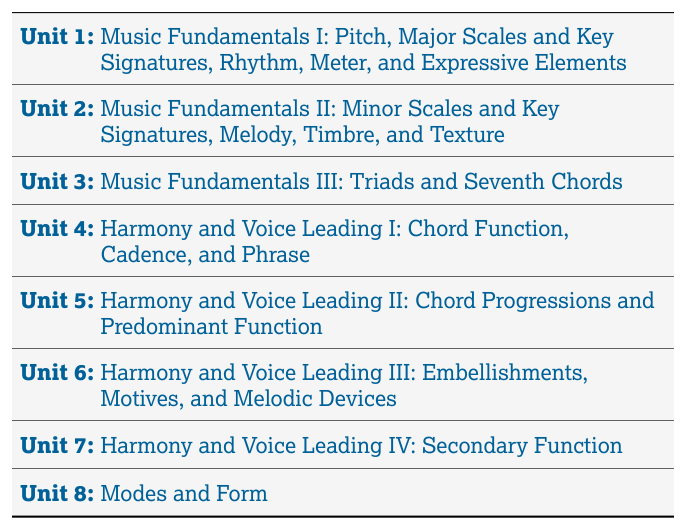
- Figure — AP Music Theory Course and Exam Description (p. 1)
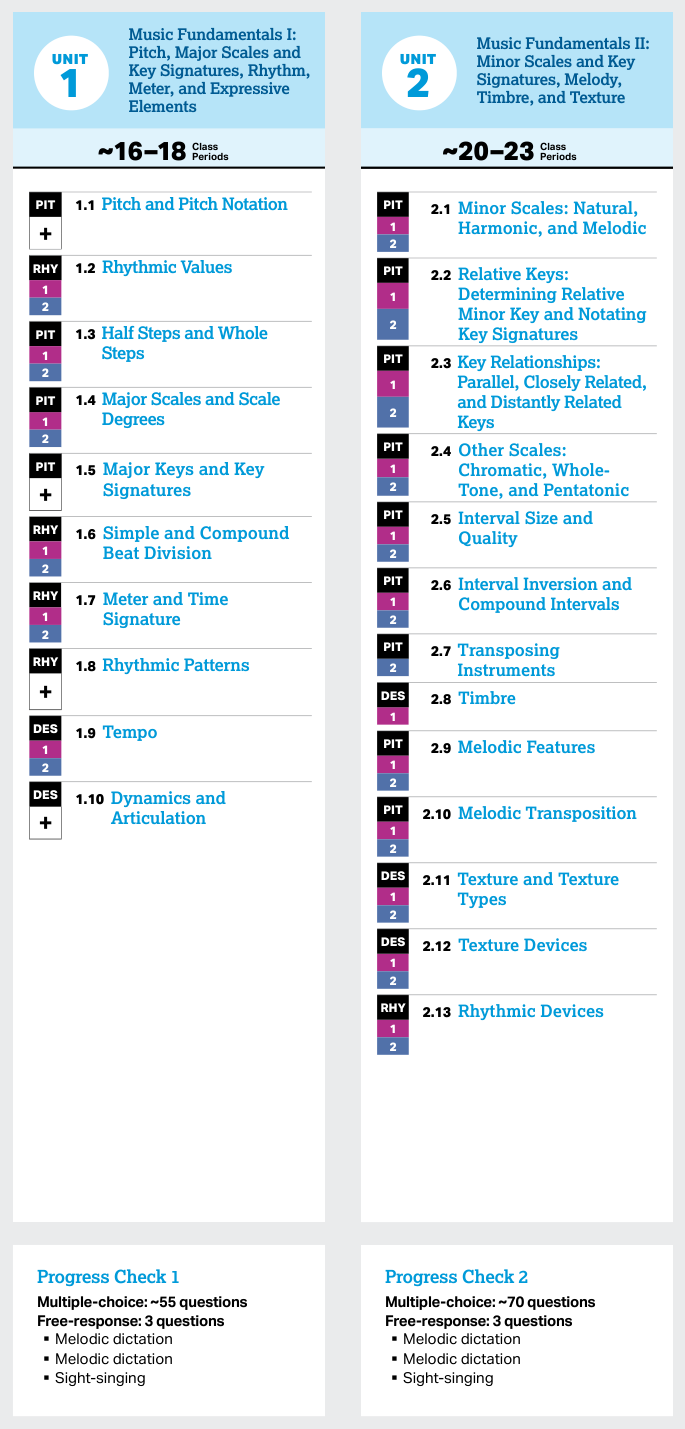
- Figure — AP Music Theory Course and Exam Description (p. 17)
- Pacing recommendations for each unit are suggestions for how to allocate teaching time and administer the Personal Progress Checks. Class periods are based on a 45-minute class period, meeting five da
- Figure — AP Music Theory Course and Exam Description (p. 29)


Study AP Music Theory on Lykke
This course page is free to open: signed out, you can read its first two sections, and signing in, on any plan, opens the rest. The free Lykke Chrome extension syncs your own Canvas courses, so ChatGPT, Claude and Muse can answer from your classes and deadlines. It only reads Canvas.
Add the free extensionSign in to open every section