From the free course AP Music Theory on Lykke
3.2 Diatonic chords and Roman numerals
Key concepts: Diatonic chords · Roman-numeral analysis · Scale-degree identification of chord roots · Chord quality notation · Uppercase and lowercase Roman numerals · Arabic numerals for chord inversions · Figured-bass notation · Harmonic function in chord progressions · Outer-voice notation and analysis · 18th-century voice leading
A Roman numeral turns a chord into a map coordinate: it tells you which scale degree supplies the root and, through capitalization, what quality the chord has.
3.2 Diatonic chords and Roman numerals
A Roman numeral turns a chord into a map coordinate: it tells you which scale degree supplies the root and, through capitalization, what quality the chord has. In a key such as C major, the numeral V means “the chord built on scale degree $5$,” while v would mean “a minor chord built on scale degree $5$.”
Roman-numeral analysis identifies a chord by its root’s scale-degree position and its chord quality. Uppercase numerals indicate major chords; lowercase numerals indicate minor chords. The symbol $^\circ$ marks diminished quality when needed.
From scale degrees to chord symbols
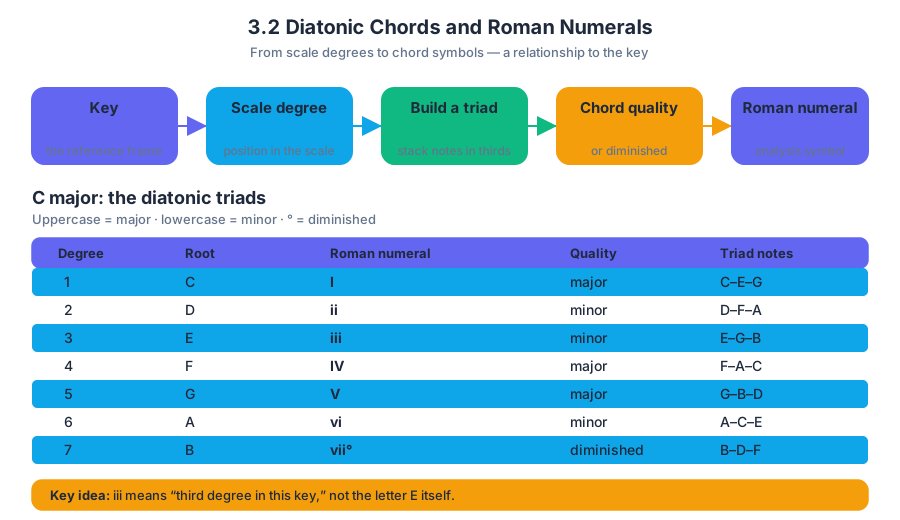
In C major, the diatonic triads can be represented as follows:
| Scale degree | Root | Roman numeral | Quality |
|---|---|---|---|
| $1$ | C | I | major |
| $2$ | D | ii | minor |
| $3$ | E | iii | minor |
| $4$ | F | IV | major |
| $5$ | G | V | major |
| $6$ | A | vi | minor |
| $7$ | B | vii$^\circ$ | diminished |
The numeral is not a letter name. It is a relationship to the key. For example, an E-major chord is III in C major only if the chord’s notes have been chromatically altered; the diatonic chord built on scale degree $3$ in C major is E–G–B, so its analysis is iii. Change the key, and the same sounding chord may receive a different numeral.
Roman numerals also describe harmonic function
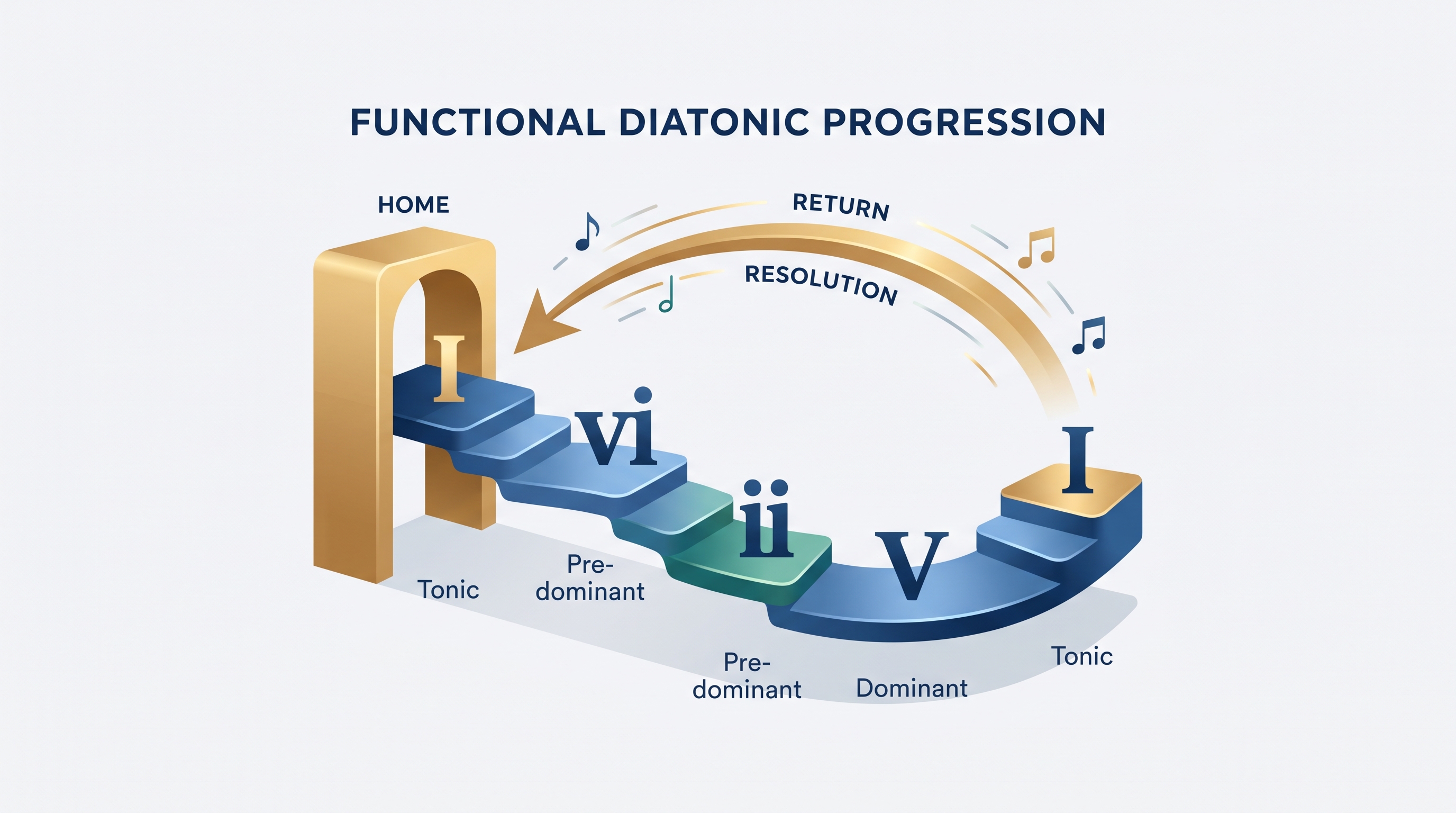
A harmonic function is the role a chord plays in creating movement and stability. Diatonic chords commonly group into three functional families:
- Tonic function: stability or arrival, especially I; vi can also substitute for tonic.
- Predominant function: motion away from tonic toward dominant, especially ii and IV.
- Dominant function: tension that strongly points back to tonic, especially V and vii$^\circ$.
These roles explain why a harmonic progression—a particular sequence of chords underlying a passage—often sounds directed rather than random. A useful basic pattern is
$$ \mathrm{I \rightarrow vi \rightarrow ii \rightarrow V \rightarrow I}. $$
In C major, this means
$$ \mathrm{C \rightarrow Am \rightarrow Dm \rightarrow G \rightarrow C}. $$
The opening I establishes tonic. The vi remains relatively stable but creates contrast without leaving the tonic family. The ii acts as predominant, preparing V; V supplies dominant tension; and the final I restores tonic stability.
This functional reading is more informative than simply listing chord names. I–vi–ii–V–I tells both what the chords are and how they behave: tonic area, predominant preparation, dominant tension, and tonic resolution.
Applying an analysis to performed or notated music
Roman-numeral analysis applies to music heard in performance as well as music shown in notation. Start by determining the key, identify the likely chord roots from the sounding notes, and then express each chord relative to the key. The sounding soprano and bass are especially useful clues, but an accurate analysis must account for every written or heard note assigned to each harmony.
For example, suppose a notated passage in C major contains the simultaneous pitch collections C–E–G, A–C–E, D–F–A, G–B–D, and C–E–G. The analysis is I–vi–ii–V–I. Every note belongs to its assigned diatonic chord, and the progression’s functional pattern supports the interpretation.
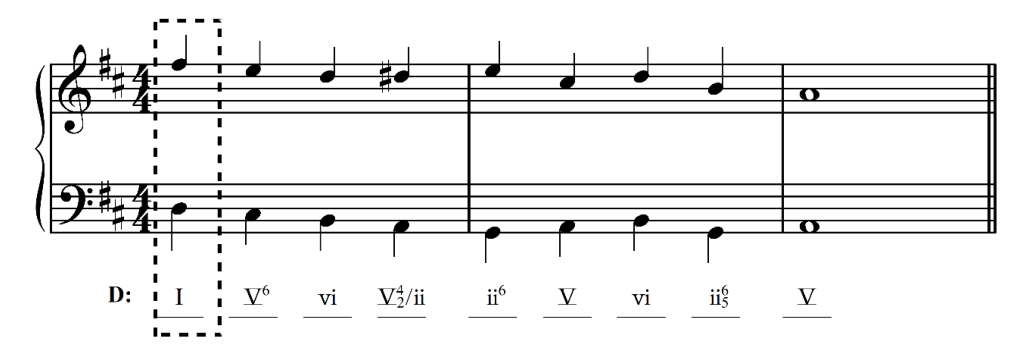
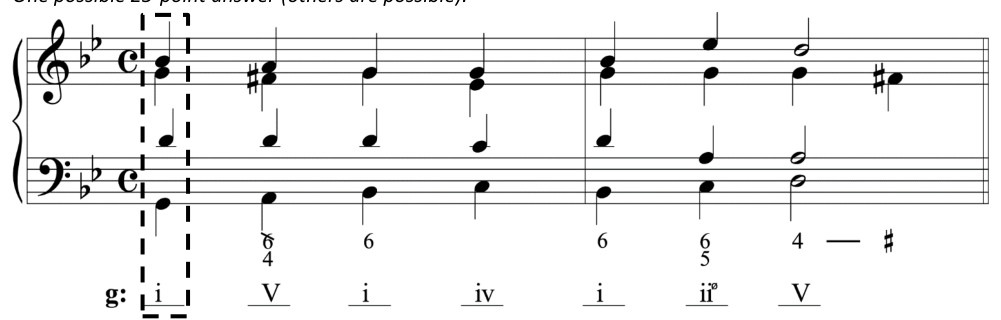
PIT-2.F.1: Notes of a bass line, especially when combined with other information, may be used with Arabic numerals to show chord inversion and/or specific voice leading. If the Roman-numeral analysis is accurate, all given notes must be explainable by the chords represented.
Arabic numerals may be added to a Roman numeral to indicate inversion or a particular voice-leading configuration, such as a chord symbol containing a figure like $6$. That compact addition says which chord and gives limited information about how it is arranged. It is not the same as figured bass: in figured bass, Arabic numerals are intervals to be performed above the given bass note, whereas Roman-numeral analysis labels the harmony itself. Detailed inversion and figured-bass procedures belong with chord inversions.
Voice-leading accuracy and exam reasoning
Roman numerals should describe the harmony that actually explains the music, not merely provide a plausible sequence. In 18th-century-style writing, chord choices and their connections follow voice-leading procedures; a theoretically possible label can still produce a poor progression if the parts move incorrectly. Common warning signs include an unstable root-position vii$^\circ$ used without an appropriate resolution and parallel motion by first-inversion chords, except in contexts where the style permits it.
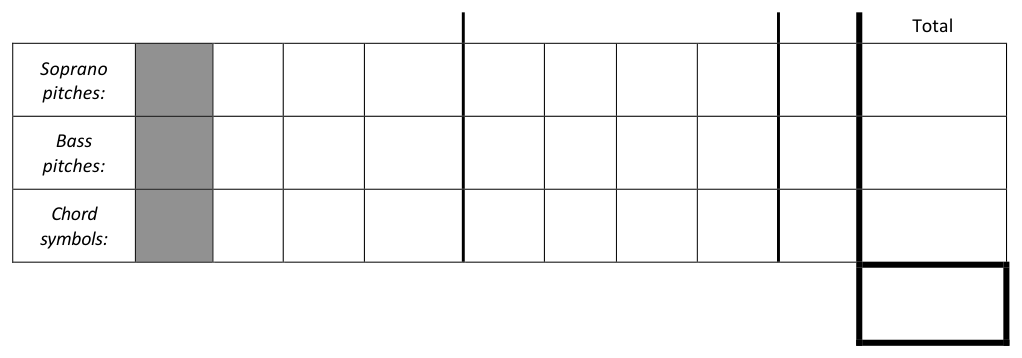
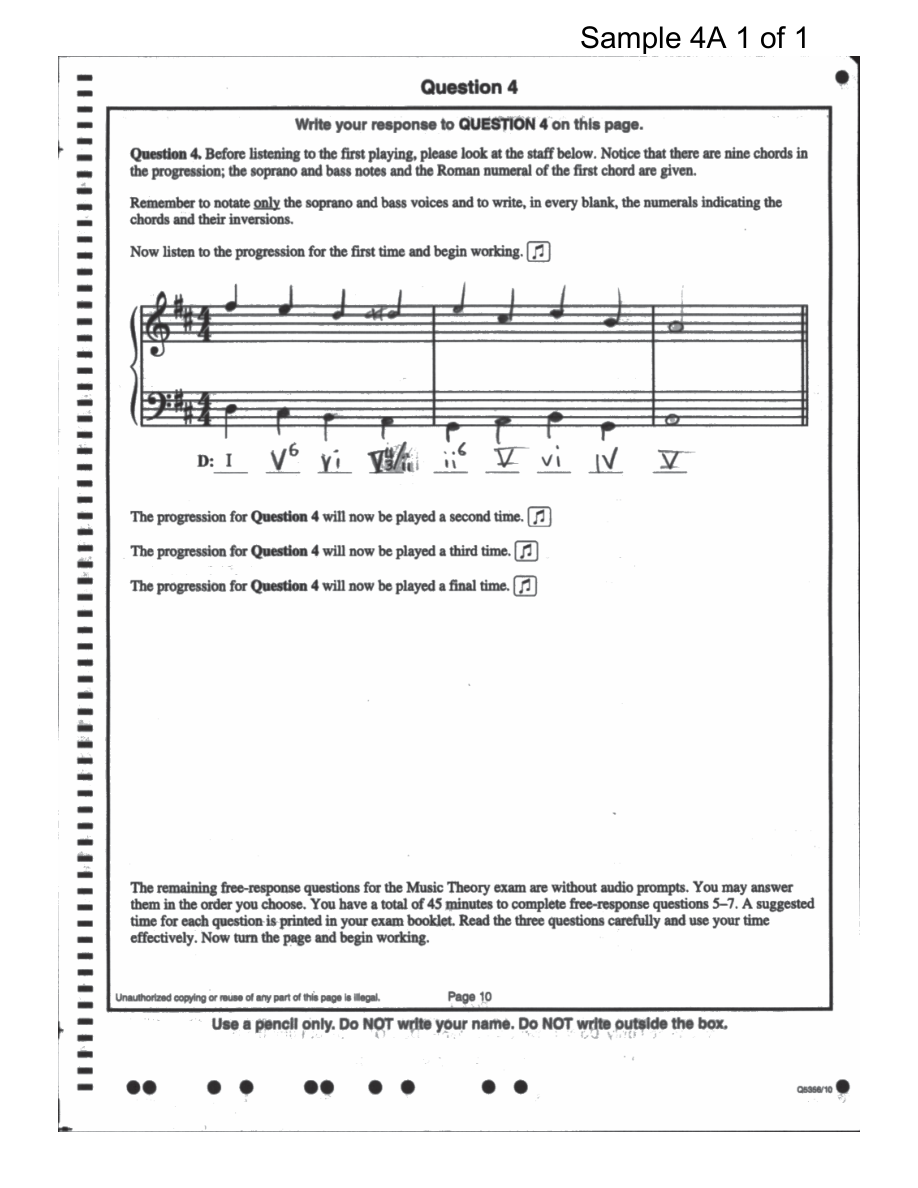
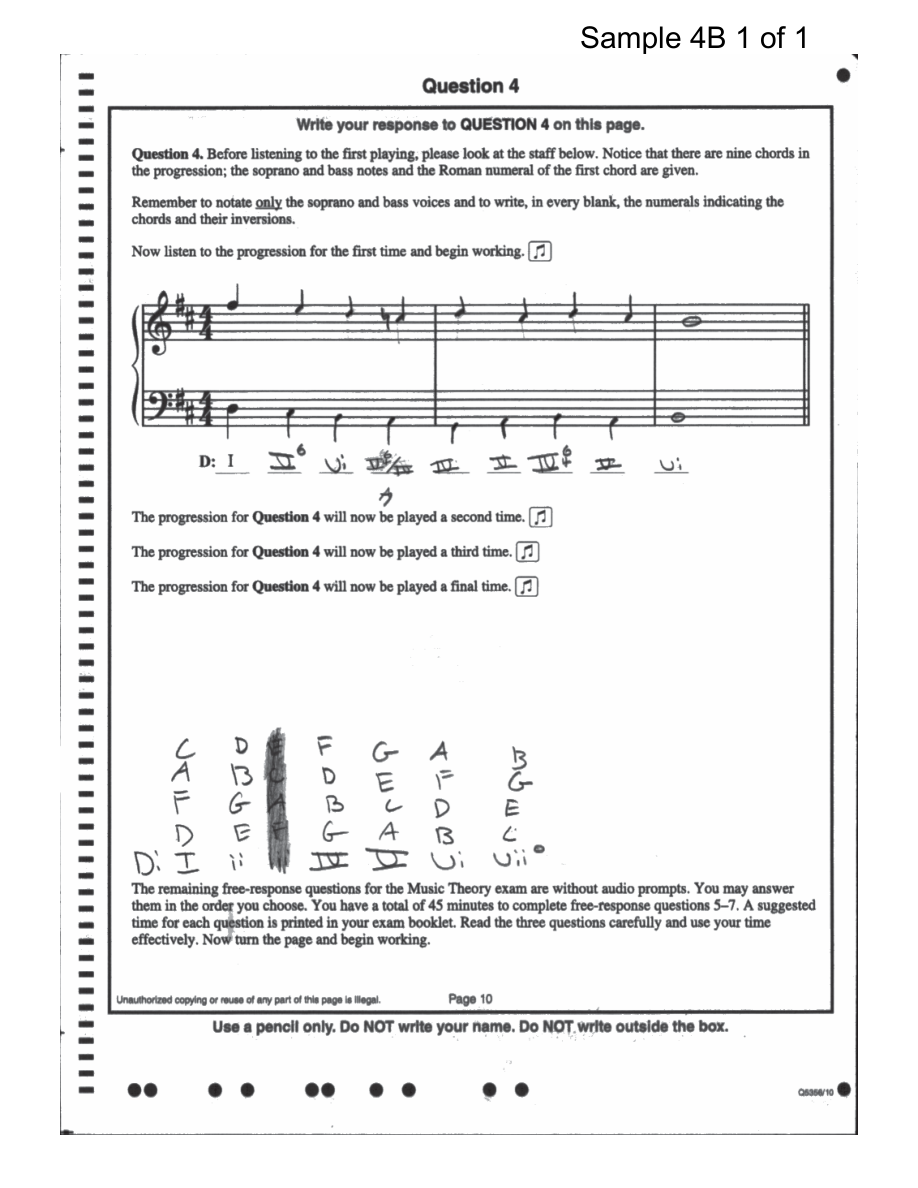
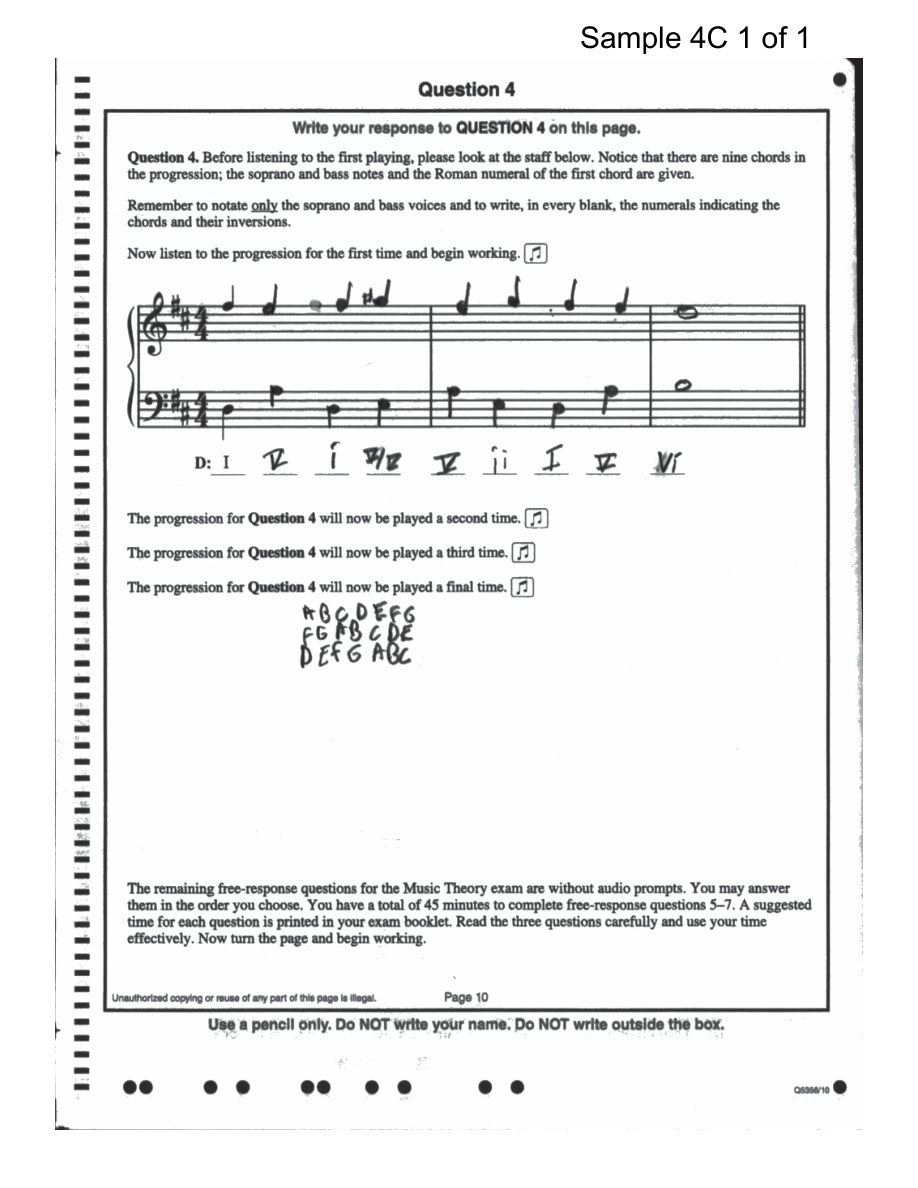
For performed harmonic progressions, PIT-2.G.1 emphasizes accurate notation of the sounding pitches and rhythms, while PIT-2.G.2 requires the outer voices—soprano and bass—to provide clues to the chords and requires every written note to be accounted for in the Roman-numeral analysis. PIT-2.G therefore connects hearing, notation, and harmonic labeling rather than treating them as separate tasks.
Misconception check
Misconception: “Uppercase means the chord’s letter name is uppercase.” Uppercase and lowercase describe quality, not spelling style: IV means a major chord on scale degree $4$, while iv means a minor chord on scale degree $4$. In C major, F–A–C is IV; F–A-flat–C would be iv, because the third has changed.
Retrieval check
In G major, identify the Roman numerals and functions for the progression G–E minor–A minor–D–G. Then explain why the final chord sounds like a resolution. A complete answer should name the sequence I–vi–ii–V–I, identify tonic, predominant, and dominant areas, and connect the dominant V to the returning tonic I.
Source Materials
- Learn More (.pdf)
- AP Music Theory Course and Exam Description
- AP Music Theory Course Overview
- AP Music Theory Course at a Glance
- AP Music Theory Course at a Glance Poster
- Adopt AP Music Theory
- AP Music Theory
- AP Music Theory
- Total
- Figure — Sample Responses Q4 (p. 3)
- Figure — Sample Responses Q4 (p. 4)
- Figure — Sample Responses Q4 (p. 5)