From the free course AP Music Theory on Lykke
1.6 Simple and compound beat division
Key concepts: Rhythm · Meter · Beat · Beat division · Measure · Simple meter · Compound meter · Rhythmic values · Rhythmic patterns · Triplets
Rhythm is music organized in time: long and short sounds, separated by silences, unfold against a pulse that listeners can feel even when no instrument states it directly.
1.6 Simple and compound beat division
Rhythm is music organized in time: long and short sounds, separated by silences, unfold against a pulse that listeners can feel even when no instrument states it directly. The crucial question is: How is one beat subdivided—as two equal parts or as three? That distinction creates the difference between simple and compound meter.
RHY-1 — Rhythm and meter: Rhythm is the temporal aspect of music, often governed by a layered structure of interrelated pulses called meter.
The three layers of meter
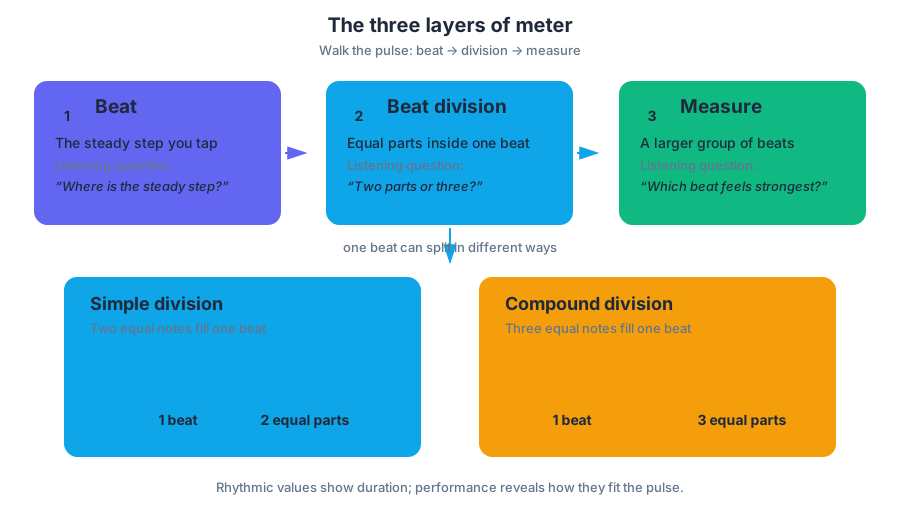
Imagine walking while a drummer plays. Your regular footsteps establish the beat. The smaller motions inside each step establish beat division. The recurring pattern that groups several steps together establishes the measure. These three pulse speeds interlock:
| Pulse layer | What it means | Listening question |
|---|---|---|
| Beat | The recurring pulse you could tap or conduct | “Where is the steady step?” |
| Beat division | The equal parts inside one beat | “Does each beat split into two or three?” |
| Measure | A larger grouping of beats | “Which beats feel stronger or weaker?” |
A rhythmic value symbolizes the duration of a note or rest. Several rhythmic values may fill a single beat. For example, if one beat is divided simply, two equal shorter notes can occupy it; if it is divided compoundly, three equal shorter notes can occupy it. The written symbols show duration, while the performed sound reveals how those durations fit the pulse.
Simple versus compound division
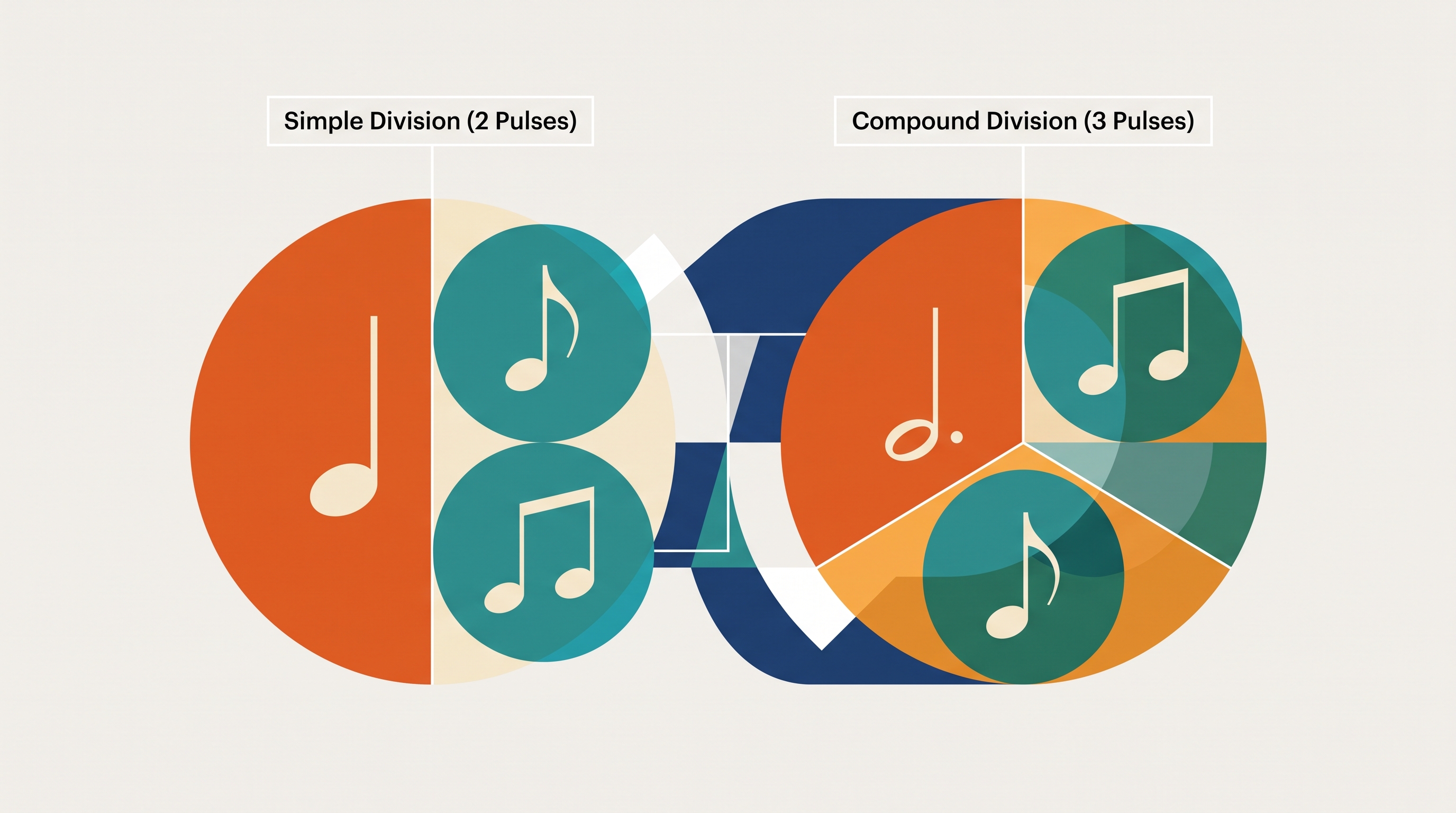
A simple meter is a meter in which the beat is parsed, or divided, into two equal divisions. A compound meter is a meter in which the beat is parsed into three equal divisions.
| Beat division | Internal pattern | Syllabic feel |
|---|---|---|
| Simple | $1;+;2$ equal parts | “one-and” |
| Compound | $1;+;2;+;3$ equal parts | “one-la-li” or “one-and-a” |
The distinction concerns the beat itself, not merely the number of notes visible on the page. A beat in simple meter can contain one note, two equal notes, or a rest-and-note combination. A beat in compound meter can contain one sustained note, three equal notes, or other combinations whose total duration equals the three-part beat.
Triplets: three in the space of two
A triplet occurs when three notes of equal duration take up the time normally held by two notes of equal duration, or when an equivalent three-part grouping is compressed into a two-part rhythmic space. In a simple-meter beat, three eighth-note triplet notes can occupy the duration of two ordinary eighth notes.
Worked example: Suppose one beat normally contains two equal eighth notes:
$$\text{beat} = \text{eighth}+\text{eighth}$$
To create a triplet, fit three equal notes into that same beat:
$$\text{beat} = \text{three triplet notes}$$
The three notes are therefore not three ordinary eighth notes lasting one and one-half beats. Their bracket or numeral indicates that their combined duration has been reduced to the time of two eighth notes.
Misconception check: “Three notes always mean compound meter.”
Correction: A triplet is a temporary three-part subdivision inside a meter that may otherwise be simple. Meter describes the prevailing organization; a triplet describes a local rhythmic event.
Identifying meter in sound and notation
RHY-1.B.1 identifies meter as three interlocking pulse speeds—beat, beat division, and measure. RHY-1.B.2 distinguishes simple beat division, in which the beat divides into two, from compound beat division, in which it divides into three. RHY-1.C and RHY-1.C.1 extend the task to identifying meter type in both performed and notated music.
Meter type depends on two relationships: the relationship of the beat to its division—simple or compound—and the relationship of the beat to the measure. A measure grouping two beats is duple; three beats is triple; four beats is quadruple. Thus, common time, $\binom{4}{4}$, is simple quadruple: the quarter-note beat divides into two eighth-note parts, and four beats group into each measure.
When listening, first tap the steady beat, then speak or sing smaller equal subdivisions. If “one-and, two-and” fits naturally, the division is probably simple. If “one-la-li, two-la-li” fits, the division is probably compound. In notation, inspect the rhythmic values and grouping, but do not decide from the upper numeral alone: the beat’s internal division is essential.
Skill application
This topic develops Skill 1.B — Analyze Performed Music: Use symbols and terms to describe features of rhythm in performed music, including meter, note values, and rhythmic patterns and devices, and Skill 2.B — Analyze Notated Music: Use symbols and terms to describe features of rhythm in notated music, including meter, note values, and rhythmic patterns and devices. It also supports recognizing patterns by ear, reading them aloud, performing them steadily, and notating the heard division accurately.
Retrieval check: A melody feels like each beat contains three equal pulses, but an occasional group of three appears in a passage whose prevailing beat divides into two. Is the passage necessarily compound meter? Name the local device and explain the difference.
Answer: No. The prevailing meter may be simple, while the local group is a triplet—three notes compressed into the time normally occupied by two.