From the free course AP Music Theory on Lykke
2.6 Interval inversion and compound intervals
Key concepts: Interval inversion · Compound intervals · Interval size and quality · Perfect intervals · Major and minor intervals · Diminished and augmented intervals · Performed music · Notated music
An interval inversion changes the register of an interval without changing its two pitch classes: move the lower note up one octave, and the interval turns “inside out.” A small interval becomes its complementary large interval, while its quality follows a fixed transformation.
2.6 Interval inversion and compound intervals
An interval inversion changes the register of an interval without changing its two pitch classes: move the lower note up one octave, and the interval turns “inside out.” A small interval becomes its complementary large interval, while its quality follows a fixed transformation.
PIT-1.M — Learning Objective: Identify interval inversions and compound intervals in performed music and notated music.
The essential knowledge for this objective is divided between PIT-1.M.1, the rules of inversion, and PIT-1.M.2, the distinction between simple and compound intervals. These rules matter because the same interval relationship may appear on the page, in a melody, or as a pair of simultaneously sounding pitches.
Inverting an interval: the mechanical move
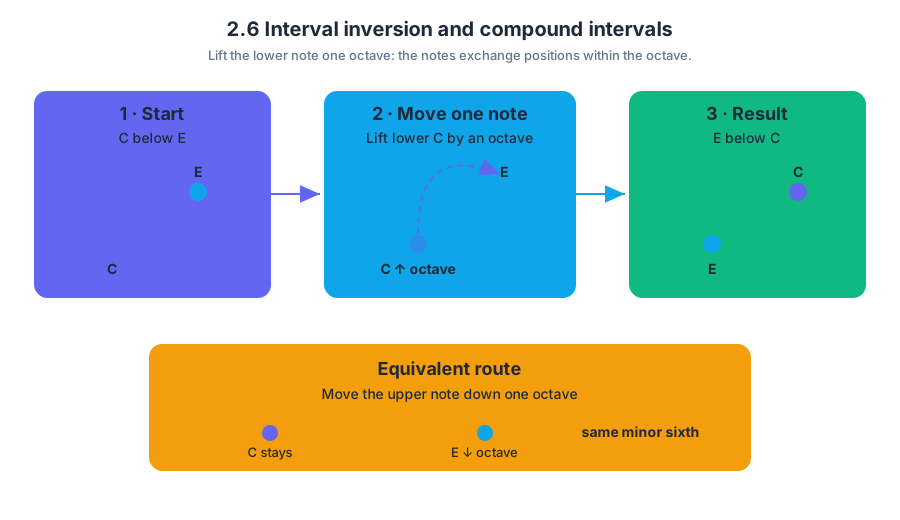
Imagine two notes as two people standing on a staircase. To invert the interval, lift the lower person up exactly one octave so that the former lower note becomes the upper note. The original upper note remains where it is; only the lower note changes register.
For example, suppose the lower note is $C$ and the upper note is $E$. The interval is a major third. Move the lower $C$ up an octave to the $C$ above $E$. The new interval, from $E$ up to $C$, is a minor sixth.
$$ \text{major third} \longrightarrow \text{minor sixth} $$
The equivalent operation is to move the upper note down an octave. Both procedures produce the same inverted interval, because the two notes exchange their positions within the octave.
The Rule of Nine: interval sizes
The numerical sizes of an interval and its inversion always add to $9$. This is the Rule of Nine.
| Original interval | Inverted interval | Check |
|---|---|---|
| second | seventh | $2+7=9$ |
| third | sixth | $3+6=9$ |
| fourth | fifth | $4+5=9$ |
| fifth | fourth | $5+4=9$ |
| sixth | third | $6+3=9$ |
| seventh | second | $7+2=9$ |
| octave | unison | $8+1=9$ |
The rule works because the original interval and its inversion together fill an octave. Notice that a second does not invert to another kind of second: it becomes a seventh, because $2+7=9$.
Quality changes under inversion
Interval quality follows a second set of complementary rules. Perfect intervals remain perfect; major intervals become minor, and minor intervals become major; diminished intervals become augmented, and augmented intervals become diminished.
Worked example: invert a diminished fifth. Its size becomes a fourth because $5+4=9$. Its quality changes from diminished to augmented. Therefore:
$$ \text{diminished fifth} \longrightarrow \text{augmented fourth} $$
A perfect fourth similarly becomes a perfect fifth, not a major or minor fifth:
$$ \text{perfect fourth} \longrightarrow \text{perfect fifth} $$
Misconception check — “Inversion changes only the number.” It does not. A major third becomes a minor sixth, not a major sixth; a diminished interval becomes augmented. Always solve both parts: first the numerical size, then the quality.
Simple and compound intervals
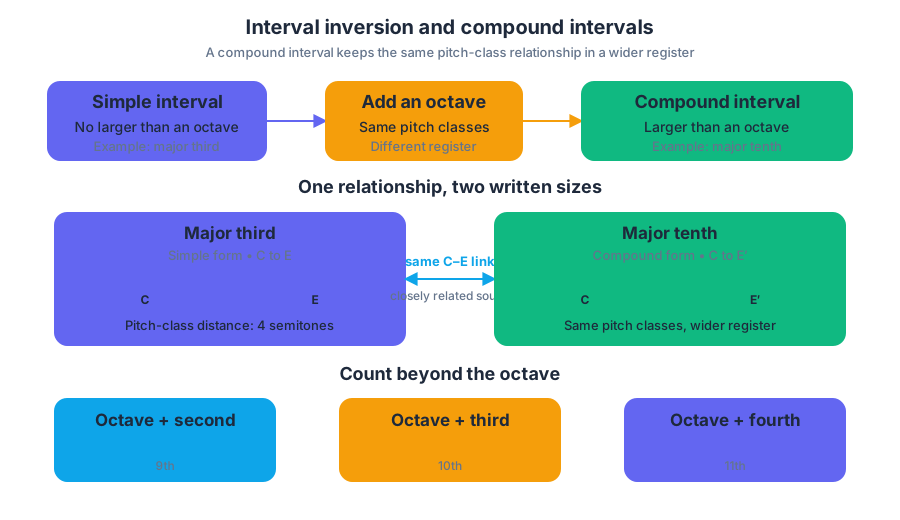
A simple interval is an interval no larger than an octave. A compound interval is formed by adding an octave to a simple interval. Thus, an octave plus a major third produces a major tenth.
$$ \text{major third} + \text{octave} = \text{major tenth} $$
Compound and simple forms contain the same pitch classes in different registers, so they have a closely related sound. A major tenth and a major third are not the same written size, but both express the pitch-class relationship between $C$ and $E$.
To identify a compound interval in notation, count beyond the octave: an octave plus a second is a ninth, an octave plus a third is a tenth, and an octave plus a fourth is an eleventh. To identify one by ear, listen for the underlying simple relationship even though the notes are spread farther apart.
Performed and notated music
Skill 1: Analyze Performed Music applies when you hear two pitches and determine their interval, inversion, or compound form. First identify the lower and upper sounding pitches; then reduce a compound interval by an octave if useful, determine its simple size and quality, and finally name the full interval.
Skill 2: Analyze Notated Music applies when the notes are visible in a score. Count letter names for numerical size, inspect accidentals for quality, and use the Rule of Nine if the interval is inverted. For example, a notated $E$ below $C$ can be recognized as a compound sixth; reducing it by an octave reveals the corresponding simple interval.
Retrieval check:
- What does a major seventh invert to?
- What does an augmented fourth invert to?
- What is the compound form of a minor sixth?
Answers: A major seventh becomes a minor second; an augmented fourth becomes a diminished fifth; a minor sixth plus an octave becomes a minor thirteenth.