From the free course AP Music Theory on Lykke
2.3 Key relationships: parallel, closely related, and distantly related keys
Key concepts: Parallel keys · Closely related keys · Distantly related keys · Relative major and minor keys · Key signatures and accidentals · Major and minor keys with one additional or fewer sharp/flat · Diatonic major and minor triads · Key relationships as a basis for musical expression
A key relationship describes how one tonal center connects to another through tonic, mode, key signature, or diatonic harmony. These relationships help explain why a passage can sound like it has moved naturally, suddenly, brightly, or darkly—even when the music remains connected.
2.3 Key relationships: parallel, closely related, and distantly related keys
A key relationship describes how one tonal center connects to another through tonic, mode, key signature, or diatonic harmony. These relationships help explain why a passage can sound like it has moved naturally, suddenly, brightly, or darkly—even when the music remains connected.
Learning Objective PIT-1.J: Describe key relationships in performed and notated music.
Parallel keys: same tonic, different mode
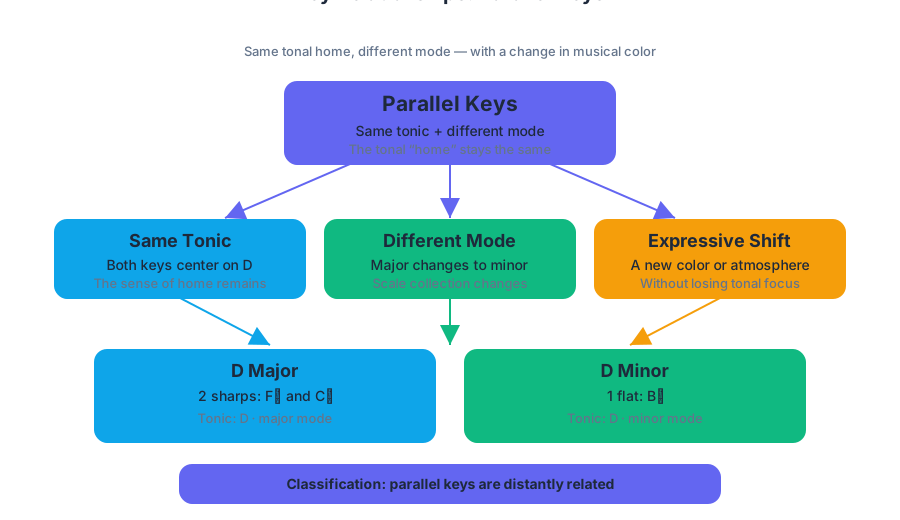
Parallel keys share the same tonic—the same pitch that functions as the tonal “home”—but use different modes. The most familiar example is C major and C minor: both center on C, but their key signatures and scale collections differ.
For example:
- D major has the key signature of two sharps: F-sharp and C-sharp.
- D minor has one flat: B-flat.
- Both keys have D as tonic, but one is major and the other is minor.
The contrast is expressive. A composer, arranger, film scorer, or songwriter can shift from D major to D minor while preserving D as the musical center. The listener experiences a change of color or emotional atmosphere without losing the sense of “where home is.”
Essential Knowledge PIT-1.J.1: A parallel key shares the same tonic as the original key but has a different mode and key signature.
Important classification: Parallel keys are a subset of distantly related keys because their key signatures differ by more than one accidental. C major has no accidentals, while C minor has three flats, so the signatures differ by three accidentals.
Closely related keys: one accidental away
Closely related keys have key signatures that differ from the original by no more than one accidental. These are the keys to which a musical passage most commonly shifts because they retain much of the original pitch vocabulary while introducing only a small amount of change.
Essential Knowledge PIT-1.J.2: Closely related keys differ from the original key signature by no more than one accidental.
There are two reliable ways to identify them:
- Find the relative key, which shares the same key signature.
- Find the major and minor keys with one additional accidental and one fewer accidental, together with their relative keys.
Worked example: D major
D major has two sharps. Move through the key-signature neighborhood:
| Relationship to D major | Key | Key signature |
|---|---|---|
| Same signature: relative key | B minor | Two sharps |
| One additional sharp | A major | Three sharps |
| Relative of A major | F-sharp minor | Three sharps |
| One fewer sharp | G major | One sharp |
| Relative of G major | E minor | One sharp |
Therefore, the closely related keys of D major are B minor, A major, F-sharp minor, G major, and E minor. Notice that the list contains five keys, not merely three key signatures, because each neighboring major key has a relative minor.
A second method reaches the same answer through the original key’s diatonic triads—the major and minor triads built only from notes in the D-major scale:
- ii: E minor
- iii: F-sharp minor
- IV: G major
- V: A major
- vi: B minor
Each triad can function as the tonic triad of one closely related key. This gives the useful principle that the tonic triads of closely related keys are the diatonic major and minor triads of the original key. The relative key is therefore a subset of the closely related keys, not a competing category.
Distantly related keys: more than one accidental away
Distantly related keys have key signatures that differ from the original by more than one accidental. The word distant describes the amount of notational and pitch-material change, not necessarily the emotional effect or the physical distance between notes.
Essential Knowledge PIT-1.J.3: Distantly related keys differ from the original key signature by more than one accidental; parallel keys are a subset of distantly related keys.
From D major, E-flat major is distantly related: D major has two sharps, while E-flat major has three flats. The signatures differ by more than one accidental, so the relationship is not close under the CED definition.
A common misconception is that “relative” and “parallel” mean the same thing. They do not: relative keys share a key signature but have different tonics, while parallel keys share a tonic but have different modes and signatures.
AP skill lens and retrieval check
This topic can be assessed through all four official skill categories:
- Skill 1: Analyze performed music — hear a change of tonal center or mode and identify its likely relationship.
- Skill 2: Analyze notated music — compare key signatures, tonic pitches, and diatonic triads.
- Skill 3: Convert between performed and notated music — hear a modulation and represent the new key with the correct signature and accidentals.
- Skill 4: Complete based on cues — continue a passage after a cue such as a new tonic, mode, or key signature.
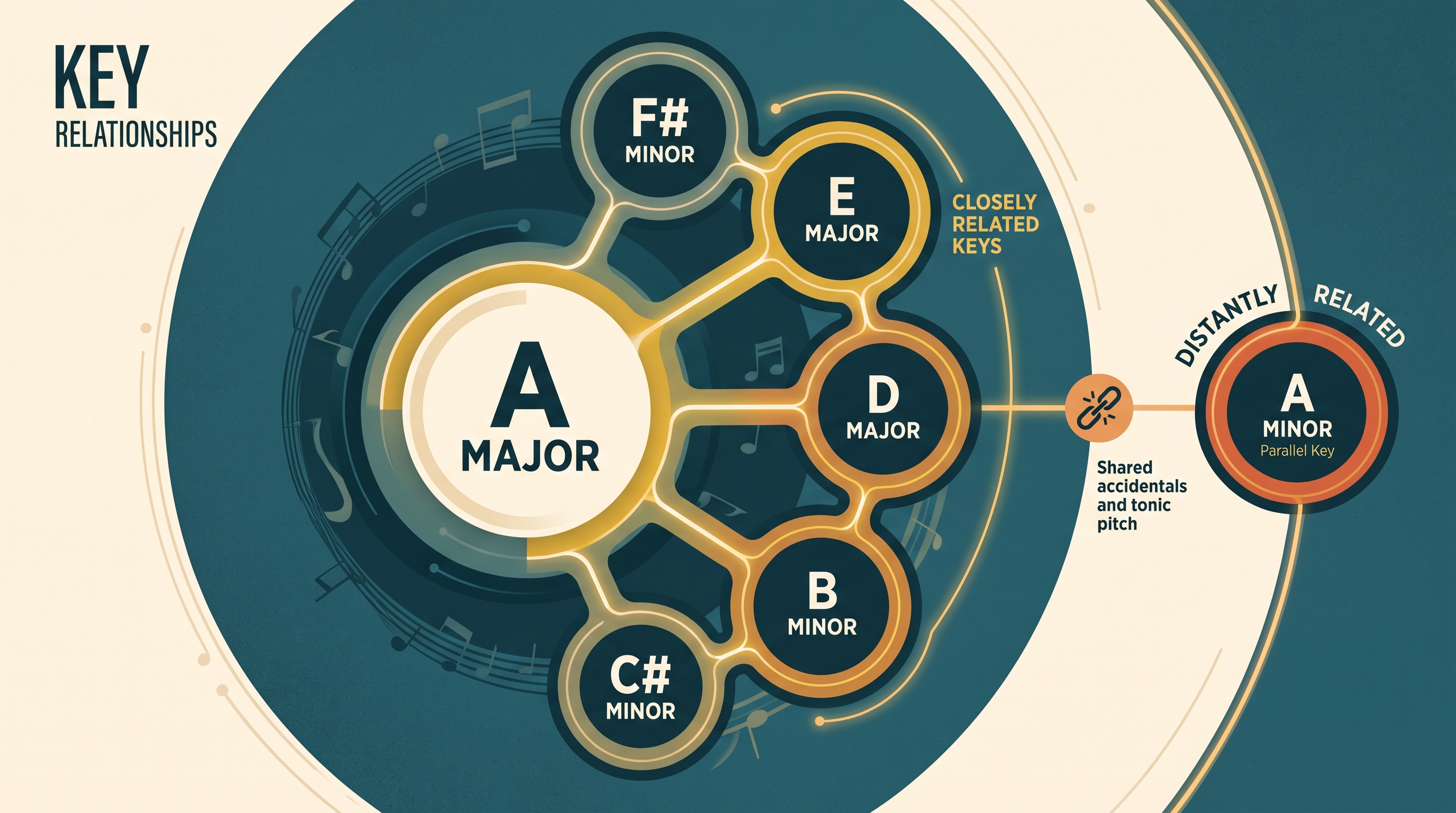
Retrieval check: Starting in A major, name the five closely related keys. Then classify A minor: is it closely or distantly related to A major, and why? The five closely related keys are F-sharp minor, E major, C-sharp minor, D major, and B minor. A minor is distantly related because A major has three sharps while A minor has no accidentals; the keys are parallel, so parallel-key relationships belong to the distantly related category.