From the free course AP Music Theory on Lykke
5.1 Adding predominant-function IV (iv) and ii (ii°) to a melodic phrase
Key concepts: Predominant function · IV chord · iv chord · ii° chord · Tonic–predominant–dominant–tonic functional order · Harmonic progression · Melodic phrase · Normative chord successions · Harmonic function · Roman-numeral chord notation
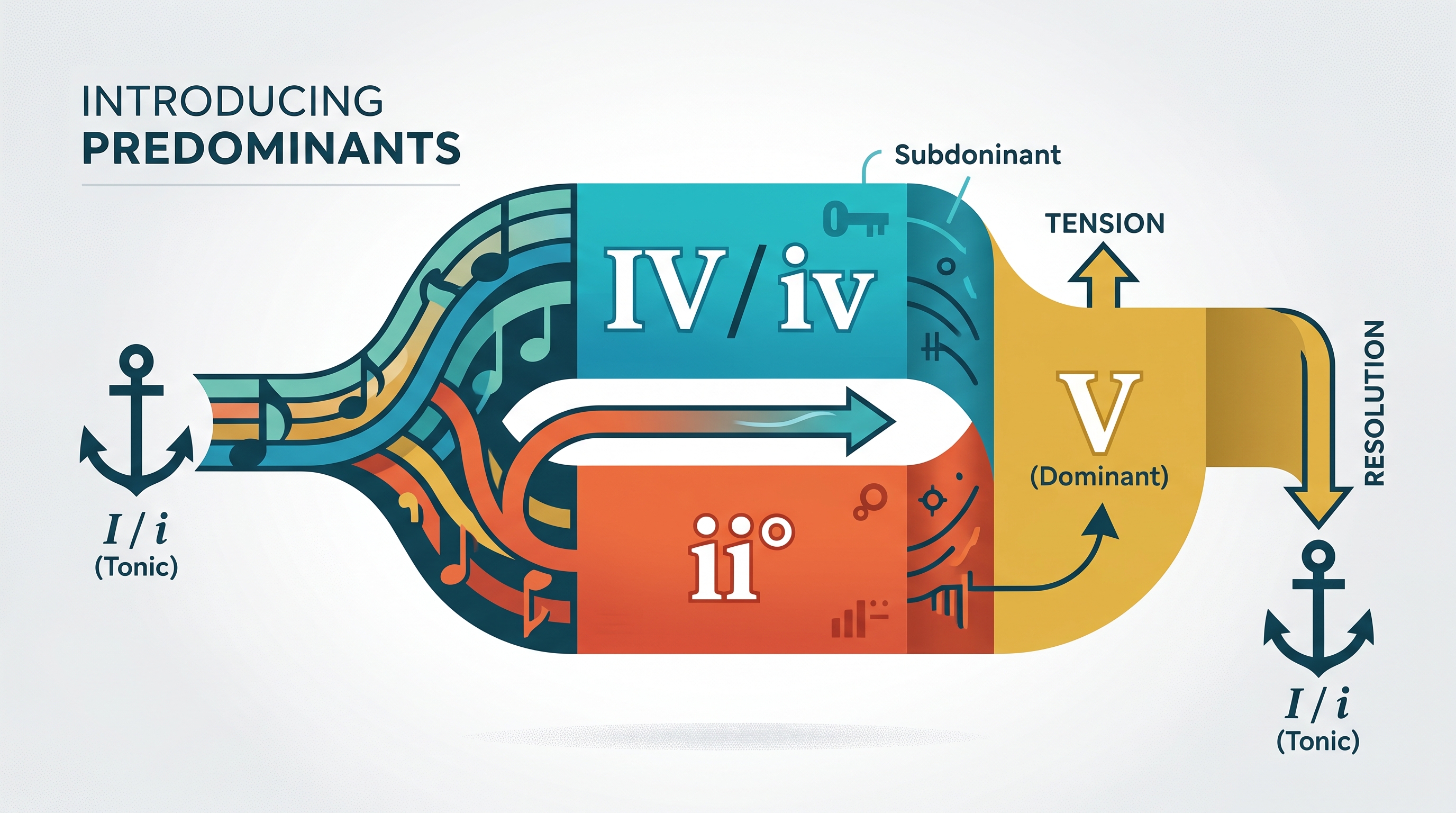
A melody can sound as though it is heading somewhere before the dominant chord arrives. That sense of direction often comes from a predominant-function chord: a harmony whose contextual role is to move away from tonic and prepare the dominant.
5.1 Adding predominant-function IV (iv) and ii (ii°) to a melodic phrase
A melody can sound as though it is heading somewhere before the dominant chord arrives. That sense of direction often comes from a predominant-function chord: a harmony whose contextual role is to move away from tonic and prepare the dominant.
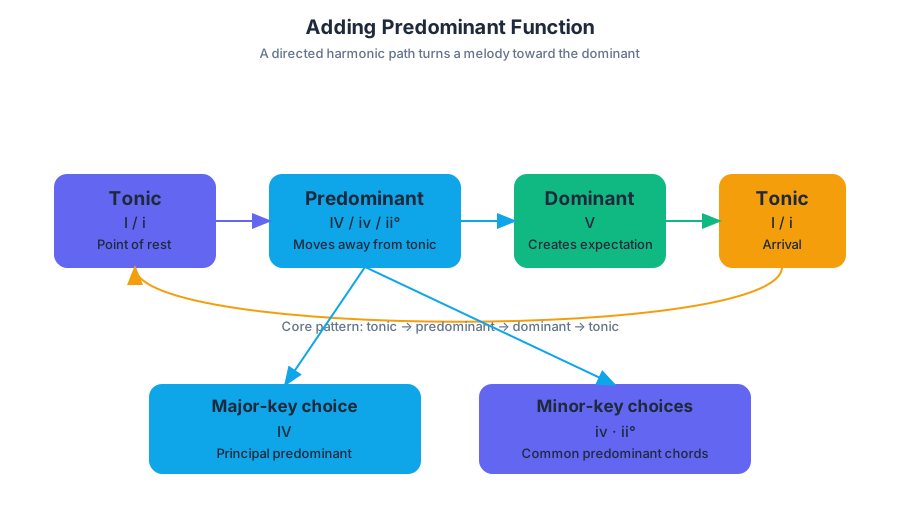
Core pattern: tonic $\rightarrow$ predominant $\rightarrow$ dominant $\rightarrow$ tonic
The Roman numerals identify the chords, while the functional labels explain their behavior. In a major-key context, the principal predominant chord is usually $IV$; in a minor-key context, common predominant choices include $iv$ and $ii^\circ$. These chords do not merely “fill space.” They intensify the establishment of the key by creating a directed path toward the dominant.
The functional order: T–PD–D–T
The functional order tonic–predominant–dominant–tonic describes a common harmonic progression. Tonic establishes stability and key; predominant creates motion away from that stability; dominant produces tension that seeks resolution; and the returning tonic supplies closure.
This is a normative succession: a historically common and usable pattern, not an unbreakable rule. Composers expand this background in many ways, creating a harmonic foreground in which chords may be repeated, prolonged, or combined in varied sequences. The functional relationship remains the important idea: a chord’s role depends on its context within the progression.
| Function | Typical role | Major-key example | Minor-key example |
|---|---|---|---|
| Tonic | Establishes or confirms the key | $I$ | $i$ |
| Predominant | Prepares the dominant area | $IV$ | $iv$ or $ii^\circ$ |
| Dominant | Creates directed tension | $V$ or $V^7$ | $V$ or $V^7$ |
| Tonic | Resolves the progression | $I$ | $i$ |
Misconception check — “predominant” means any chord before the dominant. Position alone is not enough. A chord may occur before $V$ without functioning as a predominant; the label describes a contextual harmonic relationship, not simply a location in time. In the standard pattern, $IV$, $iv$, and $ii^\circ$ are identified as predominant harmonies because their usual role is to precede the dominant functional area.
Adding $IV$ to a major-key melody
Suppose a melody in C major ends with the notes $D$–$G$–$C$. A simple harmonic reading is:
$$ I \rightarrow IV \rightarrow V \rightarrow I $$
Spell the chords first: $I$ is C–E–G, $IV$ is F–A–C, $V$ is G–B–D, and the final $I$ is C–E–G. The melody supports the progression because $D$ belongs to $V$, while the final $C$ strongly supports the return to tonic. The $IV$ chord introduces $F$ and $A$, broadening the harmonic surface before the dominant arrives.
A useful procedure is to let the melody suggest likely harmonies, then test those harmonies by function:
- Locate a stable opening or ending that may support $I$.
- Find a melodic or rhythmic point where the harmony should begin moving.
- Insert $IV$ to create predominant motion.
- Use $V$ or $V^7$ where the melody and phrase direction produce dominant tension.
- Confirm the final tonic as the point of resolution.
Adding $iv$ and $ii^\circ$ in minor
In a minor-key phrase, the predominant color often comes from the minor subdominant $iv$. In A minor, for example:
The chords are A–C–E, D–F–A, E–G-sharp–B, and A–C–E. Notice the raised $G$ in $V$: the leading tone strengthens the dominant’s pull toward A. The $iv$ chord, by contrast, supplies the predominant motion through D and F without requiring the raised leading tone.
The diminished supertonic chord $ii^\circ$ also has predominant function in a minor-key context. In A minor:
$$ i \rightarrow ii^\circ \rightarrow V \rightarrow i $$
Here $ii^\circ$ contains B–D–F. Its diminished quality gives it instability, but its contextual role is still predominant because it leads toward the dominant. A common mistake is to identify a chord only by its quality—“diminished means dominant.” Function must be determined from the chord’s scale-degree content and its relationship to neighboring harmonies.
Worked interpretation: If a minor-key phrase presents the bass notes A–B–E–A and the surrounding melody confirms A minor, a plausible Roman-numeral analysis is $i$–$ii^\circ$–$V$–$i$. The bass movement alone does not prove the analysis, but the complete pattern supports it: tonic stability, predominant departure, dominant tension, and tonic resolution.
AP skills in action
This topic develops 1.C — Use symbols and terms to describe melodic, harmonic, and rhythmic relationships in performed music. When listening, hear the phrase’s functional trajectory and describe it with Roman numerals such as $I$–$IV$–$V$–$I$ or $i$–$iv$–$V$–$i$.
It also develops 2.C — Use symbols and terms to describe melodic, harmonic, and rhythmic relationships in notated music. In a score, connect the melodic notes, bass movement, and chord spelling before assigning the Roman numeral. The strongest analysis explains not only what chord is present, but why that chord functions as predominant in that phrase.
Retrieval check: In G major, which progression best represents the standard functional order: $I$–$ii^\circ$–$V$–$I$, $I$–$IV$–$V$–$I$, or $I$–$V$–$IV$–$I$? In a minor key, name two predominant-function chords discussed here.
Answer: $I$–$IV$–$V$–$I$ is the standard major-key example. In minor, $iv$ and $ii^\circ$ can serve predominant function.
Source Materials
- Learn More (.pdf)
- AP Music Theory Course and Exam Description
- AP Music Theory Course Overview
- AP Music Theory Course at a Glance
- AP Music Theory Course at a Glance Poster
- Adopt AP Music Theory
- AP Music Theory
- AP Music Theory
- AP Music Theory-AP Students-College Board
- AP Music Theory-Unit Study Guides
- AP Music Theory-Raidar Choir
- Everything you need to know to get a 5 on AP Music Theory