From the free course AP Music Theory on Lykke
1.2 Rhythmic values
Key concepts: Rhythmic accuracy · Quarter-note values · Beamed eighth-note values · Dotted-quarter-note values · 4/4 meter · Maintaining continuity while performing rhythms
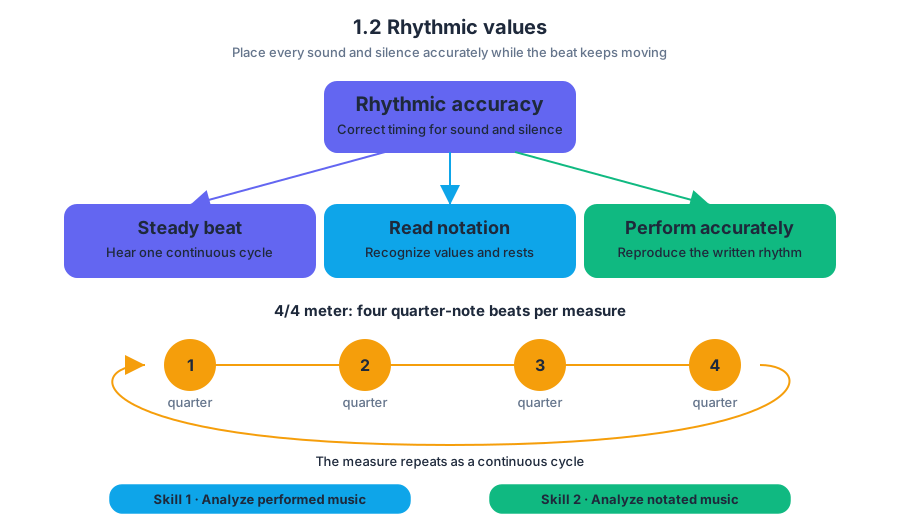
Rhythmic accuracy means placing every sound and silence at the correct moment while keeping the beat moving steadily. In $4/4$ meter, the quarter note is the basic beat: four quarter-note beats fill one measure, so the performer must hear the measure as a continuous cycle rather than as four unrelated events.
1.2 Rhythmic values
Rhythmic accuracy means placing every sound and silence at the correct moment while keeping the beat moving steadily. In $4/4$ meter, the quarter note is the basic beat: four quarter-note beats fill one measure, so the performer must hear the measure as a continuous cycle rather than as four unrelated events.
CED traceability: Topic 1.2 Rhythmic Values belongs to Big Idea RHY and is assessed through Skill 1: Analyze Performed Music and Skill 2: Analyze Notated Music. In practice, these skills work together: you must recognize rhythm in notation and then reproduce it accurately when performing.
The beat as a measuring grid
Imagine a steady walking pulse. Each step is one quarter-note beat. A measure of $4/4$ is four steps long, and the bar line marks the boundary between one group of four steps and the next.
| Rhythmic value | Duration in quarter-note beats | How it fits inside $4/4$ |
|---|---|---|
| Quarter note | $1$ beat | Four quarter notes fill a measure |
| Beamed eighth note | $\frac{1}{2}$ beat each | Two eighth notes fill one beat |
| Dotted quarter note | $1\frac{1}{2}$ beats | Two dotted quarters equal three beats |
The table describes duration, not necessarily emphasis. The first beat of a $4/4$ measure usually feels strongest, the third beat often receives secondary emphasis, and beats two and four are weaker. A correct performance preserves both the exact spacing of notes and the larger four-beat organization.
Quarter notes: establish the pulse
A quarter note lasts exactly one beat. Count a measure containing four quarter notes as:
$$ 1 \quad 2 \quad 3 \quad 4 $$
To perform the pattern accurately, begin with an even internal pulse and avoid stretching the final note of the measure. The next measure must begin on the next beat, not after an unplanned pause.
Worked example: Suppose a melody begins with four quarter notes followed by a bar line. Speak or sing one syllable on each count: “ta” on $1$, “ta” on $2$, “ta” on $3$, and “ta” on $4$. If the fourth note is held too long, the bar line arrives late and every subsequent measure shifts.
Beamed eighth notes: divide the beat, do not accelerate
A pair of beamed eighth notes divides one quarter-note beat into two equal parts. Count the measure with alternating quarter notes and eighth-note pairs as:
$$ 1 \quad 2\text{-and} \quad 3 \quad 4\text{-and} $$
The syllable “and” must occur halfway between numbered beats. The two eighth notes therefore occupy the same total time as one quarter note:
$$ \frac{1}{2}+\frac{1}{2}=1 $$
Worked example: For the pattern quarter note, two eighth notes, quarter note, two eighth notes, count:
The first note sounds on $1$; the next two sounds occur on $2$ and “and”; the following note begins on $3$; and the final pair occurs on $4$ and “and.” Keep the underlying numbered beats equally spaced.
Dotted-quarter notes: three eighth-note subdivisions
A dotted-quarter note lasts one and a half beats because the dot adds half of the original value:
$$ 1+\frac{1}{2}=1\frac{1}{2} $$
In $4/4$, a dotted-quarter note crosses the midpoint between two beats. A useful count is “$1$ and $2$,” with the note beginning on $1$ and continuing through the “and” into beat $2$. If followed by an eighth note, that eighth note begins on the second half of beat $2$.
Worked example: A dotted-quarter note followed by an eighth note occupies two beats:
$$ \text{dotted quarter}+\text{eighth}
1\frac{1}{2}+\frac{1}{2}=2 $$
Do not treat the dotted quarter as two beats. That mistake makes the following eighth note late and usually causes the performer to rush in order to recover.
Rhythmic continuity: never abandon the grid
Continuity means maintaining the rhythmic flow from beginning to end, even after a mistake. In sight-singing and performed-music tasks, a brief wrong note is less damaging than stopping, restarting, or losing the steady tempo.
A reliable procedure is:
- Establish the $4/4$ pulse before beginning.
- Subdivide internally whenever eighth notes or dotted quarters appear.
- Track each bar line as a reset point, not a stopping point.
- If one rhythm goes wrong, rejoin at the next beat or measure.
Named misconception check — “The notation tells me when to pause.” A bar line separates measures but does not automatically create silence. Unless a rest or phrase marking indicates otherwise, continue directly into the next measure.
Named misconception check — “A dotted quarter is just a long quarter note.” The dot changes the duration from $1$ beat to $1\frac{1}{2}$ beats. Its defining feature is that it crosses a beat boundary.
Retrieval check
In $4/4$, how many beats do two beamed eighth notes occupy? How many beats do a dotted-quarter note and an eighth note occupy together? Finally, if you lose your place during a melody, should you stop or continue to the next secure beat?
Answers: two beamed eighth notes occupy $1$ beat; a dotted quarter plus an eighth occupies $2$ beats; and you should continue, preserving the steady pulse and rejoining at the next secure point.