From the free course AP Music Theory on Lykke
1.4 Major scales and scale degrees
Key concepts: Major scales · Minor scales · Scale degrees · Tonic and pitch function · Major pentatonic scales · Major and minor keys · Tonic progressions · Cadences · Melodic dictation · Sight-singing stepwise melodies
A scale degree is a pitch understood by its function relative to a tonic, the pitch that acts as the tonal center of a major or minor scale.
1.4 Major scales and scale degrees
A scale degree is a pitch understood by its function relative to a tonic, the pitch that acts as the tonal center of a major or minor scale. The same sounding pitch can therefore have different scale-degree identities: $G$ is scale degree $\hat{1}$ in G major, but $\hat{5}$ in C major.
From a collection of notes to a tonal system
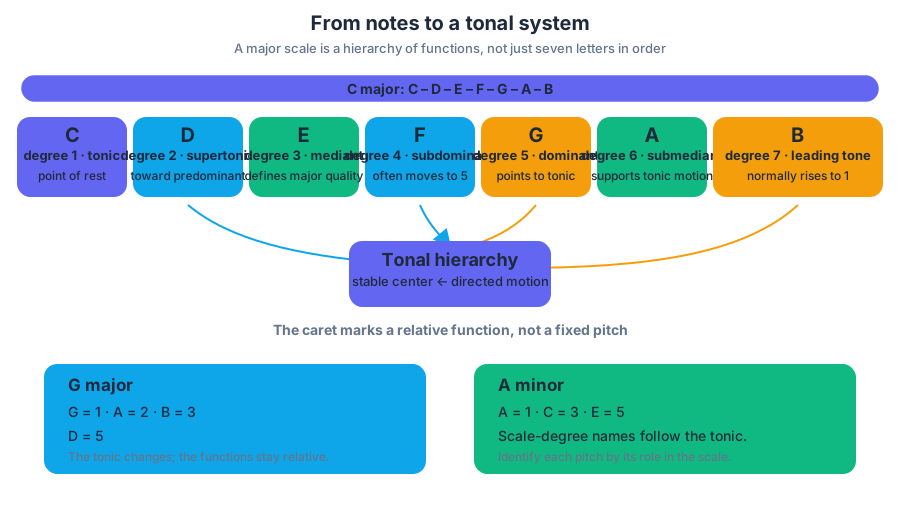
A major scale is not merely seven alphabet letters in order. Its pitches form a hierarchy: some feel stable, while others seem to lean toward the tonic. In C major, the notes are C–D–E–F–G–A–B–C, but their functions are different:
| Scale degree | Name | Function in C major |
|---|---|---|
| $\hat{1}$ | tonic | tonal center and point of rest |
| $\hat{2}$ | supertonic | often moves toward a predominant function |
| $\hat{3}$ | mediant | helps define major quality |
| $\hat{4}$ | subdominant | often moves toward $\hat{5}$ |
| $\hat{5}$ | dominant | strongly points back toward $\hat{1}$ |
| $\hat{6}$ | submediant | often supports tonic-related motion |
| $\hat{7}$ | leading tone | normally rises to $\hat{1}$ |
The caret identifies a scale-degree number, not a fixed pitch. Thus, in G major, G is $\hat{1}$, A is $\hat{2}$, B is $\hat{3}$, and D is $\hat{5}$. In A minor, A is $\hat{1}$, C is $\hat{3}$, and E is $\hat{5}$. This relative labeling is the central idea in PIT-1.E.1: identify the function of a pitch relative to a tonic and its scale using scale-degree names and/or numbers.
Reading major-scale patterns
PIT-1.D.1 requires identifying major scales in both performed music and notated music. A major scale arranges pitches in a characteristic pattern of whole and half steps, ascending or descending. Once the tonic is located, number the successive scale pitches from $\hat{1}$ through $\hat{7}$, then return to $\hat{1}$ at the octave.
Worked example: hearing a cadence
Suppose a melody in C major ends with the pitches B–C. The first pitch is $\hat{7}$, the leading tone, and the final pitch is $\hat{1}$, the tonic. Even without seeing the key signature, the directed motion from $\hat{7}$ to $\hat{1}$ strongly suggests a tonic arrival. If the preceding notes are F–G–C, their scale degrees are $\hat{4}$–$\hat{5}$–$\hat{1}$, a familiar progression into a cadence.
The reasoning is:
- Locate the tonal center: C.
- Translate pitches into relative numbers: F–G–C becomes $\hat{4}$–$\hat{5}$–$\hat{1}$.
- Hear or observe the motion toward $\hat{1}$.
- Describe the ending as a tonic-directed cadence rather than merely naming the notes.
Misconception check — “The highest or last note is always the tonic.” A final note often is the tonic, but not always. A melody may end on another scale degree, and a tonic can appear in the middle of a phrase. Identify the tonal center from the complete melodic and harmonic context, not from location alone.
Major, minor, and pentatonic selection
Major and minor scales each contain seven basic scale pitches, but their scale-degree patterns differ. In a major scale, the third scale degree is major relative to the tonic; in natural minor, the third, sixth, and seventh are lowered in comparison with major. Scale-degree numbers remain functional: $\hat{1}$ still names the tonic in either mode.
A pentatonic scale selects five pitches from the seven pitches of its corresponding major or minor scale. A major pentatonic scale contains $\hat{1}$, $\hat{2}$, $\hat{3}$, $\hat{5}$, and $\hat{6}$. For C major, that produces C–D–E–G–A. A minor pentatonic scale contains $\hat{1}$, $\hat{3}$, $\hat{4}$, $\hat{5}$, and $\hat{7}$ of the natural-minor scale; A minor pentatonic is A–C–D–E–G.
The missing pitches matter: major pentatonic omits $\hat{4}$ and $\hat{7}$, while minor pentatonic omits $\hat{2}$ and $\hat{6}$. Misconception check — “Pentatonic means any five notes.” The five pitches must be selected according to the major- or natural-minor scale-degree pattern.
Performed music, notation, and musical production
Apply Skill 1: Analyze Performed Music by listening for the tonic, scale pattern, and characteristic arrivals such as $\hat{5}$–$\hat{1}$. Apply Skill 2: Analyze Notated Music by locating the tonic in a melody and labeling pitches with scale-degree numbers. Apply Skill 3: Convert Between Performed and Notated Music through melodic dictation: first capture the simple rhythm and contour, then determine the tonic and assign scale degrees before writing exact pitches. Apply Skill 4: Complete Based on Cues by continuing a stepwise melody with pitches that fit the established major-scale pattern.
For sight-singing, identify the tonic and key before singing. Then treat $\hat{1}$ as the home pitch, use stepwise scale patterns for neighboring notes, and preserve the written rhythm. A melody such as $\hat{1}$–$\hat{2}$–$\hat{3}$–$\hat{2}$–$\hat{1}$ can be sung in any major key once its tonic relationship is secure.
Retrieval check
In E major, name the scale-degree numbers of the pitches B, C-sharp, and A. Then identify the major-pentatonic pitches by degree. Finally, explain why a melody ending on D-sharp–E sounds like a tonic arrival. (Answer: B is $\hat{5}$, C-sharp is $\hat{6}$, A is $\hat{4}$; major pentatonic uses $\hat{1}$, $\hat{2}$, $\hat{3}$, $\hat{5}$, and $\hat{6}$; D-sharp is $\hat{7}$ and E is $\hat{1}$.)