From the free course AP Music Theory on Lykke
5.4 The iii (III) chord
Key concepts: The iii (III) chord · Chord-quality abbreviations in chord symbols · Minor triad notation such as Cm · Lead-sheet chord symbols · Roman-numeral chord labels · Neighboring or pedal six-four chords · Plagal cadences · Passing six-four chords · Cadential six-four chords · Avoiding poor chord successions
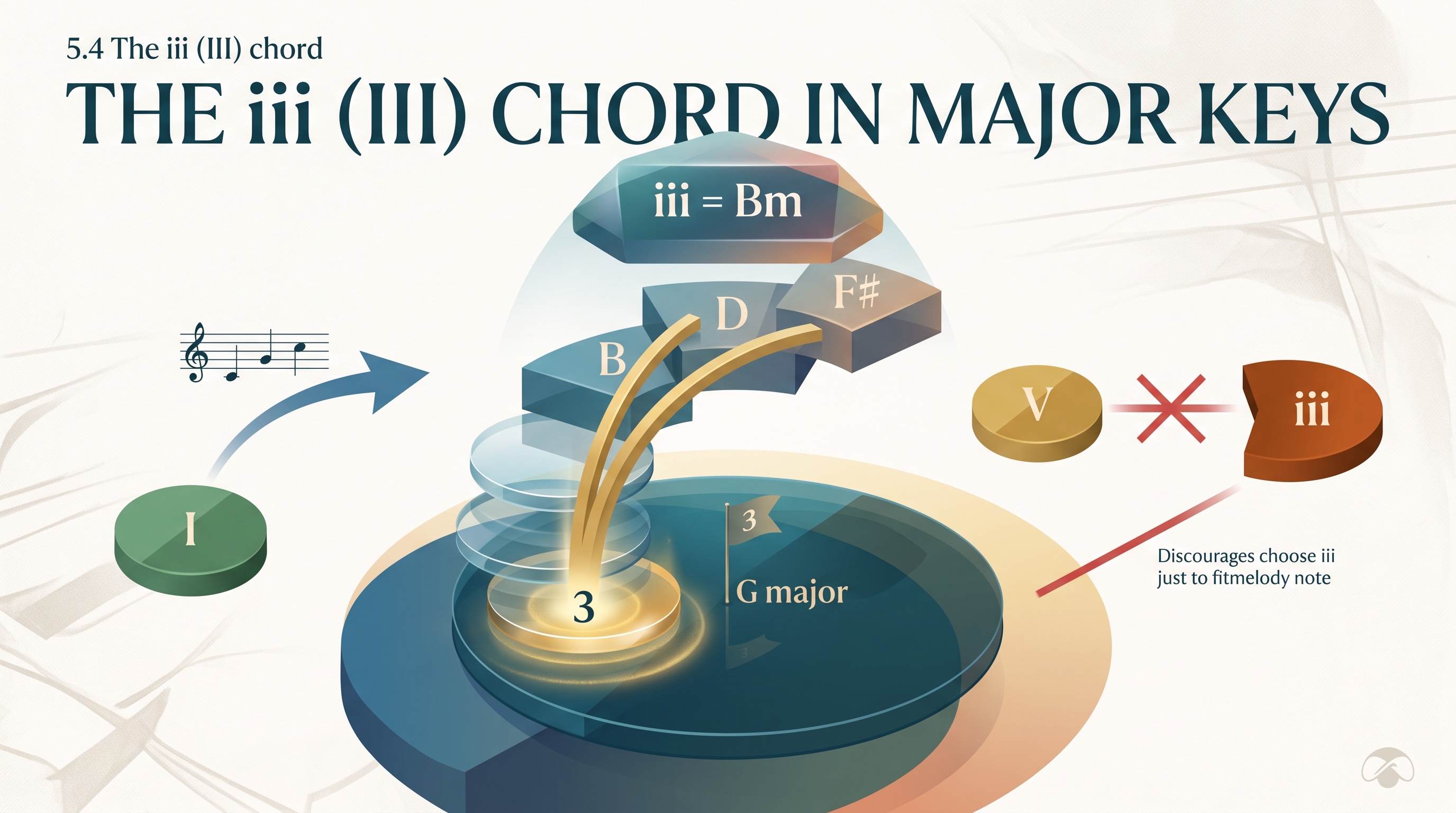
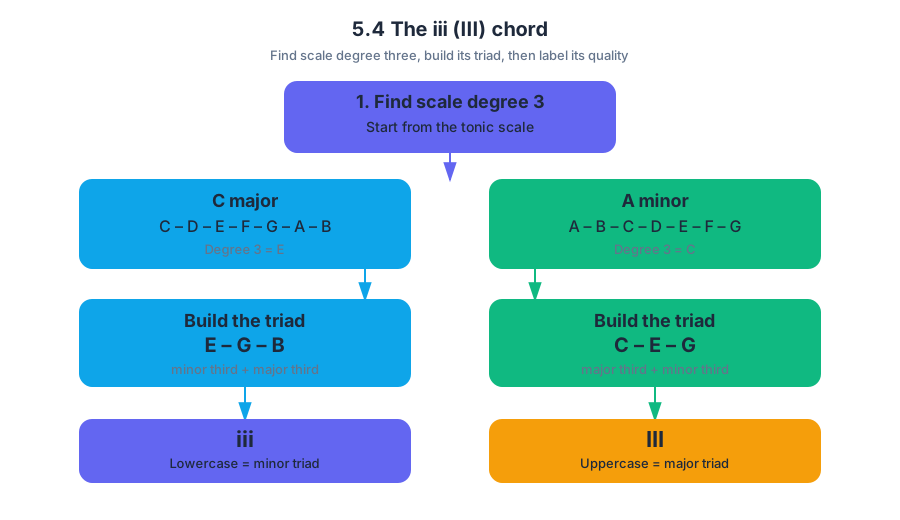
The iii chord is the diatonic triad built on scale degree $\hat{3}$: in a major key it is a minor triad, while in a minor key its quality is typically represented as a major triad, written $\mathrm{III}$.
5.4 The iii (III) chord
The iii chord is the diatonic triad built on scale degree $\hat{3}$: in a major key it is a minor triad, while in a minor key its quality is typically represented as a major triad, written $\mathrm{III}$. Its sound often connects tonic-oriented harmony with predominant or tonic-area motion, but its label depends on both scale degree and chord quality.
Finding and labeling the iii chord
In C major, the scale is
$$ \mathrm{C-D-E-F-G-A-B-C}. $$
The triad beginning on scale degree $\hat{3}$ uses $E$, $G$, and $B$:
$$ E-G-B. $$
The interval from $E$ to $G$ is a minor third, and the interval from $G$ to $B$ is a major third. Together they form a minor triad, so the Roman-numeral label is lowercase:
$$ \mathrm{iii}. $$
In A minor, the diatonic triad on scale degree $\hat{3}$ is built on $C$:
$$ C-E-G. $$
That triad is major, so it receives the uppercase label
$$ \mathrm{III}. $$
The uppercase/lowercase distinction is not cosmetic: it communicates chord quality.
Roman numerals versus lead-sheet symbols
Two labeling systems answer different questions. A Roman-numeral chord label identifies a chord’s scale-degree position within a key and uses case to show quality. A lead-sheet chord symbol gives performers the chord’s root and quality directly, usually without requiring them to infer the key.
Chord quality may be abbreviated with symbols such as $m$ for minor, $d$ for diminished, and $A$ for augmented. Thus, the C-minor triad may be labeled
$$ \mathrm{Cm}. $$
Lead-sheet chord symbols appear above the notated melody and indicate the specific chord progression expected for accompaniment. In C major, the iii chord can therefore be represented in two complementary ways:
| System | Label | Information emphasized |
|---|---|---|
| Roman numeral | $\mathrm{iii}$ | Scale-degree position and minor quality in the current key |
| Lead-sheet symbol | $\mathrm{Em}$ | Root $E$ and minor quality |
Misconception check — “iii” means the same thing as “Em.” The labels can refer to the same sounding chord in C major, but they are not interchangeable in every context. $\mathrm{iii}$ depends on the key; $\mathrm{Em}$ names the chord itself. If the key changes, the Roman numeral may change even when the sounding chord remains $E$ minor.
The iii chord in harmonic context
A chord’s identity is not enough; its neighbors matter. The iii chord can participate in a smooth bass motion, such as
$$ \mathrm{I-iii-IV}, $$
where the roots move upward by step:
$$ C \rightarrow E \rightarrow F. $$
It may also appear as part of a tonic-area prolongation, especially when the surrounding melody or bass makes its function clear. Do not automatically treat every chord containing scale degree $\hat{3}$ as $\mathrm{iii}$: determine the chord root, spell the triad, and then compare the root with the key.
Six-four chords near the iii chord
A six-four chord is a triad in second inversion, so its bass is the chord’s fifth. Not all six-four chords have the same function. The cadential six-four is especially important because it precedes the dominant:
$$ \mathrm{I^{6/4}-V-I}. $$
It commonly harmonizes the second note of a three-note ascending or descending figure. For example, a bass pattern
$$ G-A-G $$
may place the cadential six-four over $G$, the dominant over $A$, and the final tonic over $G$ in a suitable tonal context. The six-four sonority sounds like tonic, but its motion and placement make it a dominant embellishment rather than an independent tonic arrival.
By contrast, a neighboring or pedal six-four decorates a sustained or repeated bass note. The bass remains stable while the upper voices move away and return, so the six-four is heard as an embellishment of the surrounding harmony rather than as a cadential dominant preparation.
Writing and analysis warnings
Plagal cadences use the progression
$$ \mathrm{IV-I} $$
in major keys or
$$ \mathrm{iv-i} $$
in minor keys. They should not be confused with the cadential six-four, which leads into $\mathrm{V}$ before resolving to tonic.
In part-writing exercises, avoid poor successions such as
$$ \mathrm{V-IV} \qquad \text{and} \qquad \mathrm{V-vi}. $$
The latter may represent deceptive motion in an appropriate context, but it should not be inserted casually. Likewise, do not choose $\mathrm{iii}$ merely because its notes fit the melody: the progression must support a convincing harmonic function and acceptable voice leading.
Retrieval check: In G major, identify the notes and Roman numeral of the triad built on scale degree $\hat{3}$. Then give its lead-sheet symbol.
Answer: G major is $G-A-B-C-D-E-F^\sharp$; scale degree $\hat{3}$ is $B$, producing $B-D-F^\sharp$, a minor triad:
$$ \mathrm{iii}=\mathrm{Bm}. $$
Source Materials
- Learn More (.pdf)
- AP Music Theory Course and Exam Description
- AP Music Theory Course Overview
- AP Music Theory Course at a Glance
- AP Music Theory Course at a Glance Poster
- Adopt AP Music Theory
- AP Music Theory
- AP Music Theory
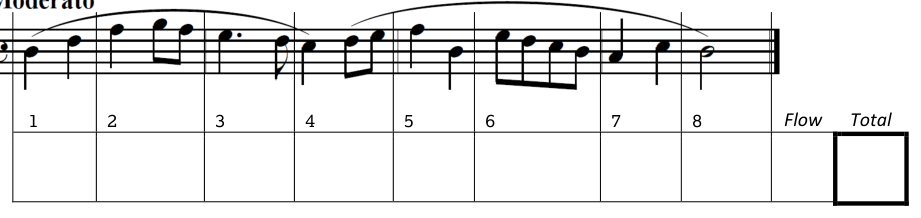
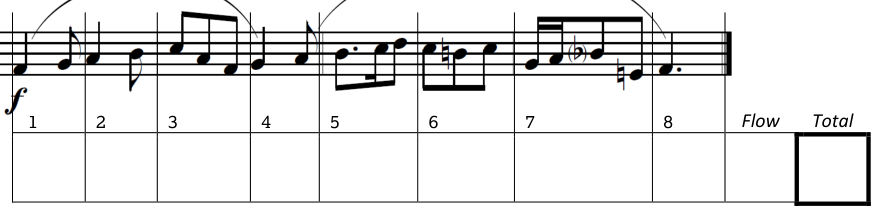
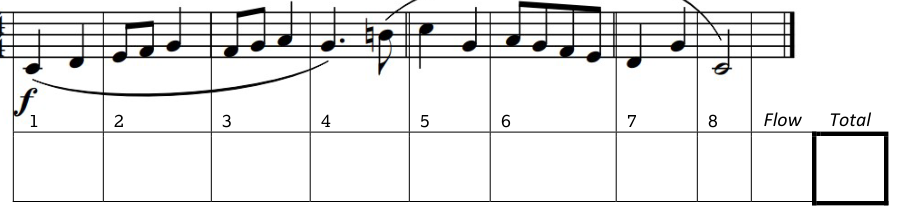
- Figure — Sight-Singing Scoring Guidelines (p. 3)
- Figure — Sight-Singing Scoring Guidelines (p. 5)
- Figure — Sight-Singing Scoring Guidelines (p. 3)
- Figure — Sight-Singing Scoring Guidelines (p. 5)