From the free course AP Music Theory on Lykke
AP Practice 5
A harmonization task asks you to turn a single melody into a convincing musical conversation: the melody supplies the visible clues, while your chords must explain its motion, support cadences, and follow eighteenth-century stylistic norms.
AP Practice 5
A harmonization task asks you to turn a single melody into a convincing musical conversation: the melody supplies the visible clues, while your chords must explain its motion, support cadences, and follow eighteenth-century stylistic norms. The strongest solution is not the one with the most chords; it is the one whose bass, harmonic function, and voice leading make the melody sound inevitable.
The task: harmonize a melody from cues
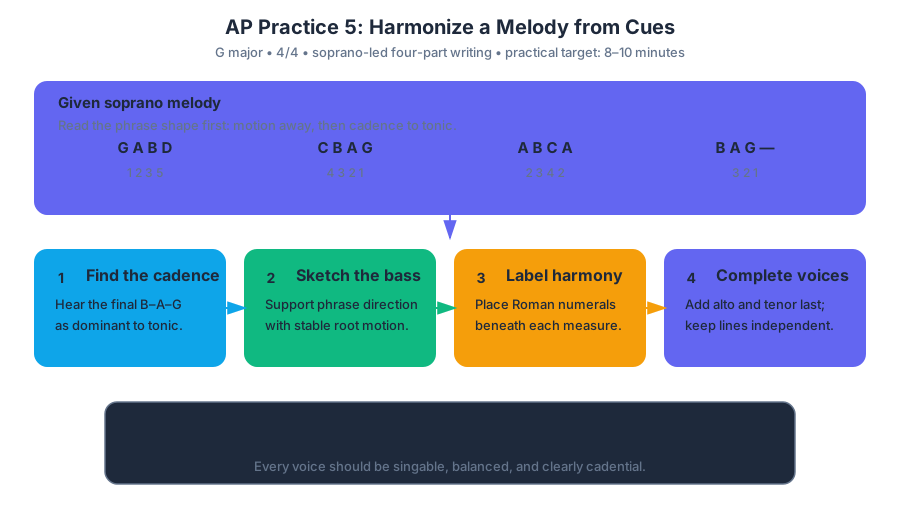
In this original, unofficial practice task, write a four-part harmonization for the melody below. The melody is in G major, common meter, and ends on the tonic. Use soprano, alto, tenor, and bass. Supply Roman numerals beneath the measures.
Key: G major        Meter: 4/4

Soprano:
| G  A  B  D | C  B  A  G | A  B  C  A | B  A  G  — |
  1  2  3  5   4  3  2  1   2  3  4  2   3  2  1
A practical time target is approximately $8$–$10$ minutes. First identify the likely cadence and phrase shape; then sketch the bass and Roman numerals; finally complete the inner voices and check for forbidden parallels, unresolved tendency tones, awkward leaps, and spacing errors.
Step 1: Read the melody as evidence
The opening notes $G$–$A$–$B$–$D$ fit several diatonic chords, including $I$, $ii$, and $V$. Do not assign a chord merely because it contains the melody note. Instead, ask what each chord does: tonic prolongs stability, predominant prepares departure, and dominant creates pressure toward tonic.
The final soprano notes $B$–$A$–$G$ strongly suggest a dominant-to-tonic close. In G major, $B$ is scale degree $3$ and also the leading tone’s resolution target; a final progression such as $V^7$–$I$ gives the phrase a clear authentic cadence.
Worked solution
One coherent harmonic plan is:
| Measure | Soprano evidence | Roman numerals | Function |
|---|---|---|---|
| $1$ | $G$–$A$–$B$–$D$ | $I \rightarrow ii$ | tonic to predominant |
| $2$ | $C$–$B$–$A$–$G$ | $IV \rightarrow I$ | predominant to tonic |
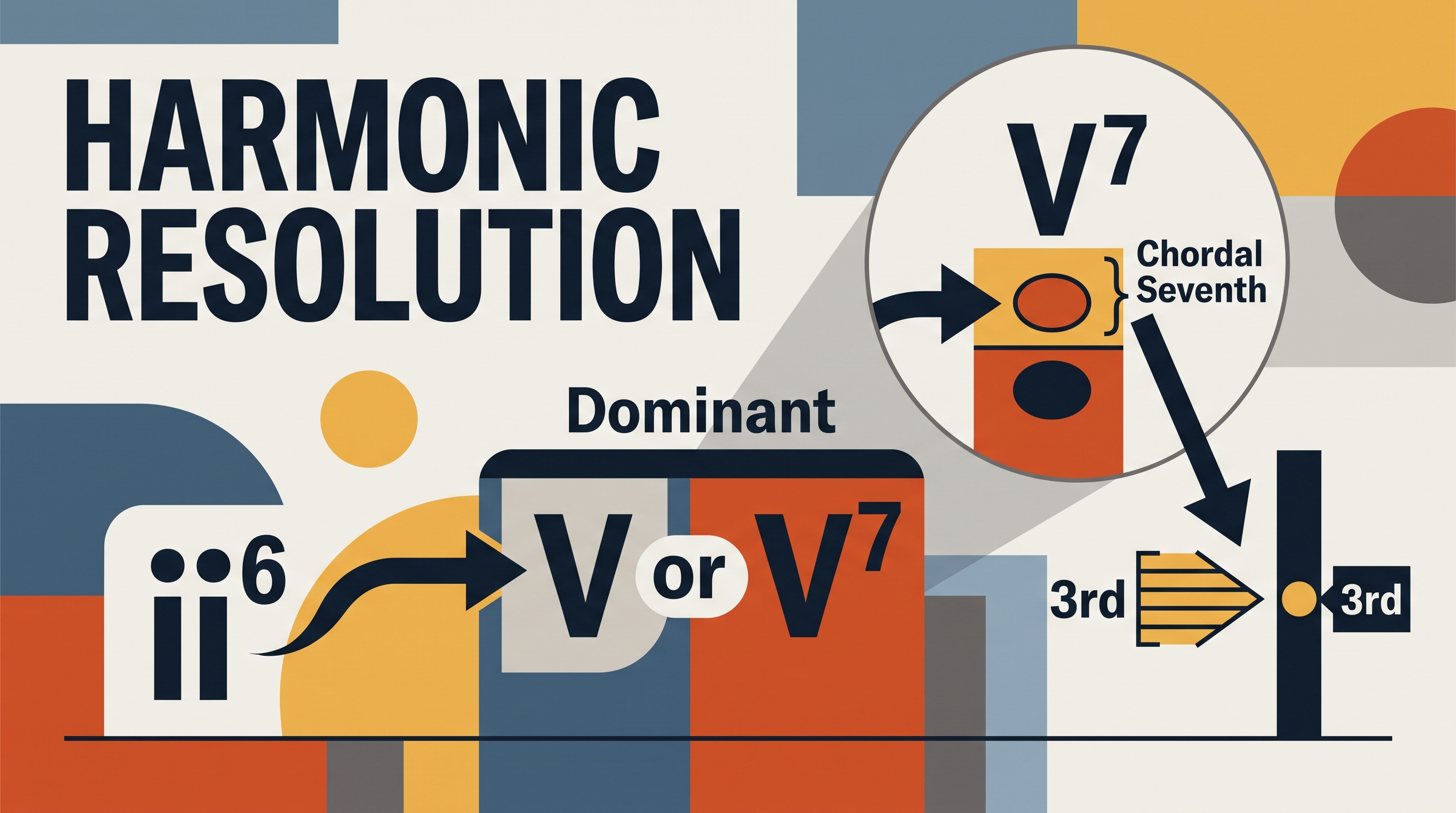
| $3$ | $A$–$B$–$C$–$A$ | $ii^6 \rightarrow V^7$ | predominant to dominant |
| $4$ | $B$–$A$–$G$ | $V^7 \rightarrow I$ | dominant to tonic |
A possible bass line is $G$–$A$–$C$–$G$–$A$–$D$–$G$. It supports the progression without becoming a distracting second melody. The first inversion of $ii$, written $ii^6$, places $F\sharp$ in the bass and can produce smoother stepwise motion into $V$.
For the final $V^7$–$I$, the chord tones are $D$–$F\sharp$–$A$–$C$ moving to $G$–$B$–$D$. The chordal seventh $C$ should normally resolve downward to $B$, while the leading tone $F\sharp$ resolves upward to $G$. These two directed resolutions are the harmonic “arrows” that make the cadence audible.
What earns credit
This task primarily activates Skill 4: Complete Based on Cues, because you must complete music while following eighteenth-century stylistic norms. It also draws on Skill 2: Analyze Notated Music, as you interpret the melody’s pitch and rhythmic information, and Skill 3: Convert Between Performed and Notated Music, because the intended harmonic result must be represented accurately in notation.
An examiner rewards the musical result through criteria such as correct chord identification, a functional harmonic progression, accurate notation, and appropriate voice leading. In practical terms, a response should make the intended chords recognizable, preserve the given soprano, maintain proper voice ranges and spacing, and avoid errors that undermine tonal syntax.
Misconception check: “Any chord containing the melody note works”
Misconception: If the soprano note belongs to a chord, that chord is automatically acceptable. Correction: Chord choice depends on context. The note $A$ in measure $3$ could belong to $ii$, $IV$, or $V^7$, but only $ii^6 \rightarrow V^7$ explains the predominant-to-dominant motion and prepares the closing cadence convincingly.
Another common error is treating the bass as leftover material. The bass determines inversion, supports harmonic function, and can create direct parallels with the soprano. Write the bass as an independent, singable line before filling in alto and tenor.
Error-review routine
After completing the harmonization, inspect it in four passes:
- Harmony: Does every Roman numeral match the notes?
- Function: Does the progression move convincingly toward a cadence?
- Voice leading: Do leading tones and chordal sevenths resolve appropriately?
- Notation: Are clefs, stems, accidentals, spacing, and Roman numerals clear?
For each error, label its cause rather than merely correcting the note: misread melody cue, wrong function, unresolved tendency tone, parallel perfect interval, or notation error. That diagnosis tells you which musical skill—not just which answer—you need to strengthen.
Retrieval check
In G major, what harmonic function most naturally follows $ii^6$, and where should the chordal seventh of $V^7$ resolve? Answer: $ii^6$ normally moves to dominant-function harmony, especially $V$ or $V^7$; the seventh of $V^7$ resolves downward by step to the third of $I$.
Source Materials
- Learn More (.pdf)
- AP Music Theory Course and Exam Description
- AP Music Theory Course Overview
- AP Music Theory Course at a Glance
- AP Music Theory Course at a Glance Poster
- Adopt AP Music Theory
- AP Music Theory
- AP Music Theory
- AP Music Theory-AP Students-College Board
- AP Music Theory-Unit Study Guides
- AP Music Theory-Raidar Choir
- Everything you need to know to get a 5 on AP Music Theory