From the free course AP Music Theory on Lykke
2.10 Melodic transposition
Key concepts: Melodic transposition
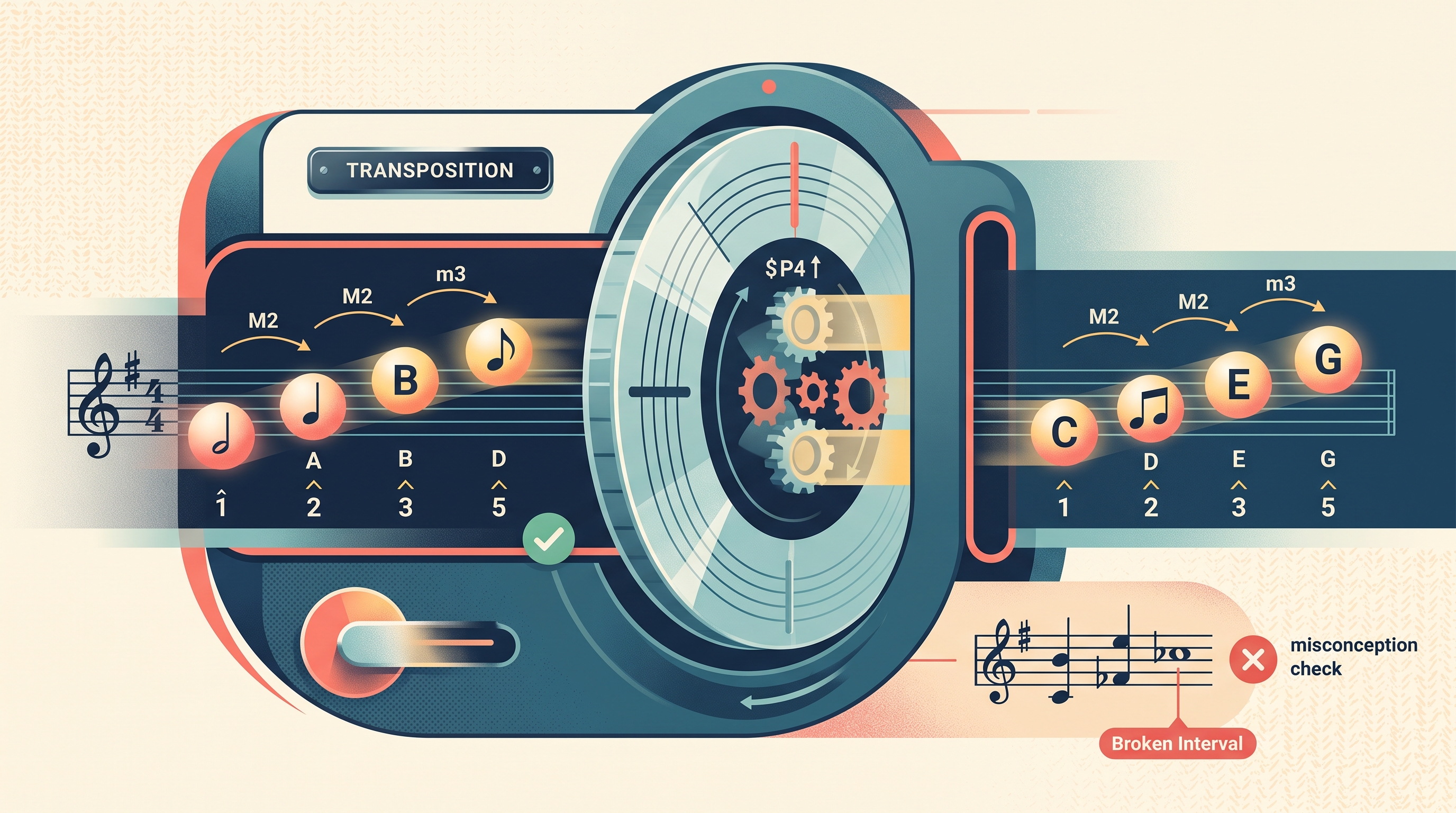
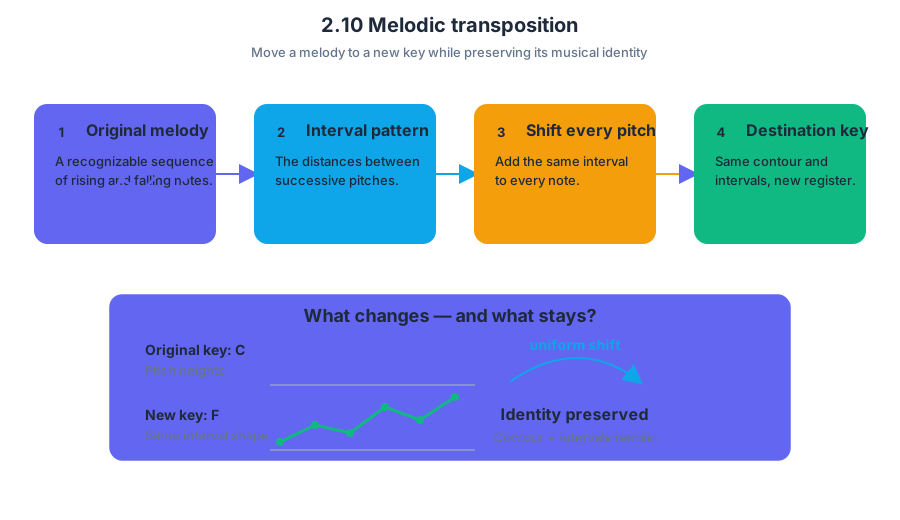
A melody can be moved to a new key without changing its musical identity: its interval pattern stays the same while every pitch shifts by the same amount.
2.10 Melodic transposition
A melody can be moved to a new key without changing its musical identity: its interval pattern stays the same while every pitch shifts by the same amount. That process is melodic transposition.
Imagine moving a sentence from one speaking register to another: the words remain recognizable, but the entire sound is higher or lower. In music, the “words” are the melody’s contour and intervals; the new register is the destination key.
The central rule: preserve intervals
A transposed melody preserves the distance between successive notes. If the original begins with an ascending major second followed by a descending minor third, the transposed version must begin with those same two interval qualities, regardless of its new starting pitch.
Melodic transposition: rewriting or performing a melody at a different pitch level while preserving its intervallic relationships and rhythmic pattern.
The melody’s rhythm, contour, and interval qualities remain constant. The key signature, pitches, and accidentals may change because the melody now belongs to a different tonal environment.
| Feature | Remains the same | May change |
|---|---|---|
| Rhythm | Yes | No |
| Contour | Yes | No |
| Interval qualities | Yes | No |
| Starting pitch | No | Yes |
| Key signature | No | Yes |
| Written accidentals | No | Yes |
| Clef or register | Not necessarily | Sometimes |
Worked example: transposing by a perfect fourth
Suppose a melody in C major uses the pitch sequence
$$ C - D - E - G - F - E - D - C $$
To transpose it up a perfect fourth, identify the destination of every original pitch:
- $C$ up a perfect fourth becomes $F$.
- $D$ up a perfect fourth becomes $G$.
- $E$ up a perfect fourth becomes $A$.
- $G$ up a perfect fourth becomes $C$.
- $F$ up a perfect fourth becomes $B\flat$.
The transposed melody is therefore
$$ F - G - A - C - B\flat - A - G - F $$
The destination key is F major, whose key signature contains one flat, $B\flat$. Notice that the original melodic pattern is unchanged: the opening rises by step, the melody leaps upward to the fifth scale degree, and the later notes descend back to the tonic. Only the pitch level has moved.
Two reliable methods
Interval method
In the interval method, calculate the interval from the original note to its transposed destination, then apply that same interval to every note. This method is especially useful when the transposition is specified as “up a major third” or “down a perfect fifth.”
For example, transposing $E - F\sharp - G\sharp$ down a minor third gives:
$$ E \rightarrow C\sharp,\qquad F\sharp \rightarrow D,\qquad G\sharp \rightarrow E $$
The result is
$$ C\sharp - D - E $$
The chromatic spelling matters: $F\sharp$ lowered by a minor third is $D$, not an enharmonically equivalent but incorrectly spelled alternative.
Scale-degree method
In the scale-degree method, identify each note’s role in the original key and reproduce that role in the destination key. The C-major melody $C-D-E-G$ represents
$$ \hat{1}-\hat{2}-\hat{3}-\hat{5} $$
In F major, those same scale degrees are
$$ F-G-A-C $$
This method is often faster for diatonic melodies because it treats the melody as a pattern within a key rather than as isolated letter names.
Accidentals and notation
A melody may contain chromatic notes that are not included in the destination key signature. Transpose the pitch relationship first, then decide whether each resulting note is represented by the key signature or needs an accidental.
For instance, a raised fourth scale degree in C major is $F\sharp$. If the melody is transposed up a perfect fourth into F major, that pitch becomes $B$, because $F\sharp$ shifted upward by a perfect fourth produces $B$. The destination key signature already supplies $B\flat$ in F major, so the written note must use a natural sign:
$$ B\flat \rightarrow B\natural $$
This is a frequent source of error: students copy the destination key signature mechanically and forget that an accidental may cancel or override a pitch supplied by that signature.
AP skills and reasoning processes
Skill 2.A, Analyze Notated Music, applies when you inspect the original notation, determine its key and scale-degree relationships, and identify the exact interval pattern that must survive the transposition.
Skill 3.A, Convert Between Performed and Notated Music, applies when you hear or sing a melody in one key and notate it in another. The performer may use solfège, scale-degree numbers, note names, or a neutral syllable, but the transposed notation must preserve the melody’s rhythmic and pitch relationships.
Skill 4.A, Complete Based on Cues, applies when a destination key, starting pitch, or transposition interval supplies the cue and you must complete the rewritten melody accurately.
Misconception check
Misconception: “Transposition means moving each note the same number of staff spaces.” Staff distance alone does not guarantee correct interval quality. A transposition must preserve both interval size and quality, so letter names, key signatures, and accidentals must be checked together.
Retrieval check: A melody in G major begins $G-A-B-D$. Transpose it up a perfect fourth. What are the new pitches, and which key signature should you use?
Answer: $C-D-E-G$ in C major. The scale-degree pattern is $\hat{1}-\hat{2}-\hat{3}-\hat{5}$, and the rhythm and contour remain unchanged.