From the free course AP Music Theory on Lykke
1.8 Rhythmic patterns and devices
Key concepts: Rhythm · Meter · Note values · Rhythmic patterns · Rhythmic devices · Steady beat · Stressed beats · Augmentation · Diminution · Dotted rhythms
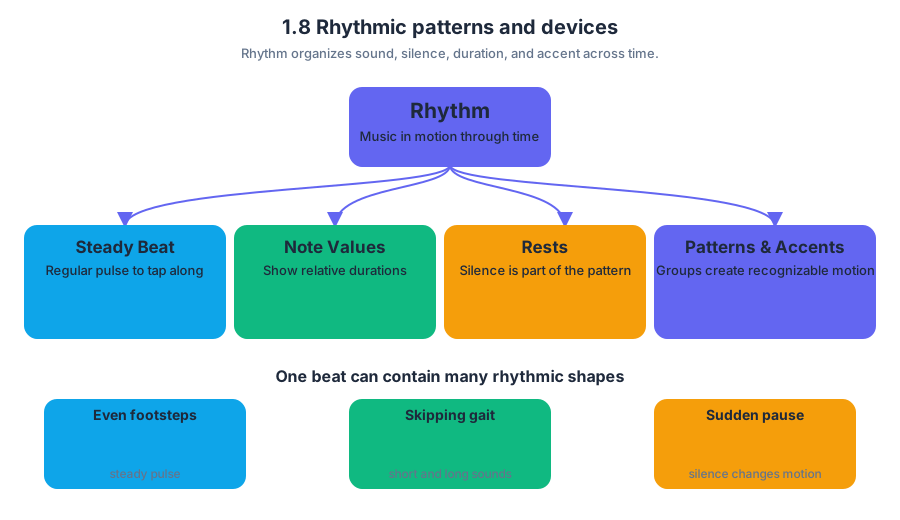
Rhythm is the temporal organization of music: long and short sounds, rests, and accents arranged across time. Against the meter established earlier, rhythm gives a passage its recognizable motion—like the difference between footsteps, a skipping gait, and a sudden pause in a conversation.
1.8 Rhythmic patterns and devices
Rhythm is the temporal organization of music: long and short sounds, rests, and accents arranged across time. Against the meter established earlier, rhythm gives a passage its recognizable motion—like the difference between footsteps, a skipping gait, and a sudden pause in a conversation.
A steady beat is the regular underlying pulse that listeners can often find by tapping along with a recording. The beat is not necessarily every note: several notes may occur within one beat, or a single note may last across several beats. Note values and rests represent these relative durations, while rhythmic patterns group those durations and silences into distinctive combinations.
Hearing rhythm as layers
Listen first for the steady beat, then notice which beats receive emphasis. Stressed beats—especially downbeats—help the ear recognize the meter, while the durations placed around those beats create the rhythm. A useful listening sequence is:
- Tap the pulse without trying to copy every note.
- Notice whether the pulse feels grouped in twos or threes.
- Hear where the music places longer sounds, rests, or accents.
- Describe the resulting pattern using note values and rhythmic-device vocabulary.
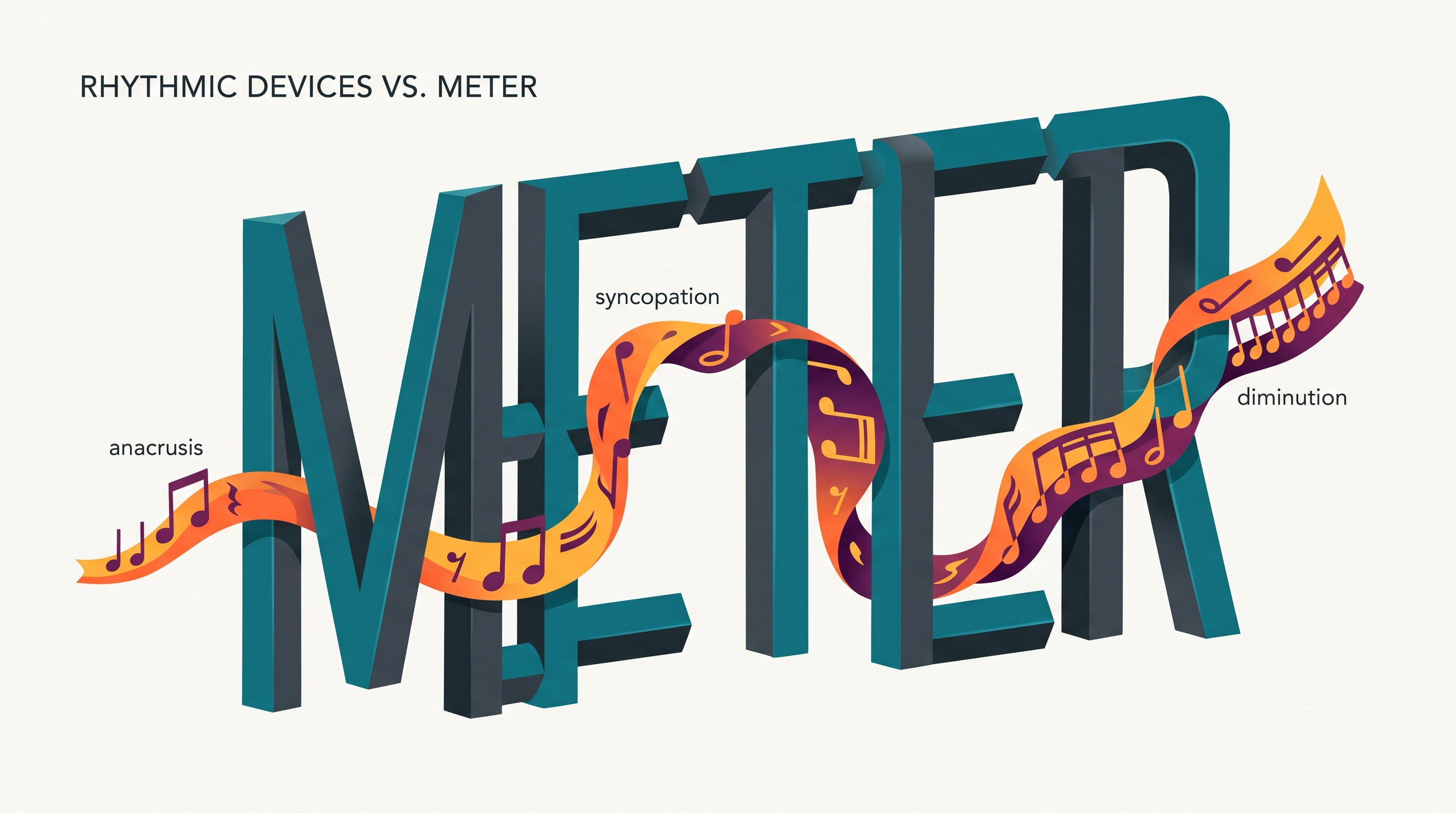
For example, imagine four beats in which the first beat contains two equal subdivisions, the second contains a longer sound followed by a shorter one, the third is silent, and the fourth contains two quick sounds. The meter supplies the repeating grid; the rhythm supplies the changing pattern of attacks and silences. If the longer sound begins on a normally weak subdivision, the pattern may sound syncopated—its accent conflicts with the expected metric emphasis.
Rhythmic patterns that challenge regularity
A syncopation occurs when rhythm places emphasis on a weak beat or weak division, often by beginning a note there or sustaining a sound across a stronger beat. The listener still senses the steady beat, but the musical surface pulls against it.
A cross-rhythm, also called a polyrhythm, occurs when two or more rhythmic patterns happen simultaneously and do not derive from one another. The familiar “two-against-three” effect is a cross-rhythm: one layer divides the same span into two events while another divides it into three.
A hemiola creates a temporary reorganization of the metric accents so that a passage heard in groups of three seems briefly grouped in twos, or a passage in twos seems grouped in threes. The contrasting structures may occur successively or simultaneously; when simultaneous, the result can also be understood as a polyrhythmic relationship.
Some patterns are distinctive enough to receive names. A dotted rhythm, for instance, combines a note extended by a dot with a shorter following value. The dot adds half the original note’s value: a dotted quarter note lasts as long as a quarter note plus an eighth note, or $1 + \frac{1}{2} = 1\frac{1}{2}$ beats when the quarter note receives one beat.
Devices that reshape a pattern
Several rhythmic devices alter duration, placement, or emphasis:
- Augmentation lengthens the note values of an existing rhythmic pattern. If a pattern contains four quarter notes, augmentation might transform it into four half notes while preserving the order of events.
- Diminution shortens the note values while preserving the pattern’s basic design. Four quarter notes might become four eighth notes.
- An agogic accent is emphasis created naturally by a longer note duration.
- An anacrusis, or pickup, is a note or group of notes that begins before the first downbeat of a phrase.
- A fermata placed over a note or rest indicates that it should last longer than its normal written duration.
Worked example: Suppose the original pattern is quarter note, two eighth notes, quarter note, quarter rest. To create diminution, halve every duration: the quarter note becomes an eighth note, each eighth note becomes a sixteenth note, and the quarter rest becomes an eighth rest. The order and contour of activity remain recognizable, but the pattern moves twice as quickly.
Misconception check
Misconception: “Rhythm and meter are the same thing.” Meter is the organized pulse framework; rhythm is the particular arrangement of durations, rests, and accents within—or sometimes against—that framework. A passage can keep the same meter while changing its rhythmic pattern completely.
Skill connection — Skill 1: Analyze performed music. In an aural example, identify the steady beat by tapping, locate stressed beats, and describe the rhythmic pattern or device you hear. In notation, use RHY-1, RHY-3.A.1, RHY-3.A.2, and RHY-3.B.1 to connect what is heard with precise descriptions of rhythmic values, devices, and transformations.
Retrieval check: A melody begins with two short notes before its first strong beat, sustains a note across a weak-to-strong boundary, and later changes four quarter notes into four eighth notes. Name the three devices or features: the opening is an anacrusis, the sustained displacement is syncopation, and the faster version is diminution.