From the free course AP Music Theory on Lykke
6.3 Other embellishing tones
Key concepts: Embellishing tones · Upper-neighbor tones · Passing tones · Identifying embellishing tones in a musical score · Marking the score with color coding
An embellishing tone is easiest to recognize when you stop asking only, “What chord is sounding?” and ask instead, “How does this note behave between the surrounding stable notes?” In a score, the answer is often visible as a small melodic detour: a note leaves a stable pitch and returns, or it fills the space…
6.3 Other embellishing tones
An embellishing tone is easiest to recognize when you stop asking only, “What chord is sounding?” and ask instead, “How does this note behave between the surrounding stable notes?” In a score, the answer is often visible as a small melodic detour: a note leaves a stable pitch and returns, or it fills the space between two stable pitches.
PIT-2.M: Identify types of embellishing tones, including nonharmonic tones, in performed and notated music.
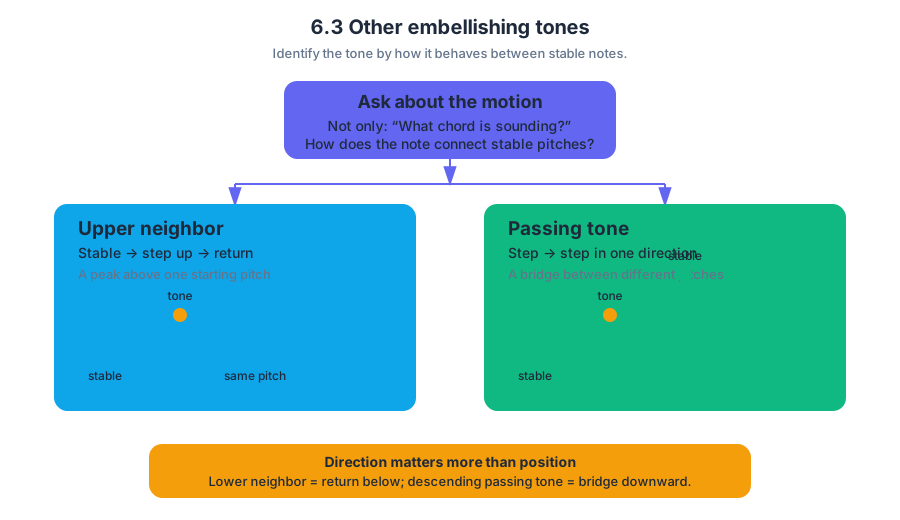
For this topic, treat the previously learned patterns as a compact working reference rather than a new writing exercise. An upper neighbor leaves a stable note by step upward and returns to that same note; a passing tone moves by step in one direction between two stable notes.
| Melodic pattern | Motion | Return pattern | Quick visual clue |
|---|---|---|---|
| Upper neighbor | Stable note–step up–step down | Returns to the starting pitch | A “peak” above one pitch |
| Passing tone | Step–step in the same direction | Connects two different stable pitches | A “bridge” between endpoints |
The distinction is not determined by whether the embellishing tone is above or below its neighbors. It depends on the pattern of motion: a lower neighbor makes the same return shape below the starting note, while a descending passing tone fills the space between two different pitches.
Hear the pattern, then verify it in the notation
Listen to the opening phrases of Mozart’s Piano Sonata in C major, K. 545, while following the score. Do not circle every note that sounds dissonant or every note that moves quickly. First locate the notes that seem structurally stable—often notes belonging to the prevailing chord—then inspect the notes between them.
A reliable score-reading sequence is:
- Trace the melodic line. Follow one voice at a time, especially the soprano or the most prominent upper line.
- Mark candidate notes. Look for stepwise motion that either returns to its starting pitch or continues toward a different pitch.
- Check the surrounding harmony. Ask whether the candidate belongs to the chord sounding at that moment. If it does not, it may be a nonharmonic embellishing tone.
- Classify the motion. A return to the original pitch suggests a neighbor; continued stepwise motion toward another pitch suggests a passing tone.
- Confirm by listening. The ear should hear either a brief departure and return or a smooth connection between two anchors.
Use two consistent colors while marking the score: circle upper neighbors in one color, such as blue, and circle passing tones in a different color, such as red. The colors are not the analysis; they are an external memory aid that makes the melodic pattern visible across several measures.
Worked score-marking example
Imagine a soprano line with the pitch sequence
$$ G ;-; A ;-; G ;-; F ;-; E $$
The $A$ is an upper neighbor because it rises by step from $G$ and returns to $G$. Circle $A$ in blue. The $F$ is a passing tone because it continues downward by step from $G$ toward $E$; circle $F$ in red.
Now compare
$$ E ;-; F ;-; G $$
Here $F$ is not a neighbor, even though it is stepwise and may be dissonant against the harmony. It connects two different boundary pitches, $E$ and $G$, so its melodic role is passing. This is the central identification test: does the line return, or does it continue?
Melodic pattern versus harmonic function
A note’s classification requires both its melodic surroundings and its harmonic context. A stepwise note can resemble a passing tone melodically, but if the phrase contains a change of harmony, the note may instead be a chord tone in the new harmony. Do not classify a note from its pitch interval alone.
For example, in the line
$$ C ;-; D ;-; E $$
$D$ may be a passing tone if the same harmony spans all three notes and $D$ does not belong to that chord. But if the harmony changes so that $D$ becomes a chord member, the note is no longer nonharmonic merely because the melody moves by step.
Misconception check: “Every dissonant-sounding step is a passing tone.”
Correction: First determine the melodic pattern, then test the note against the harmony. A passing tone connects two different stable notes by step while functioning as a nonharmonic tone within the prevailing harmony.
The broader classification under PIT-2.M.4 also includes anticipation, escape tone, appoggiatura, and pedal point. The color-coding exercise concentrates on upper neighbors and passing tones because their similar stepwise surfaces make them especially easy to confuse in real scores.
Retrieval check
A melody contains $B$ between $A$ and $C$, all in one sustained harmony. Which color should mark $B$, and why? A later phrase contains $D$ between $C$ and $D$ with a return to $C$—classify that note using the same two-part test: motion pattern first, harmonic context second.