From the free course AP Music Theory on Lykke
2.13 Rhythmic devices
A rhythm can become more than a sequence of durations when it creates expectation, interruption, or competing patterns. A rhythmic device is a recurring or distinctive way of organizing beats and durations that shapes a passage’s energy, groove, and musical design.
2.13 Rhythmic devices
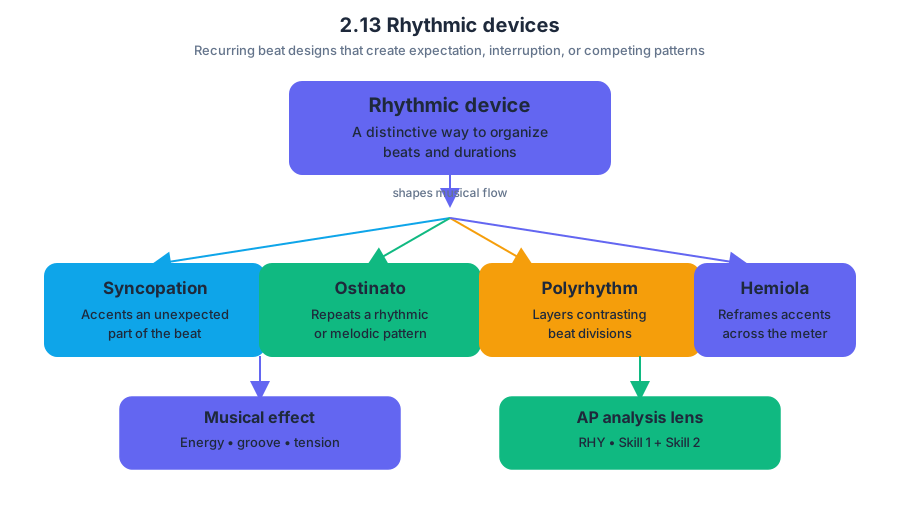
A rhythm can become more than a sequence of durations when it creates expectation, interruption, or competing patterns. A rhythmic device is a recurring or distinctive way of organizing beats and durations that shapes a passage’s energy, groove, and musical design. In AP Music Theory, Topic 2.13 Rhythmic Devices is associated with the big idea RHY (Rhythm) and Skill 1: Analyze Performed Music plus Skill 2: Analyze Notated Music.
The main devices: what the listener notices
The most reliable way to identify a rhythmic device is to compare the written durations with the heard accents. A pattern may sound unstable because it delays an expected accent, repeats insistently, or places two regular groupings against each other.
| Device | What happens | Listening or notation clue |
|---|---|---|
| Syncopation | An accent falls on a normally weak part of the beat, or an expected strong beat is tied across | A note begins off the beat and continues through the next strong beat |
| Ostinato | A short rhythmic or melodic pattern repeats persistently | The same pattern returns while other material changes |
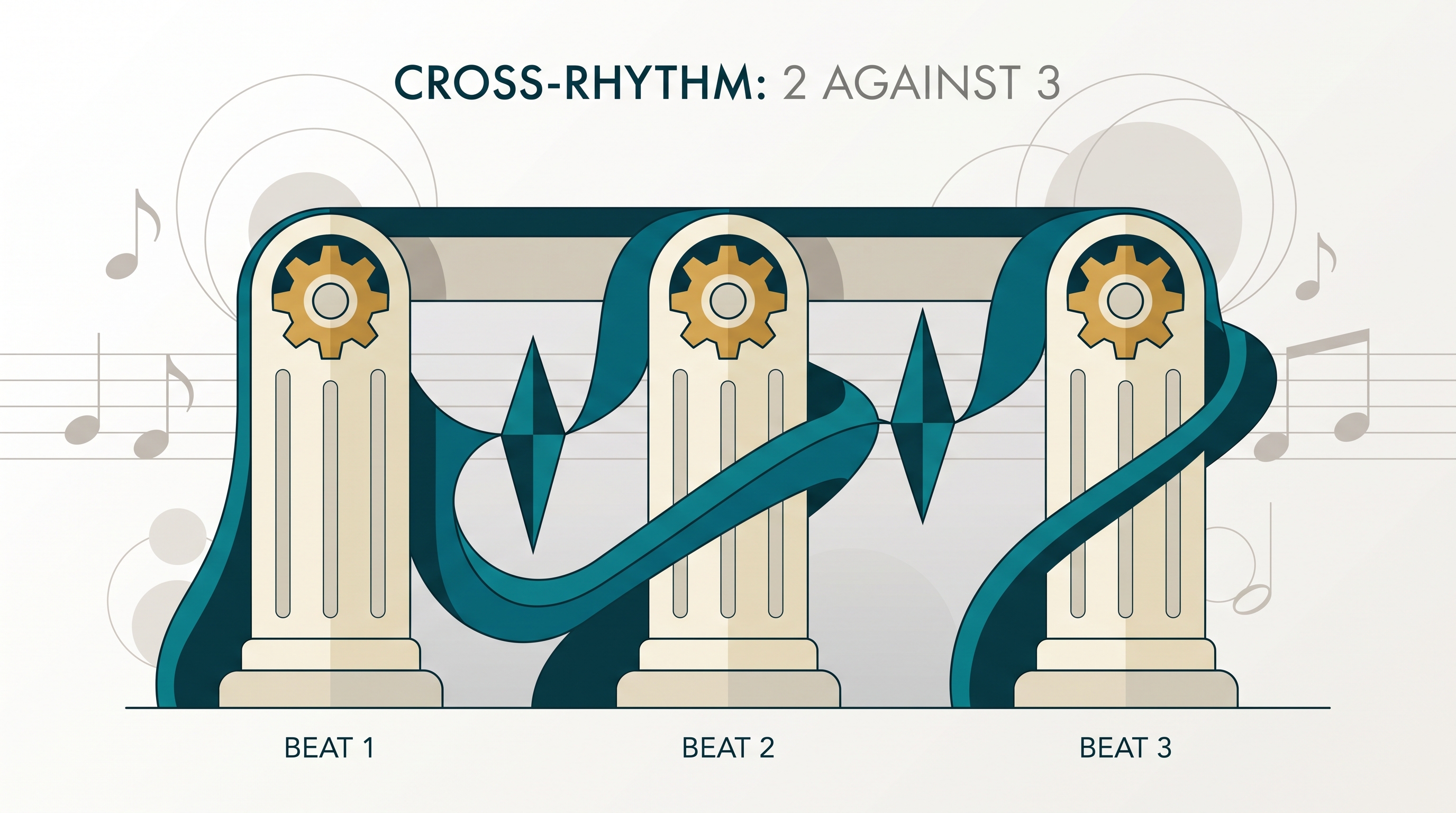
| Duple–triple conflict or cross-rhythm | Two simultaneous layers organize the same span in different groupings, commonly $2$ against $3$ | One layer groups events in twos while another groups them in threes |
| Triplet subdivision | A beat normally divided into two equal parts is divided into three | Three equal notes occupy the time of two |
| Hemiola | The perceived grouping temporarily shifts, often from three groups of two to two groups of three | Accents reorganize without necessarily changing the notated meter |
Syncopation: moving the expected accent
In a simple meter such as $4/4$, listeners normally expect beat $1$ to be strongest, followed by beat $3$, with subdivisions supporting those beats. Syncopation deliberately emphasizes a weak location—for example, an eighth-note beginning on the “and” of beat $2$ and tied across beat $3$. The duration is not merely unusual; its placement changes the listener’s sense of forward motion.
Worked example. Imagine a $4/4$ melody whose notes enter on the eighth-note counts $1$, “and” of $2$, and $4$, with the second note tied across beat $3$. The tie prevents a new attack on beat $3$, so the melody’s audible emphasis falls away from the expected strong beat. The accompaniment may continue marking beats $1$, $2$, $3$, and $4, creating tension between the meter’s pulse and the melody’s accents.
Key insight: Syncopation concerns accent and expectation, not simply complicated notation.
Repetition and competing groupings
An ostinato is a repeated pattern that acts like a rhythmic loop. It may remain unchanged beneath a changing melody, harmony, or texture. When analyzing performed music, listen for the layer that keeps returning; when analyzing notation, bracket the smallest repeating unit and verify that its boundaries remain consistent.
A cross-rhythm is different from syncopation because it involves simultaneous grouping systems. Suppose an accompaniment in $3/4$ gives equal accents on beats $1$, $2$, and $3$, while a melody accents every other eighth note. Across the same span, the accompaniment projects three equal beats and the melody projects two larger groupings. The resulting recurring $2$-against-$3$ relationship is a duple–triple conflict, not automatically syncopation.
A diagnostic method
Use this four-step analysis whenever a passage sounds rhythmically unsettled:
- Establish the meter: identify the notated time signature and likely beat unit.
- Mark attacks: write the exact beat or subdivision on which each layer begins.
- Mark accents: distinguish written accents, repeated attacks, longer durations, and performance emphasis.
- Compare layers: decide whether the effect comes from displaced accents, repetition, or competing groupings.
Named misconception — “Any offbeat rhythm is syncopation.” An offbeat entrance may be syncopated, but an every-other-eighth-note pattern against a steady triple meter can instead create a cross-rhythm. Always locate the accent pattern in both layers before naming the device. A meter change requires the underlying time organization to change; a cross-rhythm can occur while the notated meter remains constant.
Retrieval check
In $3/4$, the accompaniment accents beats $1$, $2$, and $3$, while the melody accents every other eighth note, producing a recurring $2$-against-$3$ pattern. Is this best described as syncopation, a duple–triple conflict/cross-rhythm, a meter change, or a timbre device? Explain how the simultaneous accent patterns support your choice.
Answer: It is a duple–triple conflict/cross-rhythm. The accompaniment maintains three beat groupings, while the melody projects two recurring groupings across the same time span; the meter itself has not changed, and timbre is unrelated to the accent organization.