From the free course AP Music Theory on Lykke
8.1 Modes
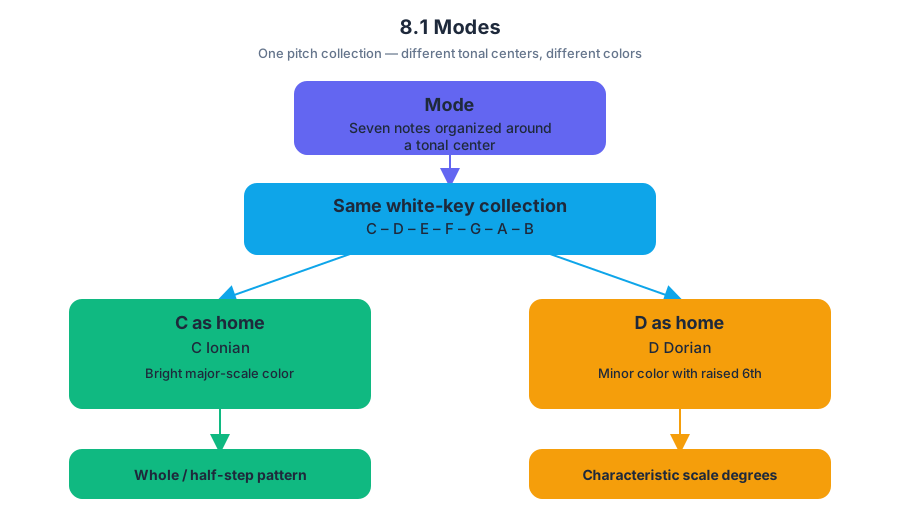
A mode is a seven-note pitch collection organized around a particular tonic, or tonal center. The same white-key collection can sound completely different depending on which note feels like “home”: C–D–E–F–G–A–B centered on C is Ionian, but the same pitches centered on D produce Dorian.
8.1 Modes
A mode is a seven-note pitch collection organized around a particular tonic, or tonal center. The same white-key collection can sound completely different depending on which note feels like “home”: C–D–E–F–G–A–B centered on C is Ionian, but the same pitches centered on D produce Dorian.
Modes matter because a melody’s identity depends on more than its individual notes. Changing the tonal center changes the pattern of whole steps and half steps around that center, which changes the location of characteristic scale degrees and therefore the melody’s color.
The seven diatonic modes
The seven common diatonic modes can be understood as rotations of the major scale. Each mode begins on a different scale degree of the same parent collection, but each must be heard and analyzed relative to its own tonic.
| Mode | Scale-degree pattern above its tonic | Characteristic relationship to major or minor |
|---|---|---|
| Ionian | $1\ 2\ 3\ 4\ 5\ 6\ 7$ | Major scale |
| Dorian | $1\ 2\ \flat 3\ 4\ 5\ 6\ \flat 7$ | Minor with raised $6$ |
| Phrygian | $1\ \flat 2\ \flat 3\ 4\ 5\ \flat 6\ \flat 7$ | Minor with lowered $2$ |
| Lydian | $1\ 2\ 3\ \sharp 4\ 5\ 6\ 7$ | Major with raised $4$ |
| Mixolydian | $1\ 2\ 3\ 4\ 5\ 6\ \flat 7$ | Major with lowered $7$ |
| Aeolian | $1\ 2\ \flat 3\ 4\ 5\ \flat 6\ \flat 7$ | Natural minor |
| Locrian | $1\ \flat 2\ \flat 3\ 4\ \flat 5\ \flat 6\ \flat 7$ | Minor with lowered $2$ and lowered $5$ |
A useful memory sequence is I–D–P–L–M–A–L: Ionian, Dorian, Phrygian, Lydian, Mixolydian, Aeolian, Locrian. The sequence follows the major scale’s degrees from $1$ through $7$.
Relative and parallel modes
Relative modes share the same pitch collection but have different tonics. C Ionian and D Dorian are relative: both use the notes C, D, E, F, G, A, and B. Parallel modes share the same tonic but use different pitch collections. C Ionian and C Dorian are parallel: both begin on C, but C Dorian contains $E\flat$ and $B\flat$ instead of E and B.
This distinction prevents a frequent analytical error: identifying a mode solely by its key signature. A key signature tells you the available pitch collection, not automatically which pitch functions as the tonic. To establish the mode, listen for or inspect the note that receives emphasis, begins or ends important phrases, and functions as the point of repose.
Worked example: identifying D Dorian
Suppose a melody uses only the notes D, E, F, G, A, B, and C. The key signature is therefore the same as C major, but the melody repeatedly returns to D, and D sounds like the point of rest.
- Treat D as scale degree $1$, not C.
- Spell the collection above D: D–E–F–G–A–B–C–D.
- Compare it with D natural minor: D–E–F–G–A–B-flat–C–D.
- The raised sixth degree, B natural, identifies D Dorian.
The crucial sound is the contrast between the minor third, F, and the raised sixth, B natural. Dorian often sounds minor without the darker quality created by the lowered sixth of natural minor.
Key insight: A mode is identified by the interaction between its tonic and its interval pattern, not by a key signature alone.
AP skills and reasoning processes
Modes are assessed through the official skill categories Analyze Performed Music, Analyze Notated Music, Convert Between Performed and Notated Music, and Complete Based on Cues. In practice, Analyze Performed Music asks you to hear a tonal center and recognize modal color; Analyze Notated Music asks you to determine the tonic and pitch collection from a score; Convert Between Performed and Notated Music connects a heard modal melody with its notation; and Complete Based on Cues may require continuing or supplying notes consistent with a given mode.
The topic is especially connected with PIT, the course big idea for Pitch, and with the skill of using symbols and terms to describe pitch patterns and relationships. Your evidence should be specific: identify the tonic, name the mode, and cite the note or scale-degree relationship that proves the identification.
Misconception check
Misconception: “A melody with no sharps or flats is in C major.”
Correction: Its notes may belong to the C-major collection, but its mode could be C Ionian, D Dorian, E Phrygian, F Lydian, G Mixolydian, A Aeolian, or B Locrian. The tonal center determines the mode.
Retrieval check
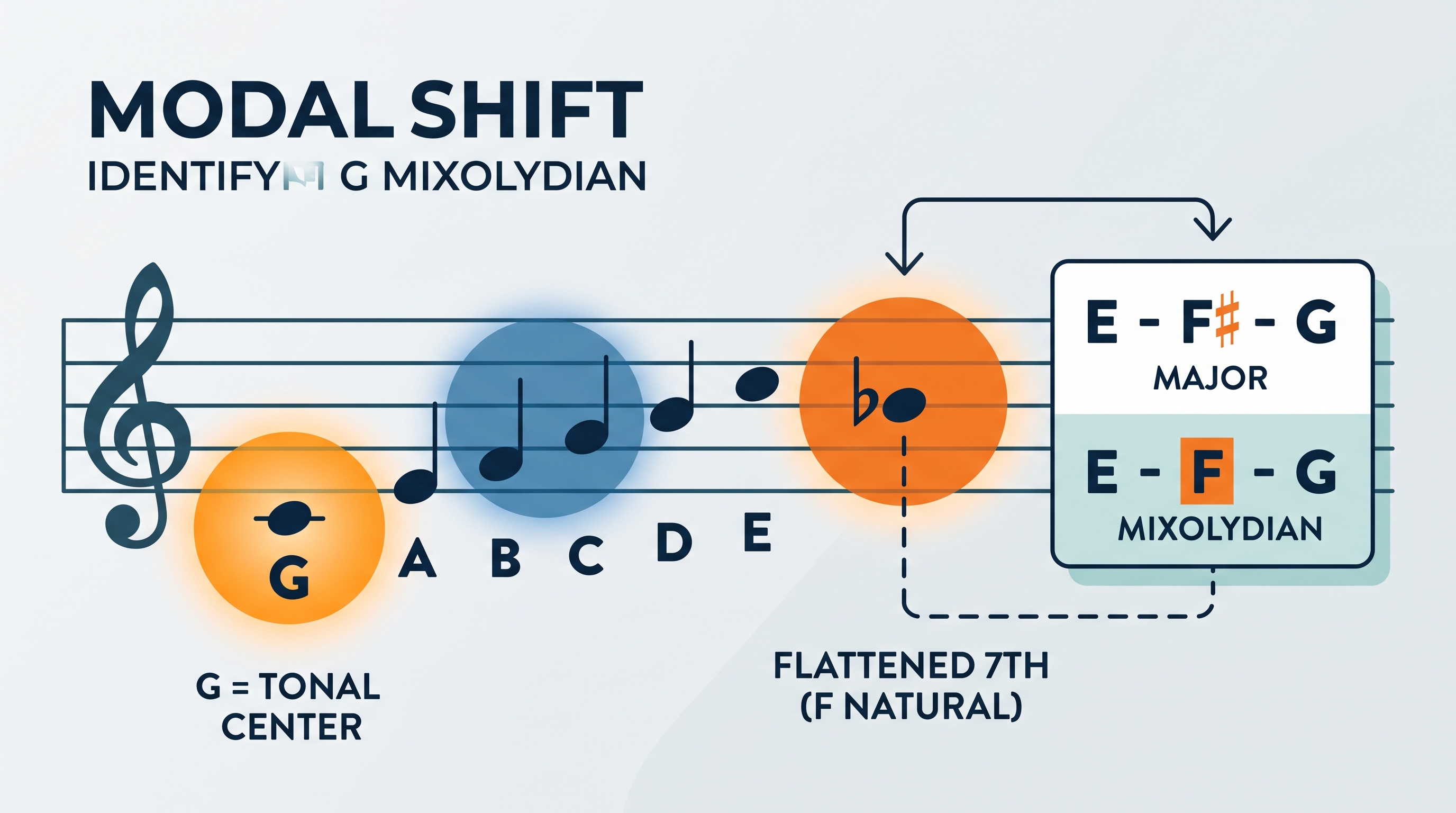
A melody uses the notes G, A, B, C, D, E, and F, but G is the clear tonal center. Identify the mode and its characteristic scale-degree alteration compared with G major.
Answer: G Mixolydian. It has a lowered seventh, F natural, instead of F-sharp.
Source Materials
- Learn More (.pdf)
- AP Music Theory Course and Exam Description
- AP Music Theory Course Overview
- AP Music Theory Course at a Glance
- AP Music Theory Course at a Glance Poster
- Adopt AP Music Theory
- AP Music Theory
- AP Music Theory
- AP Music Theory-AP Students-College Board
- AP Music Theory-Unit Study Guides
- AP Music Theory-Raidar Choir
- Everything you need to know to get a 5 on AP Music Theory