From the free course AP Music Theory on Lykke
7.4 Part writing of secondary leading-tone chords
Key concepts: Part writing of secondary leading-tone chords · Secondary functions in harmony · Spelling secondary leading-tone chords · 18th-century common-practice voice-leading procedures · Voice leading in up to four voices · Chordal seventh resolution · Score analysis of voice leading · Error detection in part writing · Harmonic dictation of secondary leading-tone chords · Converting between performed and notated music
A secondary leading-tone chord must be written as if it were a normal leading-tone chord aimed at a temporary target: its leading tone rises by step to the target chord’s root, while any chordal seventh falls by step.
7.4 Part writing of secondary leading-tone chords
A secondary leading-tone chord must be written as if it were a normal leading-tone chord aimed at a temporary target: its leading tone rises by step to the target chord’s root, while any chordal seventh falls by step. The essential question is not merely “What chord is this?” but “How can every voice move convincingly into the chord it tonicizes?”
PIT-4.A.14: When part-writing secondary leading-tone chords, all doubling and voice-leading considerations of normal leading-tone chords should be maintained, including the rule that chordal sevenths resolve down by step.
The spelling follows the target, not the home key
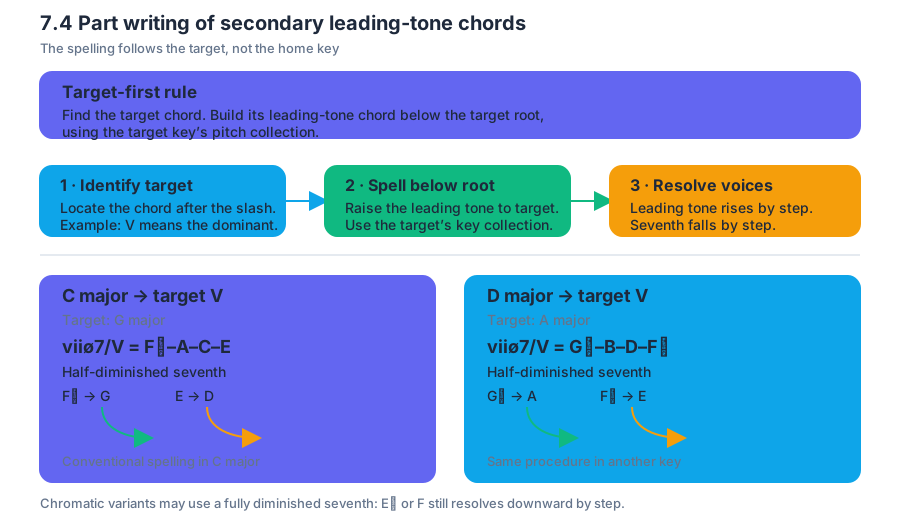
To spell a secondary leading-tone chord, first identify its target chord. Then build the leading-tone chord immediately below that target’s root, using the target key’s pitch collection. In C major, the target $V$ chord is G major. Its leading tone is $F\sharp$, so the conventional secondary leading-tone seventh chord is:
$$ \mathrm{viiø7/V} = F\sharp-A-C-E $$
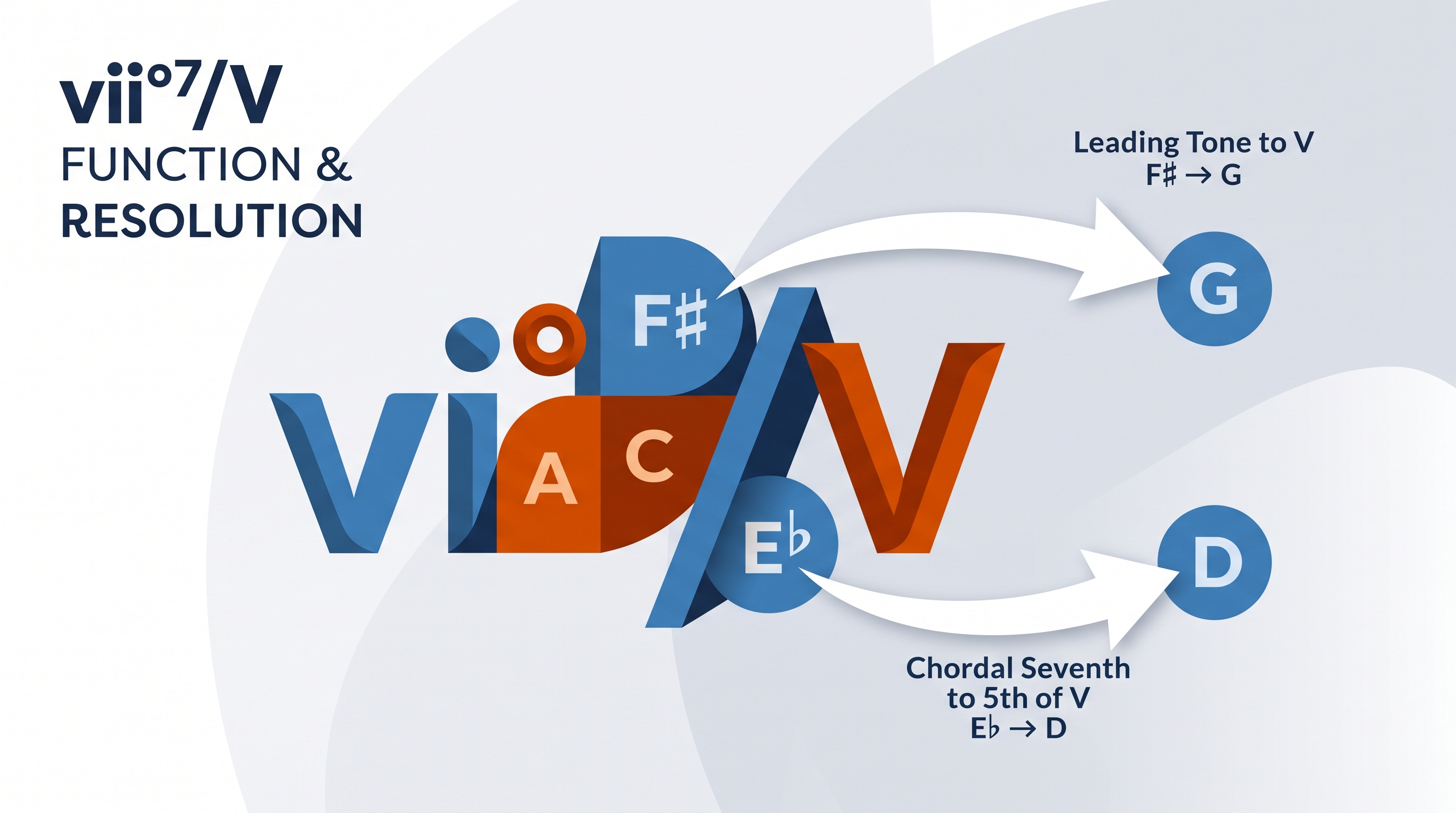
This is half-diminished seventh: a diminished triad plus a minor seventh. The $F\sharp$ leads upward to G, and the chordal seventh E falls to D, a member of the G-major target chord.
A fully diminished alternative may appear in chromatic writing:
$$ F\sharp-A-C-E\flat $$
This is fully diminished seventh because the seventh above $F\sharp$ is diminished. It is not the mandatory spelling of $\mathrm{viiø7/V}$ in C major; it is a chromatic variant. In that version, $E\flat$ still resolves downward by step to D. The spelling changes, but the voice-leading principle does not.
The same procedure works in another key. In D major, the target $V$ is A major, whose leading tone is G-sharp. The conventional secondary leading-tone seventh chord is:
$$ \mathrm{viiø7/V} = G\sharp-B-D-F\sharp $$
Here $G\sharp\rightarrow A$ and $F\sharp\rightarrow E$. A fully diminished chromatic form, $G\sharp-B-D-F$, is possible, with $F\rightarrow E$, but it should be labeled accurately rather than treated as the default spelling.
Worked four-voice realization
Suppose a progression in C major moves from $I$ to $\mathrm{viiø7/V}$ to $V$. A practical four-voice plan is:
| Voice | $I$ chord | $\mathrm{viiø7/V}$ | $V$ |
|---|---|---|---|
| Soprano | G | F-sharp | G |
| Alto | E | E | D |
| Tenor | C | C | B |
| Bass | C | A | G |
The middle chord is spelled $F\sharp-A-C-E$, although the bass has A. Its Roman-numeral identity is still $\mathrm{viiø7/V}$ because the chord’s function depends on its relation to G, not on the bass alone. The soprano’s $F\sharp\rightarrow G$ supplies normal leading-tone resolution; the alto’s E remains temporarily, then resolves down to D as the chordal seventh. The other voices move by small intervals into the dominant.
This example also illustrates a crucial writing decision: do not double a tendency tone merely to fill four voices. In a leading-tone chord, the leading tone and chordal seventh have directed resolutions, so doubling either can create parallel or unresolved tendencies. If a chord has fewer members than voices, double a stable, nontendency chord member when the voice leading permits it.
The four assessment lenses
PIT-4.A requires applying 18th-century voice-leading procedures through score analysis, error detection, writing exercises, and contextual listening. The same progression may therefore appear as notation to inspect, an error to diagnose, a partially completed texture to finish, or a performed fragment to identify and notate.
The topic draws on four named skills:
- Skill 1: Analyze Performed Music (1.E): Use harmonic, melodic, and rhythmic symbols and terms to describe 18th-century voice leading in performed music, including textures of up to four voices.
- Skill 2: Analyze Notated Music (2.C, 2.E): Use notation to describe relationships and evaluate voice-leading procedures in a score.
- Skill 3: Convert Between Performed and Notated Music (3.E): Compare heard and written pitch or rhythm and detect discrepancies in a one- or two-voice representation.
- Skill 4: Complete Based on Cues (4.A): Use common-practice tonality to spell chords and connect them through appropriate voice-leading procedures.
In harmonic dictation, a performed $F\sharp-A-C-E$ resolving to G-major may sound like a brief $vii°7-I$ motion in G, even though the larger piece remains in C major. Your notation must show the local function: $\mathrm{viiø7/V}\rightarrow V$, not a falsely tonicized change of global key.
Misconception check
Misconception: “Every secondary leading-tone seventh chord is fully diminished.” Not so. In a major-key context, the conventional chord is often half-diminished, such as $F\sharp-A-C-E$ for $\mathrm{viiø7/V}$ in C major. A fully diminished form such as $F\sharp-A-C-E\flat$ is a possible chromatic variant, not a spelling rule.
Misconception: “Because the chord is secondary, its seventh may resolve freely.” The opposite is true: secondary function does not suspend ordinary voice-leading practice. The chordal seventh resolves down by step, and the leading tone resolves up by step whenever the target chord permits.
Retrieval check
In C major, spell $\mathrm{viiø7/V}$ and state the two principal tendency-tone resolutions. Answer: $F\sharp-A-C-E$; $F\sharp\rightarrow G$ and $E\rightarrow D$. If the optional fully diminished form $F\sharp-A-C-E\flat$ is used, the seventh resolves $E\flat\rightarrow D$. Topic 7.3 emphasizes identifying such chords; Topic 7.4 emphasizes writing them correctly in context.