From the free course AP Music Theory on Lykke
1.1 Pitch and notation
Key concepts: Reading and interpreting pitch notation · Bass clef fluency · Key signatures and tonality · Pitch accuracy and interval recognition · Rhythmic accuracy and subdivisions · Time signatures and meter · Tempo, dynamics, and phrasing · Singing from visual notation · Scalar, leap, and chromatic motion · Starting pitch and tonal context
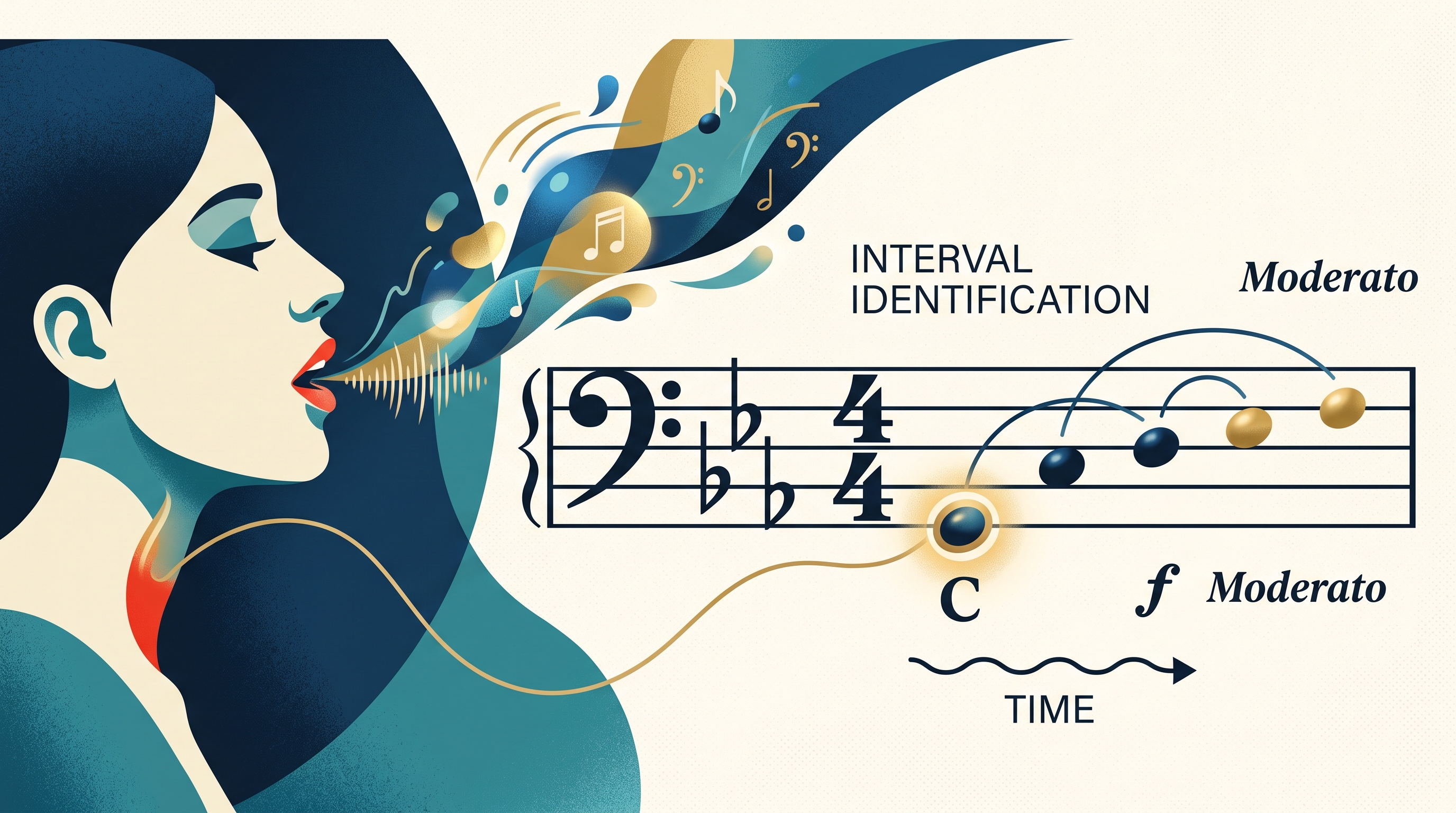
A written melody becomes performable when three coordinates agree: where the pitch sits, which tonal collection governs it, and when the sound occurs. In a bass-clef melody marked with three flats, for example, the performer must read the staff, preserve the key of E-flat major, and keep every note aligned with the…
1.1 Pitch and notation
A written melody becomes performable when three coordinates agree: where the pitch sits, which tonal collection governs it, and when the sound occurs. In a bass-clef melody marked with three flats, for example, the performer must read the staff, preserve the key of E-flat major, and keep every note aligned with the meter.
CED traceability: Topic 1.1 Pitch and notation; Big Idea PIT: Pitch; associated skills include Skill 1: Analyze performed music, Skill 2: Analyze notated music, Skill 3: Convert between performed and notated music, and Skill 4: Complete based on cues. The topic is assessed through visual reading, aural interpretation, and performance from notation.
The staff is a pitch map
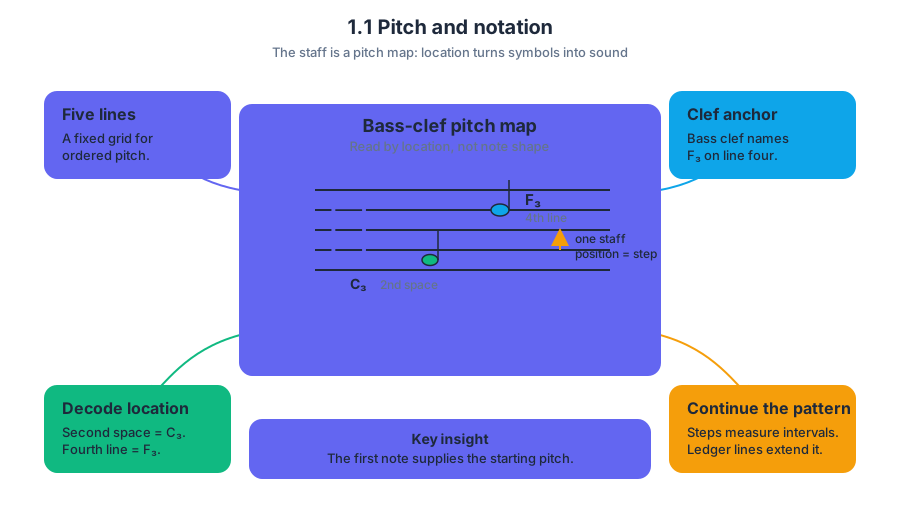
A staff is a set of five horizontal lines. A clef assigns pitch names to those lines and spaces. The bass clef places $F_3$ on the fourth line from the bottom, so the surrounding notes can be decoded relative to that anchor:
For bass-clef fluency, read by location, not by guessing from the shape of a note. A note on the second space is $C_3$; a note on the fourth line is $F_3$. Ledger lines extend the same ordered pattern above or below the staff. Moving one staff position—line to adjacent space or space to adjacent line—produces a scalar step; skipping a staff position creates a larger interval.
Key insight: The printed first note is not decorative. It supplies the starting pitch from which the rest of the melody’s relative intervals can be measured.
Key signatures establish tonality
A key signature is the group of sharps or flats placed after the clef. It tells the performer which pitches are altered throughout the passage unless an accidental changes one temporarily. Three flats—$B\flat$, $E\flat$, and $A\flat$—identify E-flat major or its relative minor, $C$ minor. In a melody clearly centered on $E\flat$, the scale is
$$ E\flat-F-G-A\flat-B\flat-C-D-E\flat. $$
A practical reading routine is:
- Locate the tonic, or tonal “home,” $E\flat$.
- Recall the three flats: $B\flat$, $E\flat$, and $A\flat$.
- Read each notated pitch using the clef and key signature together.
- Listen for whether the melody moves toward or away from the tonic.
The key signature does not mean that every melody begins on the tonic. A printed opening pitch may be a scale degree such as $3$ or $5$, so the performer must maintain the tonal center internally rather than repeatedly searching for the first note.
Steps, leaps, and chromatic motion
Pitch accuracy means producing the correct relative distances between notes, not merely singing isolated pitches. Scalar motion moves by adjacent scale steps; a leap covers a larger interval. For instance, $F_4$ to $B\flat_4$ is a leap of a perfect fourth. Chromatic motion uses a pitch outside the diatonic collection, such as $B\natural$ rising by a half step to $C$.
When reading, identify the contour first: rising, falling, repeated, stepwise, or leaping. Then measure the interval. A leap such as $F_4\rightarrow B\flat_4$ should be heard as a single target distance, while $B\natural\rightarrow C$ should be heard as a tight leading-tone-to-tonic pull.
Misconception check — “The key signature guarantees every note is diatonic.”
It does not. Accidentals can introduce chromatic pitches, and those pitches must be interpreted in context rather than automatically corrected to the key signature.
Meter, tempo, and expressive notation
The time signature $4/4$ indicates four quarter-note beats per measure, with the quarter note receiving one beat. Accurate performance requires both correct durations and a steady pulse. Common subdivisions include dotted quarters and mixtures of eighth and sixteenth notes; the performer must preserve their internal proportions instead of flattening them into approximately equal sounds.
Moderato indicates a moderate tempo. Forte, written $f$, calls for a strong dynamic level, while a slur connects notes into a smooth phrase. The slur usually suggests connected delivery and helps reveal logical breathing or shaping points; it does not erase the individual pitches or their rhythmic values.
| Notation cue | Performance decision |
|---|---|
| Bass clef | Identify pitch from the $F_3$ anchor |
| Three flats | Maintain $B\flat$, $E\flat$, and $A\flat$ |
| $4/4$ | Organize four quarter-note beats per measure |
| Moderato | Keep a moderate, continuous tempo |
| $f$ | Sing with forte intensity |
| Slur | Connect notes and shape the phrase |
Worked reading: from page to performance
Suppose a four-measure bass-clef melody is in E-flat major, begins on the printed pitch $C_3$, and is marked Moderato, $f$, and $4/4$. First, sound or internally hear $C_3$ as the given starting pitch. Next, establish $E\flat$ as tonal home, then decode each note using the bass clef and the three-flat signature. A step such as $C\rightarrow D\rightarrow E\flat$ should feel like a return toward tonic; a leap such as $F_4\rightarrow B\flat_4$ requires deliberate interval targeting.
Before performing, silently count each measure, speak or tap the subdivisions, and trace the slurs. Then sing on note names, scale-degree numbers, solfège, or a neutral syllable. In sight-singing performance, relative pitch, rhythmic accuracy, and continuity matter more than the quality of the singing voice. If a comfortable register is needed, the melody may be transposed while preserving its interval pattern and tonal relationships.
Retrieval check
A melody displays bass clef, three flats, $4/4$, Moderato, and $f$. Name the likely key, identify the altered pitches, state how many quarter-note beats belong in each measure, and explain why the printed first note should be used before singing the remaining intervals. Then distinguish the motion in $G\rightarrow A\flat$ from the motion in $B\natural\rightarrow C$: the first is a diatonic step in E-flat major, while the second is chromatic half-step motion.
Source Materials
- Learn More (.pdf)
- AP Music Theory Course and Exam Description
- AP Music Theory Course Overview
- AP Music Theory Course at a Glance
- AP Music Theory Course at a Glance Poster
- Adopt AP Music Theory
- AP Music Theory
- AP Music Theory
- AP Music Theory-AP Students-College Board
- AP Music Theory-Unit Study Guides
- AP Music Theory-Raidar Choir
- Everything you need to know to get a 5 on AP Music Theory