From the free course AP Music Theory on Lykke
2.4 Chromatic, whole-tone, and pentatonic scales
Key concepts: Chromatic scales · Whole-tone scales · Pentatonic scales · Identifying scales in performed music · Identifying scales in notated music · Melodic passages using non-diatonic scales · Major pentatonic scale degrees · Pitch fundamentals and successive pitches · Listening for pentatonic scales in American folksongs, spirituals, and popular music · Singing chromatic and whole-tone scales by rote
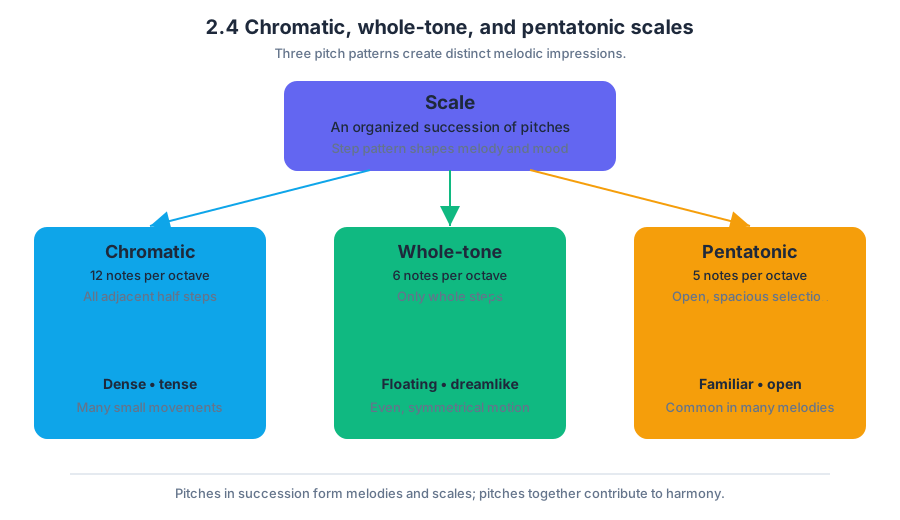
A scale is an organized succession of pitches, and its pattern of steps can make a melody sound tense, floating, open, or familiar before you identify a single chord.
2.4 Chromatic, whole-tone, and pentatonic scales
A scale is an organized succession of pitches, and its pattern of steps can make a melody sound tense, floating, open, or familiar before you identify a single chord. Three especially useful patterns are the chromatic, whole-tone, and pentatonic scales.
PIT-1.K.1 — Essential Knowledge: Pitches are specific frequencies of sound and basic units of music. When pitches occur successively, they form melodies and scales; when they occur simultaneously, they contribute to chords and harmony.
Three scale designs
The fastest way to distinguish these scales is to count their pitches and inspect the distance between neighboring notes.
| Scale | Number of pitches | Defining pattern | Sound-world |
|---|---|---|---|
| Chromatic | $12$ | Every neighboring pitch is a half step apart | Completely filled-in pitch space; highly chromatic |
| Whole-tone | $6$ | Every neighboring pitch is a whole step apart | Symmetrical, floating, and without a strong leading-tone pull |
| Pentatonic | $5$ | Five pitches selected from a major or minor scale | Open, singable, and often free of half-step friction |
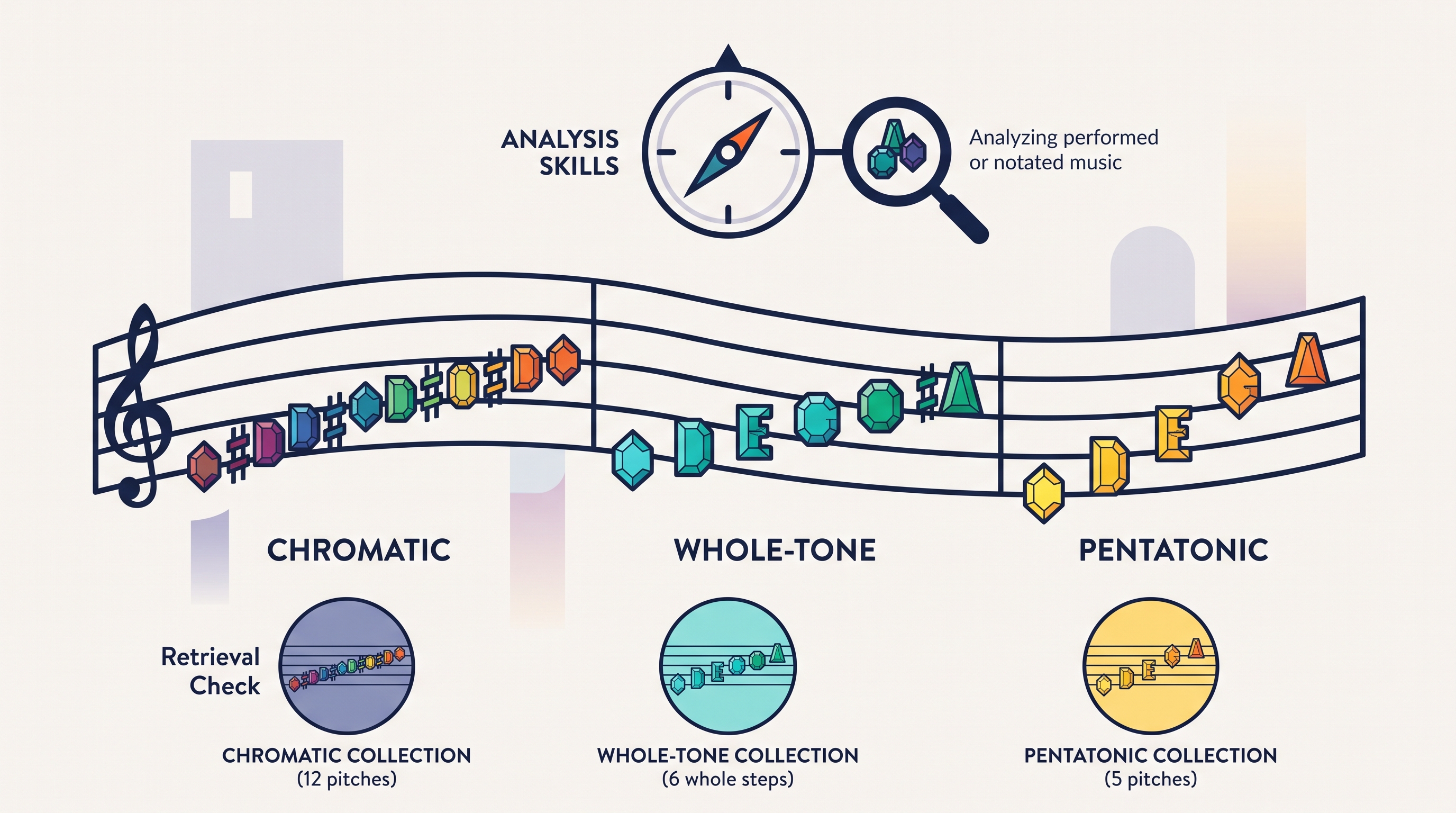
A chromatic scale uses all twelve pitch classes within the octave:
$$ \text{C--C\sharp--D--D\sharp--E--F--F\sharp--G--G\sharp--A--A\sharp--B--C} $$
Each adjacent pair is a half step. The spelling can change according to the key and melodic direction, but the defining sound is continuous motion by half steps.
A whole-tone scale contains six notes, each a whole step apart. Beginning on C, one version is:
$$ \text{C--D--E--F\sharp--G\sharp--A\sharp--C} $$
Beginning on a different pitch produces one of only two distinct whole-tone collections, because transpositions by a whole step eventually repeat the same six pitch classes.
A pentatonic scale contains five pitches drawn from the seven pitches of a major or minor scale. The major pentatonic scale uses scale degrees $\hat{1}$, $\hat{2}$, $\hat{3}$, $\hat{5}$, and $\hat{6}$. In C major:
$$ \hat{1},\hat{2},\hat{3},\hat{5},\hat{6}
\text{C--D--E--G--A} $$
The minor pentatonic scale uses scale degrees $\hat{1}$, $\hat{3}$, $\hat{4}$, $\hat{5}$, and $\hat{7}$ of the natural minor scale. In A natural minor:
$$ \hat{1},\hat{3},\hat{4},\hat{5},\hat{7}
\text{A--C--D--E--G} $$
Identifying scales in notated music
Learning Objective PIT-1.K requires identification of chromatic, whole-tone, and pentatonic scales in notated music and performed music. In notation, do not rely only on the first and last notes: scan the complete pitch collection and measure the recurring step pattern.
Worked example: A melody contains the notes C, D, E, F-sharp, G-sharp, and A-sharp, with no other pitches and with the line repeatedly moving by whole steps. There are six notes, every adjacent pitch is a whole step, and the collection therefore identifies a whole-tone scale.
For a pentatonic passage, look for the characteristic omissions. A C-major melody using C, D, E, G, and A—but avoiding F and B—matches the major pentatonic collection. A melody in A minor using A, C, D, E, and G matches the minor pentatonic collection.
Misconception check — “Five notes automatically means pentatonic.”
Not every five-note fragment is a pentatonic scale. The pitches must fit the major or minor pentatonic formulas, and the passage should present that collection as a meaningful melodic resource rather than merely passing through five accidental notes.
Identifying scales in performed music
In performed music, listen first for the motion of the melody. A chromatic line sounds like a smooth twelve-step climb or descent. A whole-tone line sounds unusually even because every move skips a half step. A pentatonic melody often sounds spacious and immediately singable because it avoids the half-step relationships found in the complete major or minor scale.
Pentatonic scales are especially important in American folksongs, spirituals, and popular music. Listening examples may not announce the scale explicitly: identify the limited pitch collection, then test whether it matches the major or minor pentatonic formula.
Rote singing makes these distinctions physical. Sing a chromatic scale slowly, noticing twelve closely packed steps; then sing a whole-tone scale, noticing the larger, identical gaps. Add major and minor pentatonic scales and compare their open, skip-based sound with the continuous chromatic line.
Melodic passages and exam reasoning
Melodic passages may employ these scales for an entire phrase or only for a brief gesture. A mostly diatonic melody can momentarily use chromatic pitches, while a passage built from six evenly spaced notes may reveal a whole-tone collection even if it does not begin on its “home” pitch.
The relevant course skills are Skill 1: Analyze performed music and Skill 2: Analyze notated music. For either skill, use the same evidence chain: collect the pitches, count them, inspect the step pattern, and compare the result with the defining formula.
Retrieval check: Identify each collection.
- C, C-sharp, D, D-sharp, E, F, F-sharp, G, G-sharp, A, A-sharp, B
- C, D, E, G, A
- C, D, E, F-sharp, G-sharp, A-sharp
Answers: $1$ is chromatic because it contains all twelve pitches by half step; $2$ is C-major pentatonic, using $\hat{1}$, $\hat{2}$, $\hat{3}$, $\hat{5}$, and $\hat{6}$; $3$ is whole-tone because it contains six pitches separated exclusively by whole steps.