From the free course AP Music Theory on Lykke
2.1 Minor scales: natural, harmonic, and melodic
Key concepts: Natural minor scale · Harmonic minor scale · Melodic minor scale · Major and minor scales · Altered forms of scales · Pitch patterns · Modes in relation to major and minor scales · Locrian mode · Key signatures · Chromatic alterations
A minor scale is not one fixed staircase of pitches: it can change its upper degrees depending on whether the music needs a darker color, a stronger pull toward the tonic, or a smoother melodic line.
2.1 Minor scales: natural, harmonic, and melodic
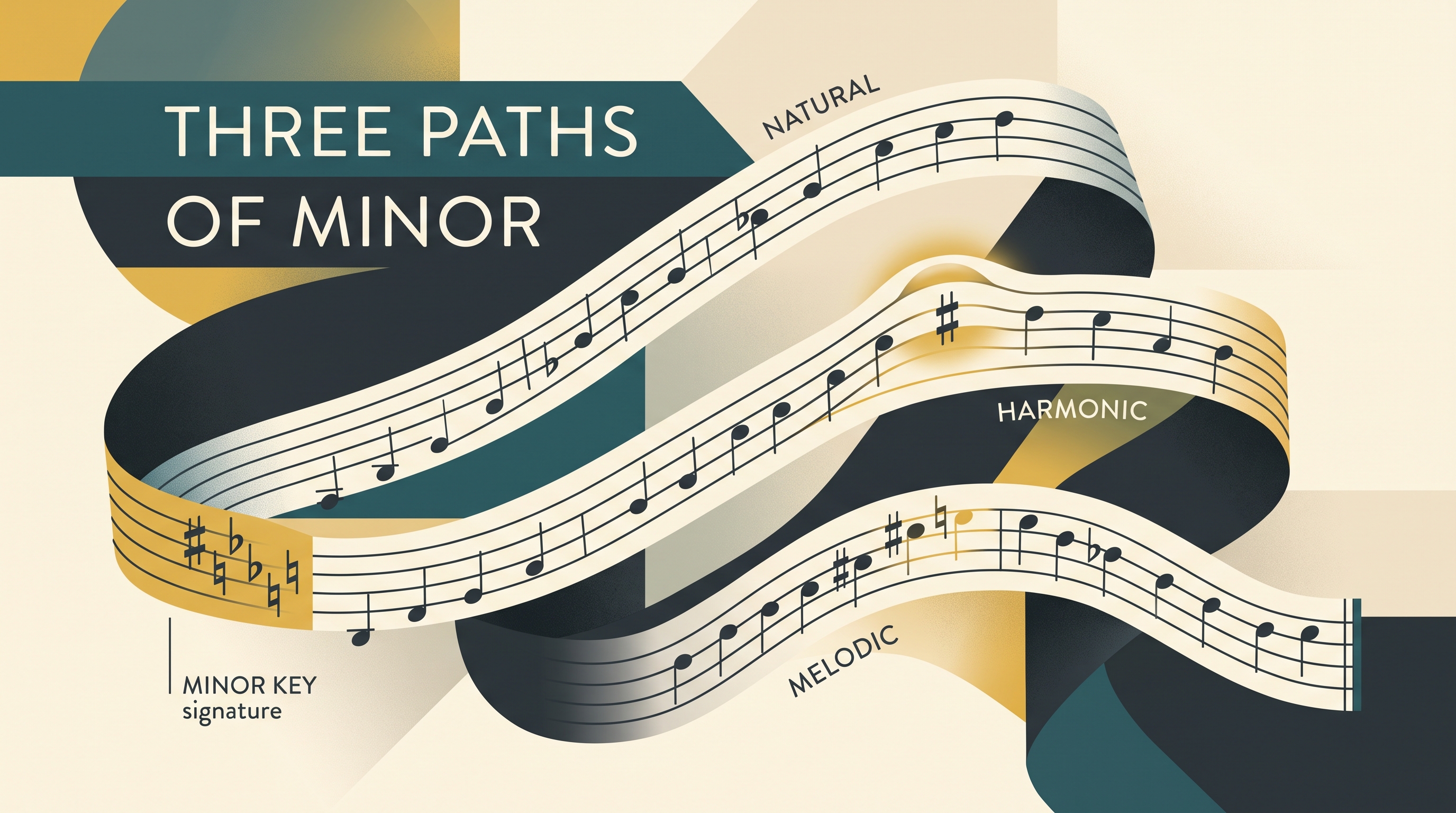
A minor scale is not one fixed staircase of pitches: it can change its upper degrees depending on whether the music needs a darker color, a stronger pull toward the tonic, or a smoother melodic line. The three forms—natural minor, harmonic minor, and melodic minor—are altered forms of the natural minor scale.
PIT-1.G: Identify forms of the minor scale, including natural, harmonic, and melodic forms, in performed music and notated music.
The basic pitch staircase
A scale is an ordered collection of pitches arranged by specific patterns of half steps and whole steps. A major or minor scale presents pitches successively, either ascending or descending, and gives the listener a tonal “map.” The pattern determines the sound more precisely than the note names alone.
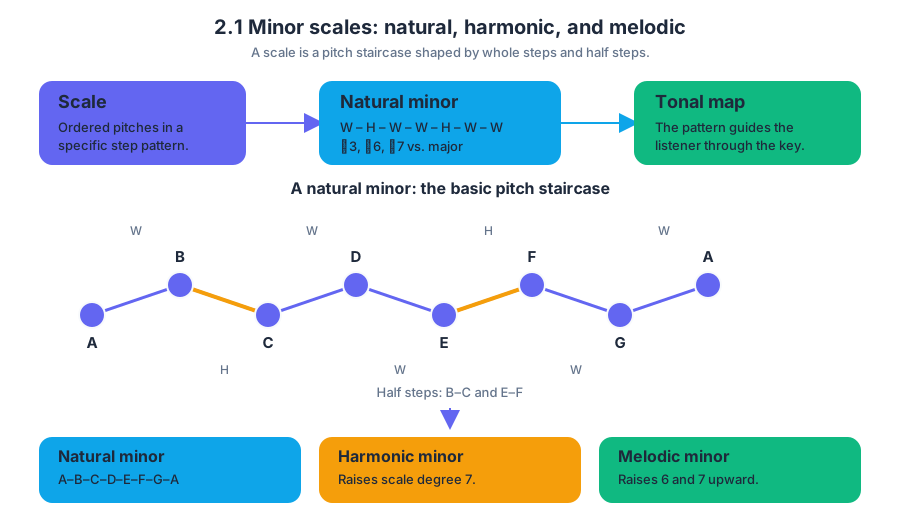
For a natural minor scale, the scale degrees follow this pattern:
$$ \text{whole} - \text{half} - \text{whole} - \text{whole} - \text{half} - \text{whole} - \text{whole} $$
In scale-degree notation, natural minor has lowered scale degrees $\hat{3}$, $\hat{6}$, and $\hat{7}$ when compared with the parallel major scale. For example, A natural minor uses the same pitch collection as C major:
$$ \text{A - B - C - D - E - F - G - A} $$
The half steps occur between B–C and E–F. Its third scale degree, C, gives the scale its minor quality.
Three forms, one minor tonic
The forms of minor are best understood by beginning with natural minor and then identifying which pitches have been chromatically altered.
| Form | Ascending pitch pattern in A minor | Defining alteration | Musical effect |
|---|---|---|---|
| Natural minor | A–B–C–D–E–F–G–A | No alteration | Dark, stable minor collection |
| Harmonic minor | A–B–C–D–E–F–G$\sharp$–A | Raised $\hat{7}$ | Strong leading-tone pull to A |
| Melodic minor, ascending | A–B–C–D–E–F$\sharp$–G$\sharp$–A | Raised $\hat{6}$ and $\hat{7}$ | Smoother ascent toward the tonic |
| Melodic minor, descending | A–G–F–E–D–C–B–A | Returns to natural minor | Familiar minor descent |
The harmonic minor scale raises scale degree $\hat{7}$ by a half step. In A minor, G becomes G$\sharp$. This creates the leading tone, which lies a half step below the tonic A and strongly directs the ear upward:
$$ \text{G}\sharp \rightarrow \text{A} $$
The distance from F to G$\sharp$ is an augmented second, a larger-than-usual melodic leap. That distinctive sound often signals harmonic minor in performed or notated music.
The melodic minor scale raises both $\hat{6}$ and $\hat{7}$ when ascending. In A minor, F becomes F$\sharp$ and G becomes G$\sharp$:
$$ \text{A - B - C - D - E - F}\sharp\text{ - G}\sharp\text{ - A} $$
The raised sixth removes the augmented second between F and G$\sharp$, making the ascent more stepwise. In the conventional form, the descending scale returns to natural minor. A passage does not have to play every scale degree in order; a few altered pitches can still reveal the minor-scale form.
Notation: key signature versus chromatic alteration
A key signature indicates the default pitches associated with a key on the staff. It does not permanently prevent other pitches from appearing. Harmonic and melodic minor forms usually require accidentals—such as $\sharp$, $\flat$, or $\natural$—because their raised scale degrees are chromatic alterations of the natural-minor collection.
For example, a melody in A minor has no sharps or flats in its key signature. If the melody uses G$\sharp$ to create a leading tone, the sharp must normally be written as an accidental beside the G. If it ascends through F$\sharp$ and G$\sharp$, both pitches must be shown as chromatic alterations unless the notation system has already established them within the measure.
Named misconception — “A minor has no sharps.”
A minor has no sharps or flats in its key signature, but music in A minor may still use G$\sharp$, F$\sharp$, or other accidentals. Confusing the key signature with the complete set of pitches used in a passage is one of the fastest ways to misidentify harmonic or melodic minor.
Minor scales and modes
Modes are also ordered pitch collections, but they are not simply interchangeable names for major and minor scales. Ionian corresponds to the major scale, while Aeolian corresponds to natural minor. Other modes, including Locrian, have their own characteristic scale-degree patterns and tonal behavior. Locrian is especially unstable because its tonic triad contains a diminished fifth.
When analyzing tonality, ask two separate questions: What is the tonic? and Which pitches surround it? A passage centered on A may use natural minor, harmonic minor, melodic minor, or even a modal collection. The presence of a raised $\hat{7}$ strongly supports a leading-tone function, but the entire melodic and harmonic context determines the most convincing interpretation.
Worked example: identifying the form
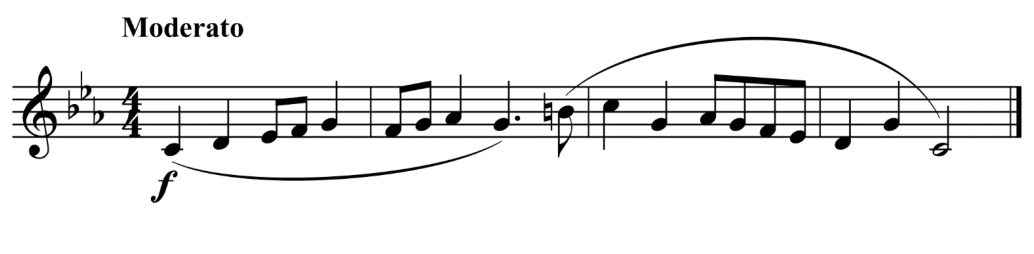
Consider the ascending passage:
The tonic is A, and the passage contains raised $\hat{6}$, F$\sharp$, and raised $\hat{7}$, G$\sharp$. Because both degrees are raised in the ascending direction, the passage uses the ascending form of melodic minor. If the same passage contained F natural but G$\sharp$, it would be harmonic minor. If it contained F natural and G natural, it would be natural minor.
Skill connection and retrieval check
This topic develops Skill 1: Analyze Performed Music by asking you to hear the raised leading tone or the characteristic augmented second in a melody. It develops Skill 2: Analyze Notated Music by requiring you to read the key signature, inspect accidentals, and identify the resulting pitch pattern. The same terminology applies to both heard and written music, supporting musical expression across genres, media, and styles.
Retrieval check: A melody centered on E contains C natural, D natural, and D$\sharp$, but no alteration to scale degree $\hat{6}$. Which minor form is most strongly indicated, and why?
Answer: Harmonic minor. In E minor, D is scale degree $\hat{7}$; raising it to D$\sharp$ creates the leading tone E. Because C remains natural, the passage does not show the raised $\hat{6}$ characteristic of ascending melodic minor.
Source Materials
- Learn More (.pdf)
- AP Music Theory Course and Exam Description
- AP Music Theory Course Overview
- AP Music Theory Course at a Glance
- AP Music Theory Course at a Glance Poster
- Adopt AP Music Theory
- AP Music Theory
- AP Music Theory
- Figure — Music, Sight Singing Question 1 Transcript (p. 1)
- AP Music Theory-AP Students-College Board
- AP Music Theory-Unit Study Guides
- AP Music Theory-Raidar Choir