From the free course AP Music Theory on Lykke
1.10 Dynamics and articulation
Key concepts: Dynamics · Articulation · Tempo · Tempo markings · Moderato · Forte (f) · Relative speed of music · Dynamic level · Sight-singing performance assessment · Musical notation stimulus
A melody can have the correct notes and rhythm yet still sound musically incomplete if it ignores dynamics and articulation. Dynamics shape loudness; articulation shapes how one sound connects to the next.
1.10 Dynamics and articulation
A melody can have the correct notes and rhythm yet still sound musically incomplete if it ignores dynamics and articulation. Dynamics shape loudness; articulation shapes how one sound connects to the next. Together with the already-established pulse, these markings turn notation into an intentional performance.
Dynamics indicate the intended level of loudness or softness. Articulation indicates how individual notes are attacked, connected, separated, or sustained.
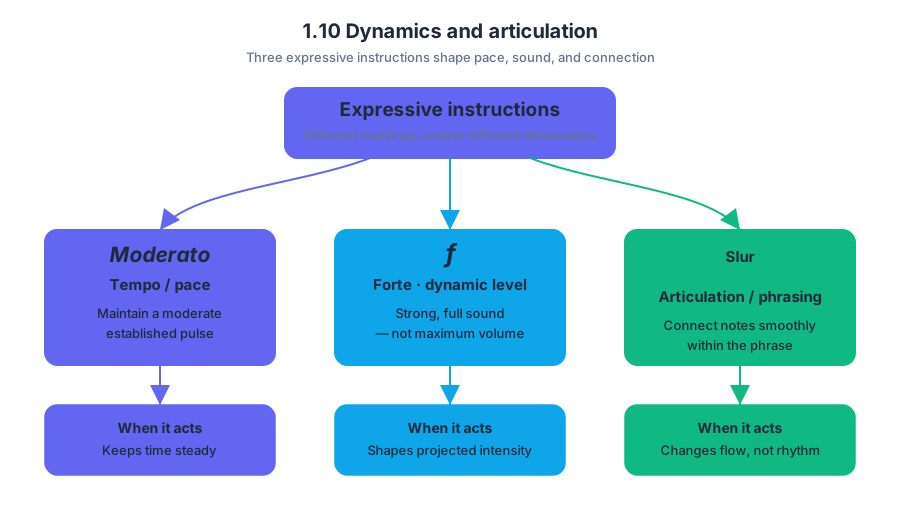
The three expressive instructions
The most important markings in this topic work on different musical dimensions:
| Marking | What it controls | Application |
|---|---|---|
| Moderato | The established tempo or pace | Maintain the previously determined moderate pulse |
| $f$, or forte | Dynamic level | Perform with a strong, full sound |
| Slur | Articulation and phrasing | Connect notes smoothly within the marked phrase |
A dynamic marking communicates the composer’s intended dynamic level. The symbol $f$ is the abbreviation for forte, meaning loud or strong. Forte does not mean “as loud as physically possible”; it means that the passage should project at a strong dynamic level appropriate to its register, instrument, ensemble, and musical context.
A slur is a curved line connecting several notes. In a vocal melody, it generally calls for legato articulation: the notes should flow smoothly, without unnecessary breaks between them. A slur is not a symbol that changes the written rhythm; it changes the manner in which the rhythm is performed.
Worked example: applying all three markings
Consider a four-measure sight-singing melody written on one treble-clef staff. It is in $4/4$ time, has a key signature indicating D major, begins and ends on D, and carries the markings Moderato and $f$. Two long phrasing slurs span measures $1$–$2$ and measures $3$–$4$.
Apply the markings in a deliberate order:
- Secure the notation first. Perform the written pitches and rhythms accurately; expressive choices cannot repair incorrect notes or durations.
- Establish the existing Moderato pulse. Keep the previously determined steady pace rather than allowing the forte marking to make the performance rush.
- Add forte. Use a clear, energized sound from the beginning, while keeping the tone controlled.
- Shape the slurs. Connect the notes in measures $1$–$2$ as one smooth phrase, then do the same for measures $3$–$4$.
- Preserve the written rhythm. Legato does not mean stretching notes or erasing the distinction between quarter notes and eighth notes.
The result should sound like one confident, flowing melody in two phrase units: strong in dynamic level, steady in pulse, and connected in articulation.
A common performance mistake
Misconception: forte means “sing loudly everywhere, regardless of control.” Forte describes a dynamic level, not a command to force the voice. A strained or shouted performance can obscure pitch and rhythm. The better interpretation is a supported, projecting sound that remains accurate and musically stable.
Misconception: a slur changes the rhythm. It does not. A slur changes the connection between notes, while the notation still determines exactly when each note begins and ends. Conversely, misconception: a slur means every note has identical emphasis is also incorrect; connected notes can still have direction within the phrase.
Reading markings in assessment
This topic is assessed through Analyze Notated Music, especially when a student must interpret expressive symbols in a notation stimulus, and through Analyze Performed Music when the listener identifies how dynamics or articulation operate in sound. The relevant musical-design identifiers include DES-3.A and DES-3.A.1: DES-3.A requires students to identify and apply tempo markings in performed and notated music, while DES-3.A.1 establishes tempo as the relative speed of the beat pulse and includes Moderato among moderate tempo indications.
In a sight-singing stimulus, the notated markings are part of the performance task. The melody is presented on a single treble-clef staff, and the performer must preserve accurate pitch, rhythm, and steady pulse while interpreting $f$ and the phrasing slurs. Regular scoring divides the melody into eight half-measure segments, awarding a point for a segment performed with correct pitch, rhythm, and tempo; a separate flow point rewards a complete response without hesitations or restarts when the required condition is met. Therefore, expressive markings should be integrated without sacrificing the elements that directly establish continuity and accuracy.
Retrieval check
A melody is marked Moderato, $f$, with a slur over two measures. What should change in performance: the pulse, the dynamic level, the articulation, or all three?
Answer: The pulse follows the established Moderato instruction, the dynamic level becomes forte, and the notes within the slur are connected smoothly. The written pitches and rhythms remain unchanged.