From the free course AP Music Theory on Lykke
3.3 Chord inversions and figured bass
Key concepts: Chord inversions · Root position, first inversion, and second inversion · Figured-bass notation · Arabic numerals for chord inversions · Roman-numeral harmonic analysis · Distinguishing chord changes from bass changes · Four-voice realization from figured bass · Chord members appearing in the bass · Major and minor triad notation · Harmonic function in performed and notated progressions
A chord’s identity and its lowest note are related but not identical: when the bass changes, the harmony may change—or the same harmony may simply appear in a different inversion.
3.3 Chord inversions and figured bass
A chord’s identity and its lowest note are related but not identical: when the bass changes, the harmony may change—or the same harmony may simply appear in a different inversion. That distinction is the key to reading figured bass and analyzing a progression accurately.
The bass determines the inversion
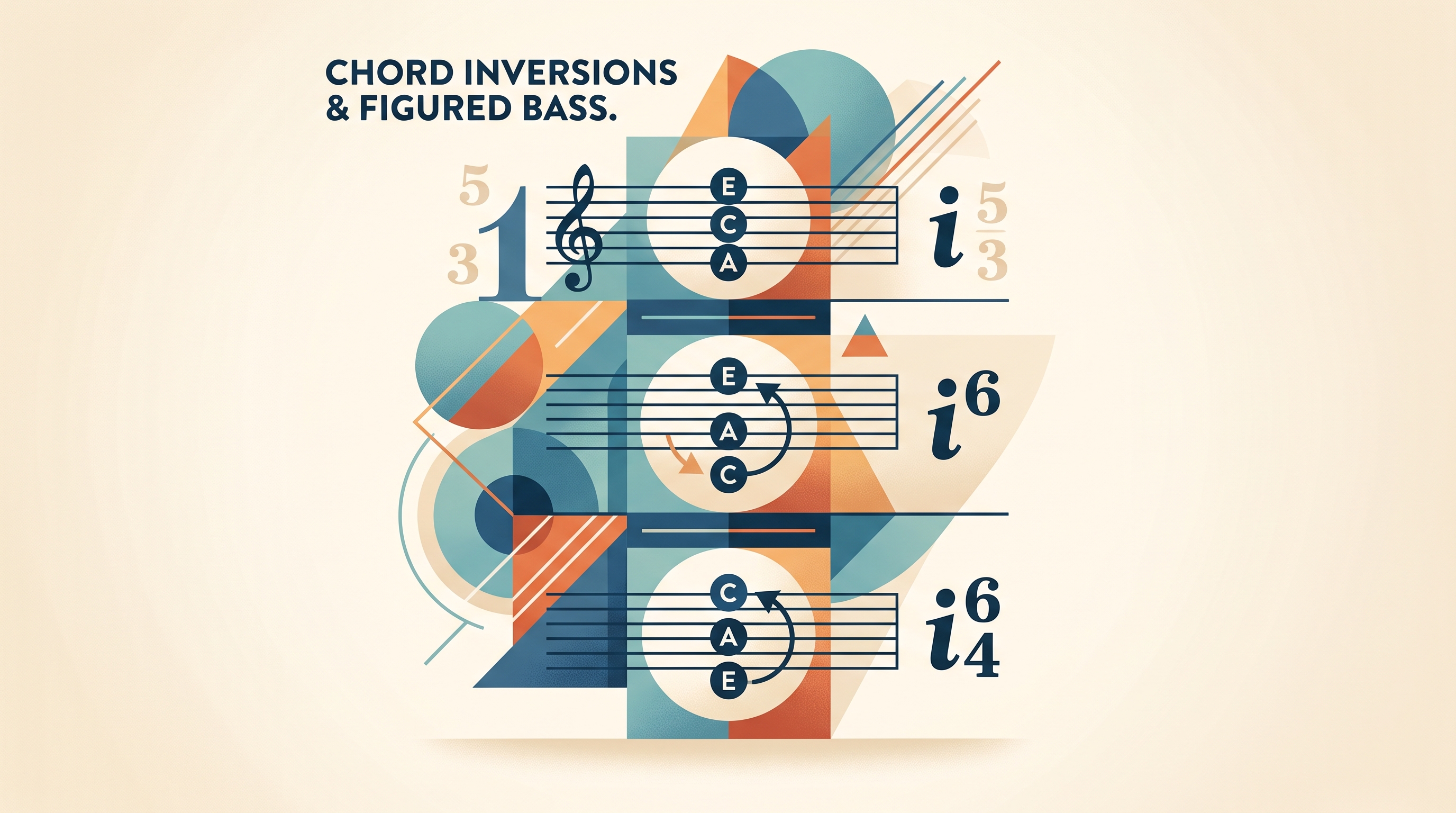
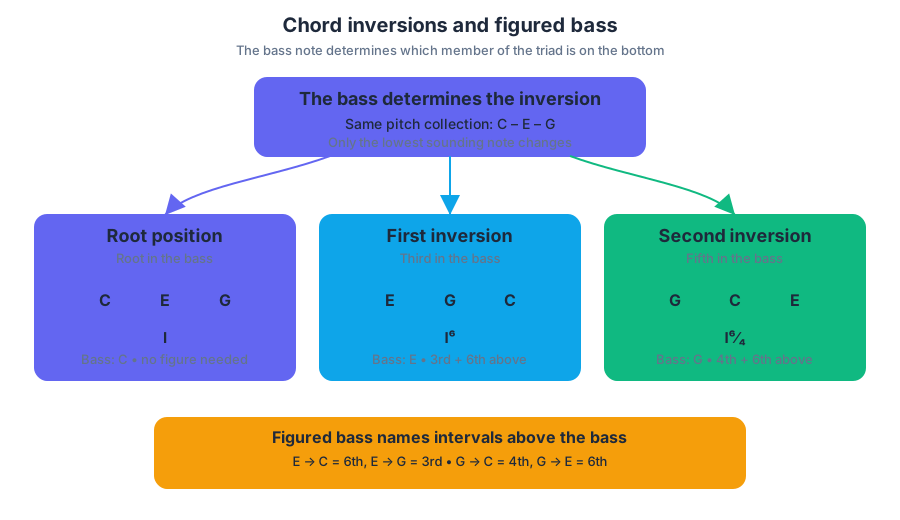
The bass is the lowest sounding part of a chord. A triad is in root position when its root appears in the bass. When another chord member appears in the bass, the chord is inverted: the third in the bass creates first inversion, while the fifth in the bass creates second inversion.
For a C-major triad, the pitch collection is always C–E–G, but its position changes:
| Bass note | Chord position | Roman-numeral figure |
|---|---|---|
| C, the root | Root position | $I$ |
| E, the third | First inversion | $I^6$ |
| G, the fifth | Second inversion | $I^{6/4}$ |
The superscript figures are not arbitrary labels. They describe the intervals formed above the bass. With E in the bass, C is a sixth above E and G is a third above E, producing the conventional first-inversion label $I^6$. With G in the bass, C is a fourth above G and E is a sixth above G, producing $I^{6/4}$.
Essential Knowledge PIT-2.A.2: When a chord member other than the root appears in the bass, chord inversions result. The third in the bass indicates first inversion; the fifth in the bass indicates second inversion.
Figured bass as interval shorthand
Figured bass is an eighteenth-century shorthand system in which Arabic numerals indicate intervals to be supplied above a given bass note. The bass line provides the bottom voice; the figures identify the remaining pitches or, more broadly, imply the harmony to be realized above it.
In a four-voice realization, the task is therefore not to stack a chord mechanically above every bass note. First identify the implied harmony, determine its inversion, and then supply soprano, alto, and tenor parts with correct chord spelling, spacing, doubling, and voice leading.
For example, in a major key, a bass note belonging to scale degree $3$ with the figure $6$ may imply a first-inversion tonic triad, $I^6$. The bass is the tonic triad’s third; the other voices must provide the root and fifth, with one chord member doubled when appropriate.
Roman numerals plus inversion figures
Use the Roman-numeral conventions established earlier, then add the inversion figure to show which chord member is in the bass. Uppercase and lowercase still communicate triad quality, while the Arabic figure communicates arrangement above the bass. Thus $V^6$ means a major dominant triad in first inversion, not a new scale-degree chord.
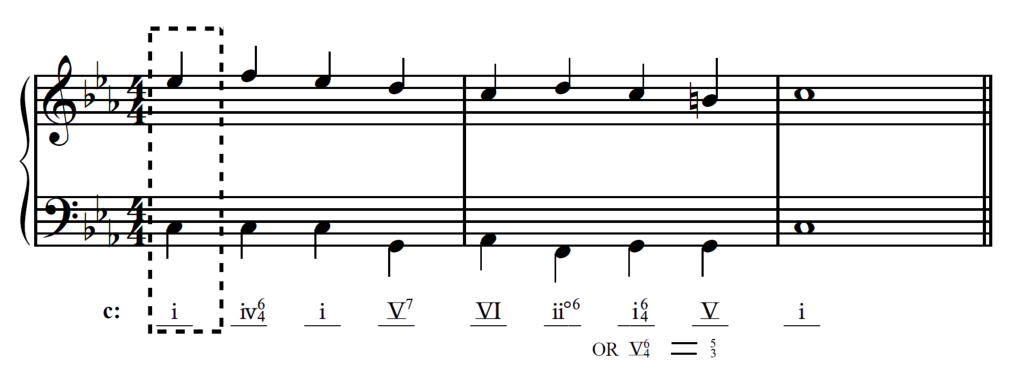
The same distinction applies in minor keys. A minor tonic triad in first inversion is written $i^6$; a diminished supertonic triad in first inversion is written $ii^{\circ6}$ or, in some analytical conventions, $ii^{\circ6}$ with the figure placed beside the Roman numeral. The essential question remains: Which chord member is in the bass?
Worked progression: chord change or bass change?
Consider the progression:
$$I ;-; I^6 ;-; IV ;-; V ;-; V^6 ;-; I$$
Read it in C major:
- $I$: C–E–G, with C in the bass.
- $I^6$: C–E–G, but E is now in the bass.
- $IV$: F–A–C, with F in the bass.
- $V$: G–B–D, with G in the bass.
- $V^6$: G–B–D, but B is now in the bass.
- $I$: C–E–G, with C in the bass.
The changes from $I$ to $I^6$ and from $V$ to $V^6$ are bass changes without chord changes: the pitch collection and harmonic identity remain constant while the lowest chord member changes. The move from $I^6$ to $IV$, however, is an actual chord change because the harmony changes from C–E–G to F–A–C.
Misconception check
Misconception: “Every new bass note creates a new Roman numeral.” Not necessarily. If the upper voices and pitch collection still belong to the same triad, label the same harmony with a new inversion figure. Conversely, a bass note can remain unchanged while the upper voices change enough to create a new chord.
Retrieval check
A triad contains the pitches A–C–E, and C is in the bass. Is the chord in root position, first inversion, or second inversion? What figure should accompany its Roman numeral?
Answer: C is the third of the A-minor triad, so the chord is in first inversion: $i^6$ if it functions as tonic in A minor.
Learning Objective PIT-2.A: Identify chords in performed and notated music by combining the Roman numeral for scale-degree root and quality with the Arabic inversion figure for the bass arrangement. Learning Objective PIT-2.B: Use Roman numerals to indicate the harmonic progression implied by figured bass. Essential Knowledge PIT-2.B.1: Figures denote intervals above the bass and therefore imply harmonies that can receive Roman-numeral labels. Essential Knowledge PIT-2.B.2: An accidental or altered figure changes the indicated pitch above the bass; interpret it before assigning the harmonic label.
Source Materials
- Learn More (.pdf)
- AP Music Theory Course and Exam Description
- AP Music Theory Course Overview
- AP Music Theory Course at a Glance
- AP Music Theory Course at a Glance Poster
- Adopt AP Music Theory
- AP Music Theory
- AP Music Theory
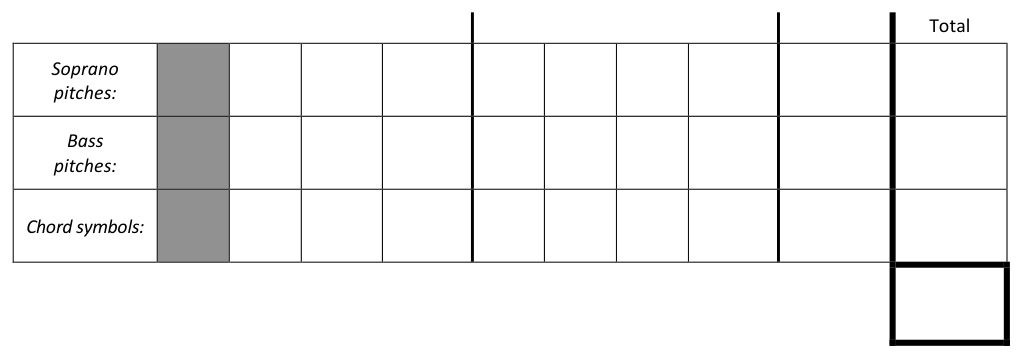
- Total
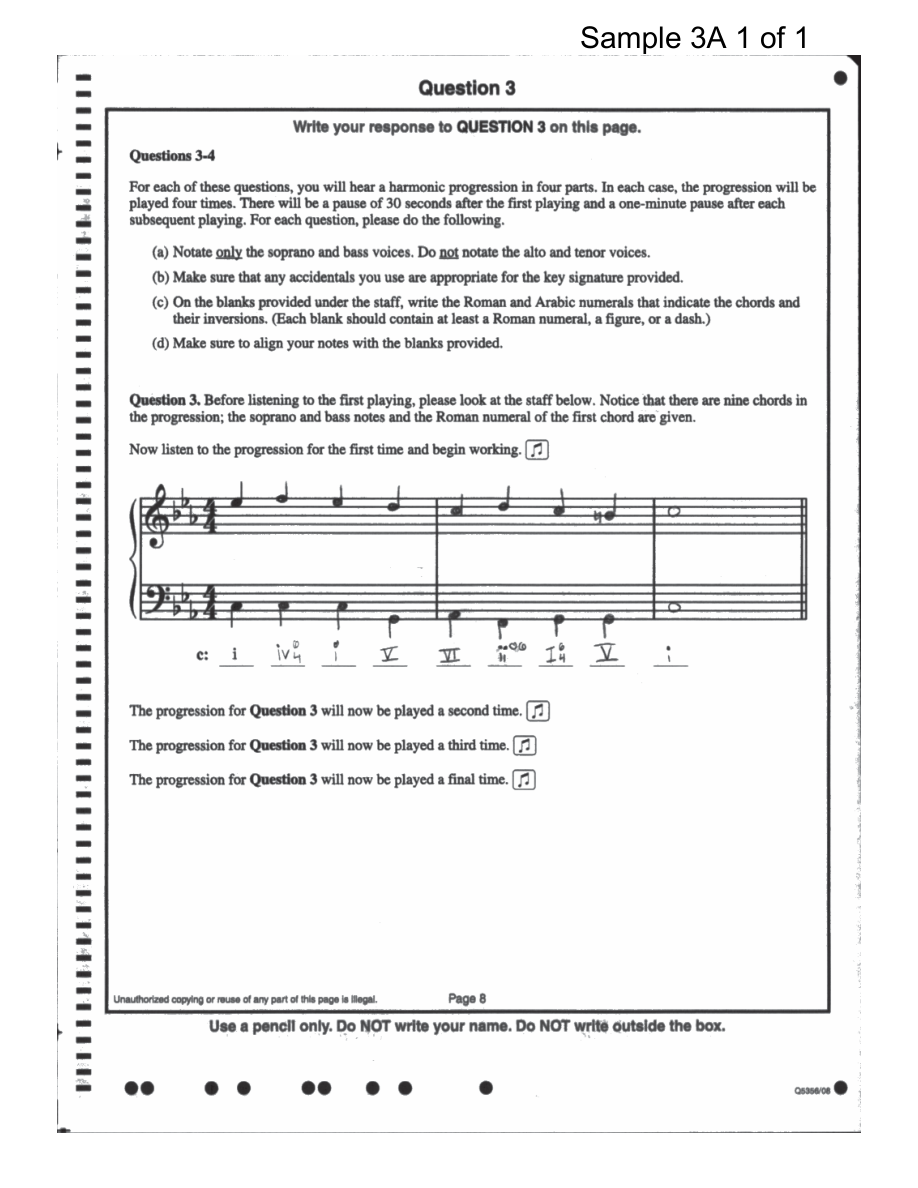
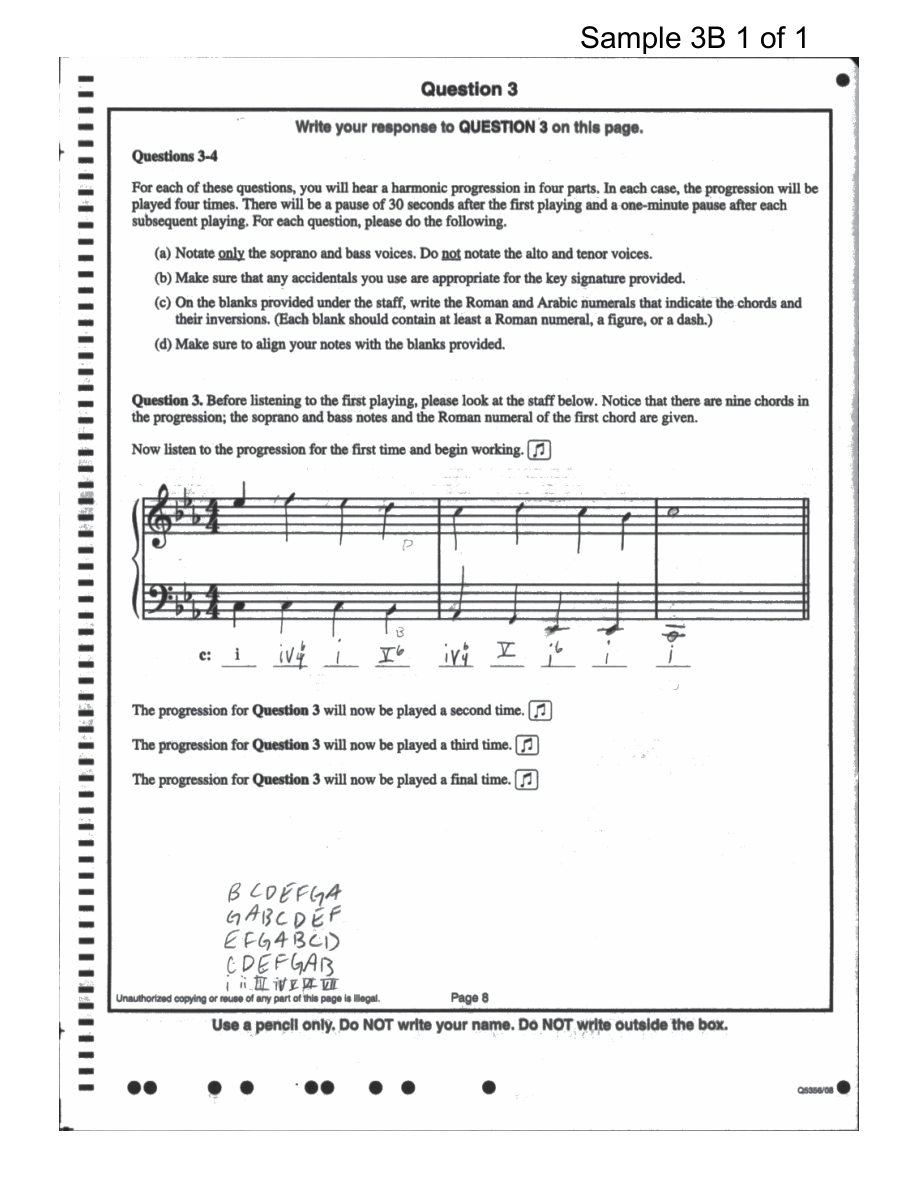
- Figure — Sample Responses Q3 (p. 3)
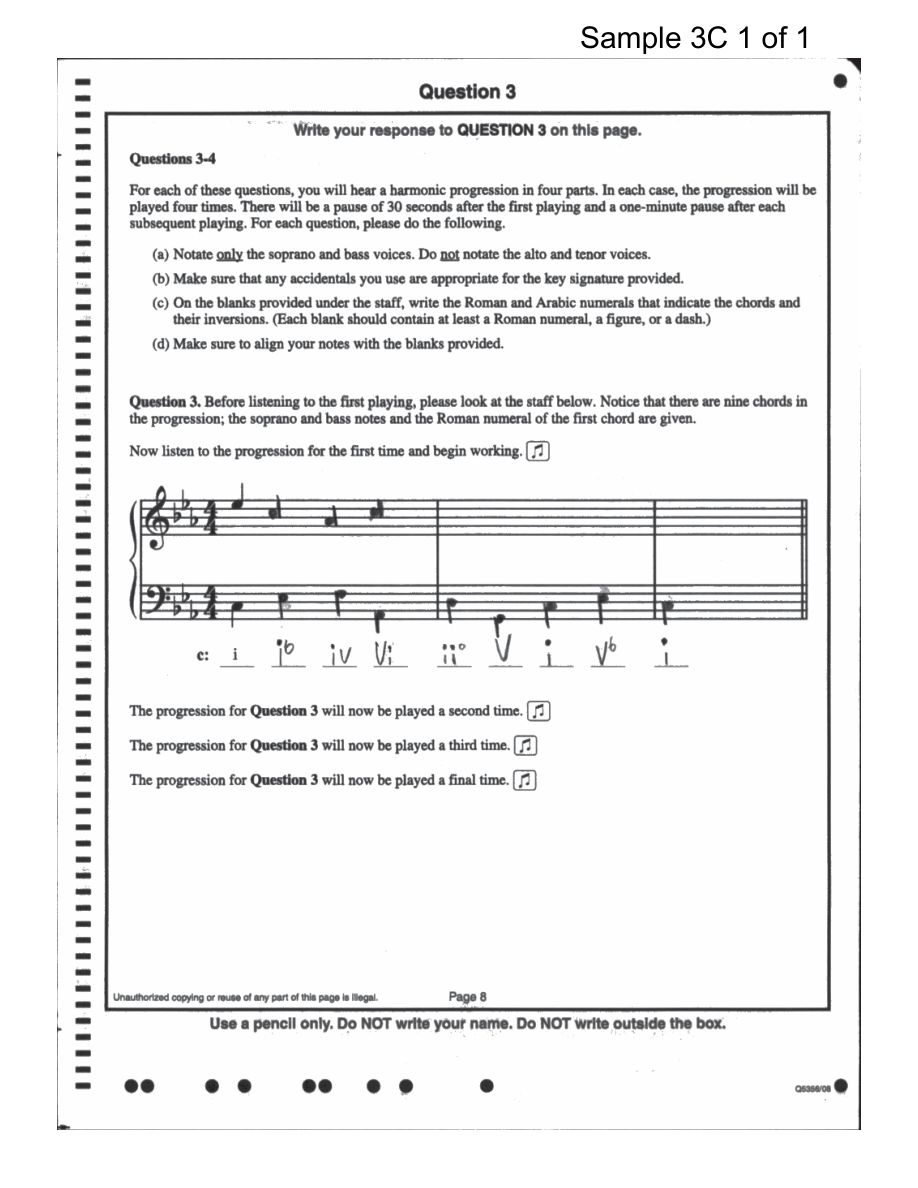
- Figure — Sample Responses Q3 (p. 4)
- Figure — Sample Responses Q3 (p. 5)