From the free course AP Music Theory on Lykke
2.12 Texture devices
Key concepts: Texture devices · Rhythm · Musical design
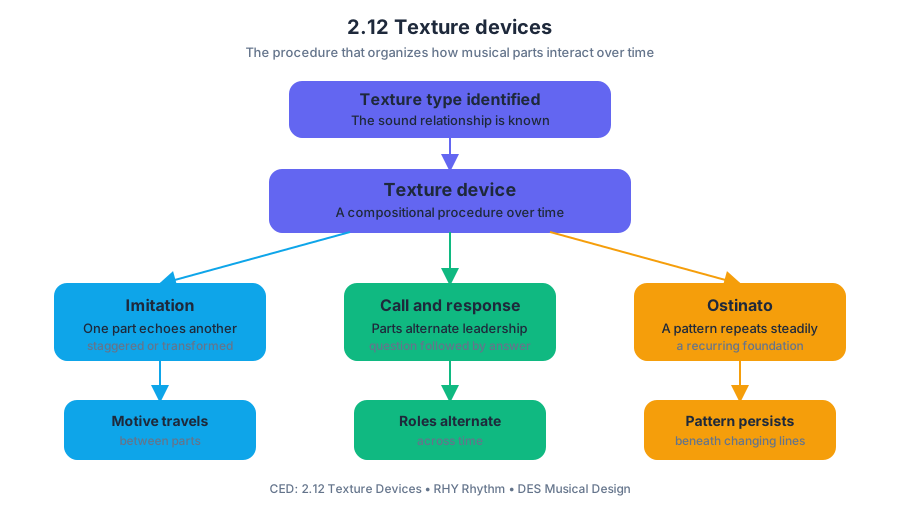
A texture device is a compositional procedure that organizes how musical parts interact over time. Building on the texture type already identified, the device names the procedure organizing the parts—such as imitation, call and response, or ostinato.
2.12 Texture devices
A texture device is a compositional procedure that organizes how musical parts interact over time. Building on the texture type already identified, the device names the procedure organizing the parts—such as imitation, call and response, or ostinato.
CED identifiers: Topic 2.12 Texture Devices; Big Ideas RHY — Rhythm and DES — Musical Design.
Imitation: one part follows another
Imitation occurs when one voice or instrument presents a musical idea and another part repeats it, usually at a different pitch or after a short delay. The repeated idea may be exact, or it may be adjusted to fit the key, mode, or harmony.
Imagine one person saying, “Where are you?” and another answering with the same contour a moment later. In music, the second part does not merely add another independent line: it refers directly to the first part.
Worked example
- Melody 1: $C-D-E-G$
- Melody 2 enters one beat later: $C-D-E-G$
The second entrance imitates the first. If Melody 2 instead begins on $G$ and preserves the same interval pattern—whole step, whole step, minor third—it is still imitation, even though the pitches have shifted.
Imitation may be:
- Exact, preserving pitches and rhythm.
- Transposed, preserving the interval pattern at another starting pitch.
- Rhythmic, preserving the rhythm while changing the pitches.
- Partial, repeating only a recognizable fragment.
The important evidence is the relationship between entrances: listen or look for the same contour, rhythm, motive, or interval pattern returning in another part.
Call and response
Call and response divides musical activity into two roles. One part presents a phrase—the call—and another part answers with a contrasting or complementary phrase—the response.
The response need not copy the call. It may use different pitches, a different rhythm, or a different register while still sounding like a reply. A call may create expectation through an open ending, and the response may provide completion through a stronger cadence.
For example:
- Call: a soprano phrase rises and ends on scale degree $2$.
- Response: an alto or instrumental group enters with a descending phrase that ends on scale degree $1$.
The musical design is dialogic: the listener hears an exchange rather than simultaneous imitation. In performed music, changes in timbre, register, dynamics, or articulation can make the two roles especially clear.
Ostinato
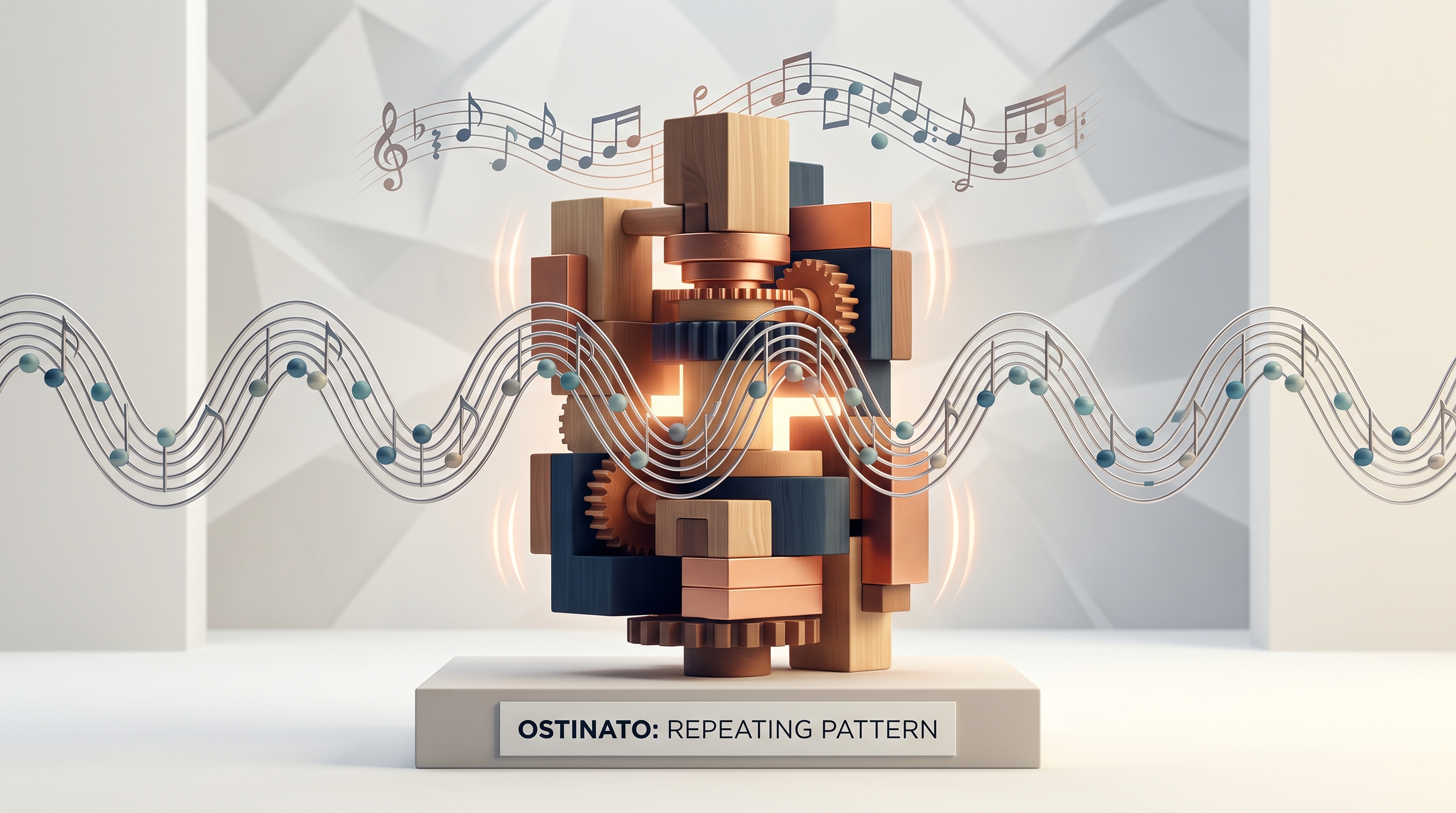
An ostinato is a short musical pattern that repeats persistently while other material changes around it. The pattern may be melodic, rhythmic, harmonic, or a combination of these.
Worked contextual example
Suppose a bass instrument repeats the two-measure pattern
$$ \text{C-G-C-G} \mid \text{C-G-C-G} $$
with the same rhythm throughout a passage. Above it, the melody changes from phrase to phrase. The bass pattern is an ostinato because its repeated identity remains stable while the surrounding musical design develops.
An ostinato can act like a musical floor: it provides continuity, pulse, and identity. Its RHY role may be especially strong when the repeated element is a distinctive rhythmic cell. Its DES role becomes clear when contrasting melodies, harmonies, or timbres are layered over that stable pattern.
An ostinato is not simply “any repeated note.” The repeated material must function as a recognizable pattern. A single pitch held continuously is better described as a drone; a recurring multi-note or rhythmic figure is an ostinato.
Recognizing devices in notation and sound
The four AP skill categories give different routes to the same musical conclusion:
- Skill 1: Analyze performed music — identify entrances, repetition, contrast, and recurring patterns by listening.
- Skill 2: Analyze notated music — compare motives, rhythms, phrase endings, and repeated figures in a score.
- Skill 3: Convert between performed and notated music — hear an ostinato or imitation and represent its recurring pattern accurately.
- Skill 4: Complete based on cues — continue a passage by preserving the established device, such as repeating an ostinato or answering a call.
Named misconception check: A device is not defined only by how many parts are present. Two parts can create imitation, call and response, or an ostinato-plus-melody design. The question is not “How many voices do I hear?” but “What procedure governs their interaction?”
Retrieval check
A short rhythmic pattern repeats in the percussion while the melody changes above it. Is the repeated pattern most likely imitation, call and response, or ostinato? What specific musical evidence supports your answer?