From the free course AP Music Theory on Lykke
2.5 Interval size and quality
Key concepts: Interval size · Interval quality · Intervals in performed music · Intervals in notated music · Pitch as a feature of performed music · Melodic intervals (successive pitches) · Harmonic intervals (simultaneous pitches) · Pitch and intervals as elements of musical expression
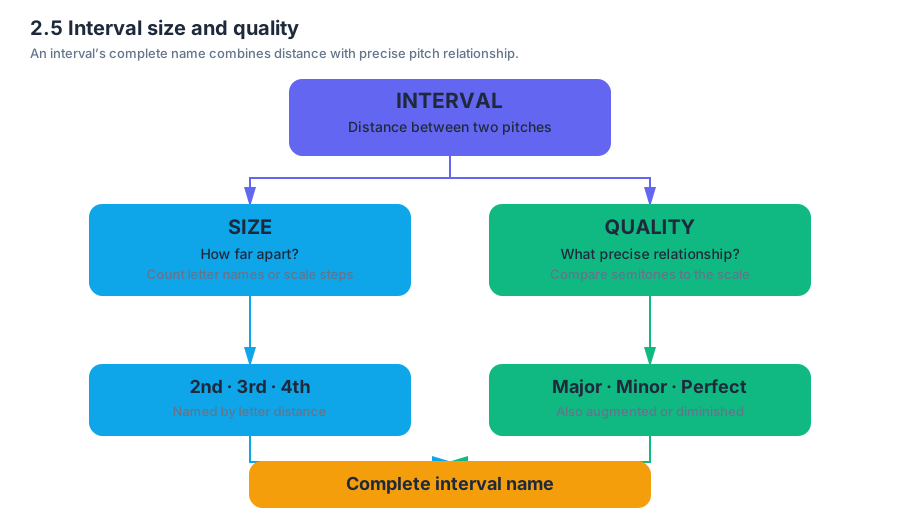
An interval is the distance between two pitches, and a complete interval name tells you both how far apart the pitches are and what precise pitch relationship they form.
2.5 Interval size and quality
An interval is the distance between two pitches, and a complete interval name tells you both how far apart the pitches are and what precise pitch relationship they form.
Learning Objective PIT-1.L: Describe the size and quality of an interval in performed music and notated music.
The two-part name: size + quality
Interval size counts the letter names from the first pitch to the second, inclusively. A pitch followed by the same letter name is a unison or prime; adjacent letter names form a second; continuing upward produces thirds, fourths, fifths, sixths, sevenths, and octaves.
Interval quality gives the interval’s exact sound and spelling. The principal quality labels are major, minor, perfect, diminished, and augmented. Thus, “second” alone is incomplete: $C$ to $D$ is a major second, while $C$ to $D\flat$ is a minor second.
| Part of name | Question it answers | Example |
|---|---|---|
| Size | How many letter names are included? | $C$–$G$ is a fifth |
| Quality | How many semitones and what spelling does it contain? | $C$–$G$ is a perfect fifth |
| Complete name | What is the interval exactly? | perfect fifth |
The labels perfect normally apply to unisons, fourths, fifths, and octaves. Seconds, thirds, sixths, and sevenths are normally major or minor. Either family can become diminished or augmented when accidentals alter the expected distance.
Worked example: naming a notated interval
Suppose the lower note is $D$ and the upper note is $G\sharp$.
- Count letter names: $D$–$E$–$F$–$G$ gives four, so the size is a fourth.
- Compare the pitch distance with the usual perfect fourth. $D$ to $G$ is a perfect fourth; raising $G$ to $G\sharp$ widens it by a half step.
- The result is an augmented fourth.
Now respell the upper pitch as $A\flat$. The sound remains the same on an equal-tempered instrument, but $D$–$A\flat$ counts five letter names and is therefore a diminished fifth. These are enharmonic equivalents: intervals that sound identical but are spelled differently.
PIT-1.L.1: Intervals are identified by distance and quality. Spelling matters, even when two intervals sound the same.
Misconception check — “Same sound means same interval.” Not in notation. $D$–$G\sharp$ and $D$–$A\flat$ may have the same sounding pitch distance, but their sizes are fourth and fifth, respectively. The written letter names determine interval size; the pitch content determines quality.
Performed music: hear the interval’s behavior
In performed music, pitch is heard rather than read. Pitch—the perceived highness or lowness associated with a specific sound frequency—is a basic unit of musical expression across genres, media, and styles. Listening for the distance between pitches helps identify melodic contour, harmonic tension, and expressive character.
Pitches sounding successively create a melodic interval. If a singer moves from $C$ up to $E$, the listener hears a major third unfolding through time. Pitches sounding simultaneously create a harmonic interval; if $C$ and $E$ sound together, the same pitch relationship is heard vertically.
The analysis procedure is the same in both cases: determine the two pitches, estimate or calculate their distance, and identify the quality. The difference is temporal: melodic intervals are successive, while harmonic intervals are simultaneous.
Stability and expression
Some intervals are experienced as relatively stable, or consonant; others are relatively unstable, or dissonant. A consonant interval has no inherent need to move elsewhere, whereas a dissonant interval has a natural inclination to resolve toward a more stable sound. For example, a harmonic diminished fifth may resolve inward to a third.
PIT-1.L.3: Consonance describes inherent stability; dissonance describes inherent instability and a tendency toward resolution.
This does not mean that a dissonance is an error or that a consonance must remain still. Composers and performers use interval quality, register, context, articulation, and dynamics to create expectation, motion, brightness, tension, intimacy, or release.
The same skill in sound and notation
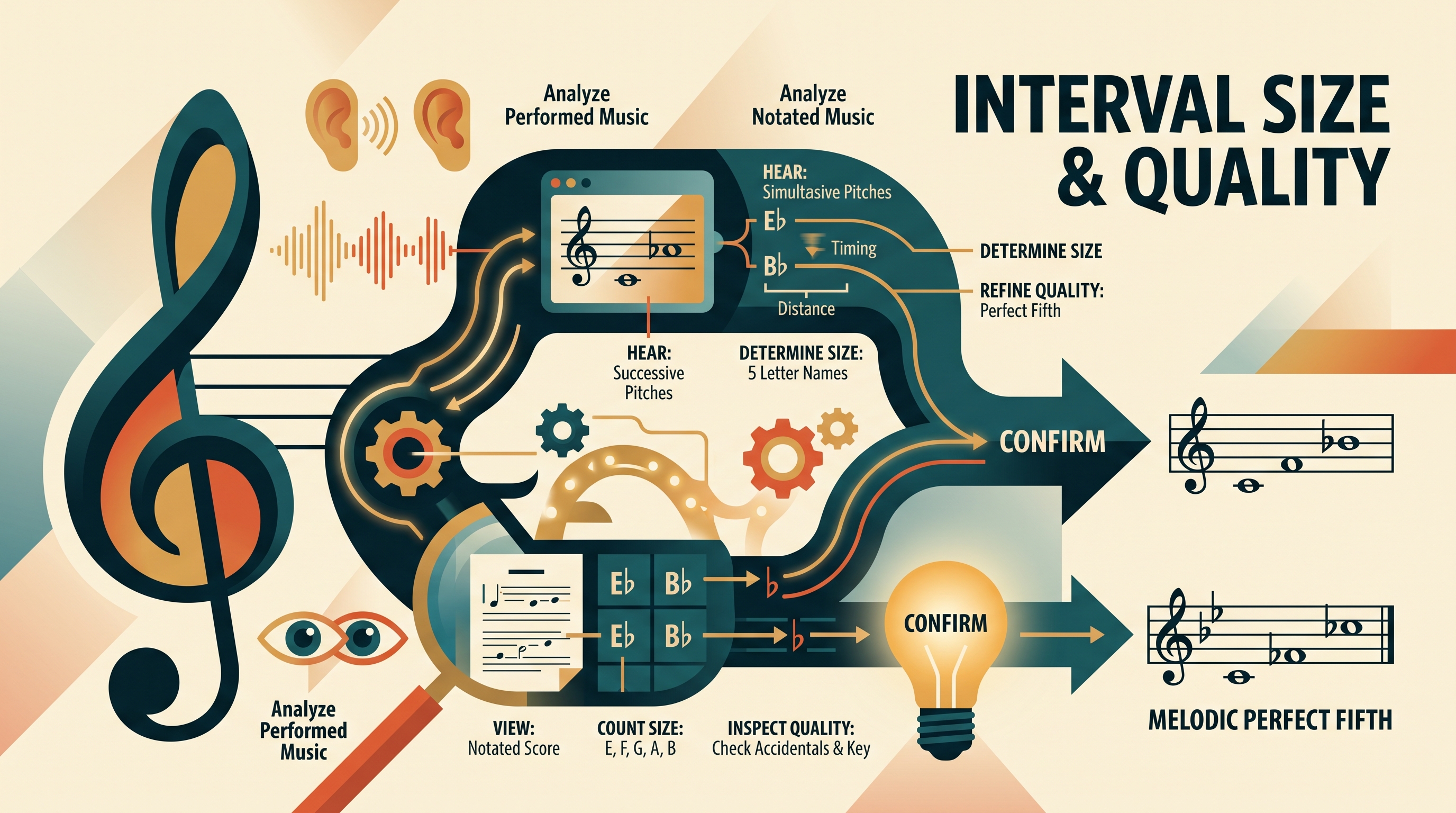
Skill 1: Analyze Performed Music asks you to extract interval information from what you hear. Track whether pitches occur melodically or harmonically, identify their relative pitch distance, and use tonal context to refine the quality.
Skill 2: Analyze Notated Music asks you to apply the same reasoning to a score. Count letter names first, then inspect accidentals and the key signature to determine quality. Do not rely only on the visual width of the notes on the staff.
PIT-1.L.2: Harmonic intervals contain simultaneous pitches; melodic intervals contain successive pitches.
Retrieval check: A melody moves from $E\flat$ to $B\flat$ one after the other. Is the interval melodic or harmonic? What is its size and quality? The answer is a melodic perfect fifth: the pitches are successive, and $E\flat$ through $B\flat$ spans five letter names with the perfect-fifth distance.