From the free course AP Music Theory on Lykke
2.9 Melodic features
Key concepts: Melodic features · Features of melody · Motives · Timbre · Texture · Meter · Treble clef · Bass clef · Musical fluency
A melody becomes recognizable not from its pitches alone, but from the way those pitches move, repeat, and occupy musical time. The same sequence of notes can sound completely different when performed by a different voice or instrument, placed in a new texture, or reorganized by the meter.
2.9 Melodic features
A melody becomes recognizable not from its pitches alone, but from the way those pitches move, repeat, and occupy musical time. The same sequence of notes can sound completely different when performed by a different voice or instrument, placed in a new texture, or reorganized by the meter.
Investigative question: What makes a short stream of notes sound like a coherent musical idea rather than a random collection of pitches?
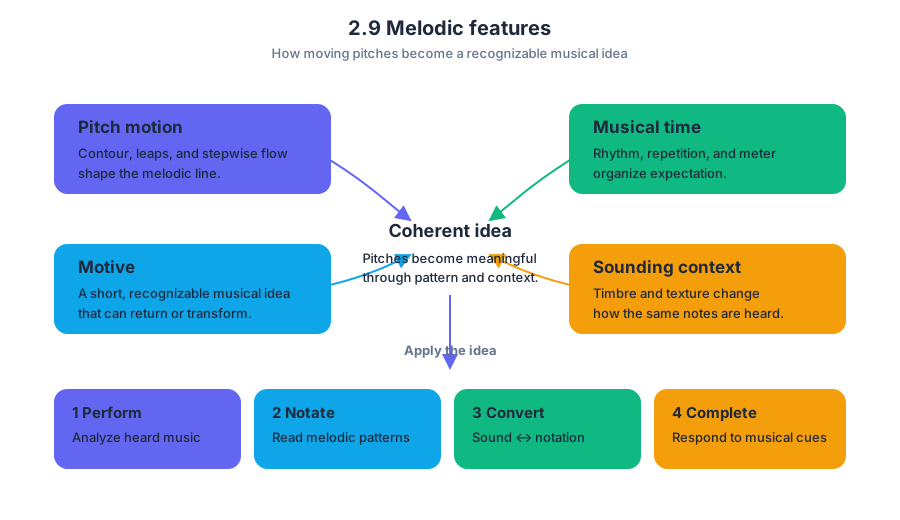
Topic 2.9: Melodic features connects the shape of a melody with the conditions in which listeners encounter it. You will examine features of melody, identify motives—short, recognizable musical ideas—and interpret those ideas alongside timbre, texture, and meter. The CED skill emphasis is especially practical: Skill 1: Analyze performed music, Skill 2: Analyze notated music, Skill 3: Convert between performed and notated music, and Skill 4: Complete based on cues.
Reading the “shape” of a melody
A melody has a contour, or overall pitch shape. It may rise, fall, arch upward and downward, remain fairly level, or alternate between directions. Other useful melodic features include range—the distance between the lowest and highest pitches—along with register, repeated notes, stepwise motion, leaps, and rhythmic repetition.
Consider this notated outline in treble clef:
$$ \text{C4–D4–E4–G4–E4–D4–C4} $$
The melody begins at C4, ascends mostly by step, leaps from E4 to G4, then descends to its starting pitch. Its contour is arch-shaped, its range is a perfect fifth, and its return to C4 creates a strong sense of closure. The leap to G4 is not an isolated fact: it becomes expressive because the surrounding notes approach and leave it by smaller intervals.
A melody’s rhythm is part of its identity as well. Two melodies can use the same pitches but sound unrelated if their note lengths and accents differ. Conversely, a repeated rhythmic pattern can make a melody recognizable even when its pitches change.
Motives: small ideas with large consequences
A motive is a short musical idea—melodic, rhythmic, or both—that can be recognized and reused. A motive may be repeated exactly, moved to a different pitch level, altered rhythmically, fragmented into a smaller portion, or combined with other material.
For example, imagine the opening idea:
$$ \text{G4–A4–B4–A4} $$
If the same contour and rhythm return later as D4–E4–F-sharp4–E4, the pitches have changed, but the listener may still recognize the motive. The important evidence is the pattern of relationships: up by step, up by step, then down by step, supported by the same rhythmic design.
Skill 2: Analyze notated music asks you to locate such repetition in notation. Skill 1: Analyze performed music asks you to hear it when the notation is absent. Skill 3: Convert between performed and notated music operates in both directions: you may hear a motive and represent it with notes, or see a notated pattern and describe how it sounds.
Melody does not exist alone
Timbre and texture change how melodic features are perceived. A melody sung by one voice may be easy to follow as a single line; the same melody played by several instruments may become the prominent strand in a thicker texture. A melody can also move between parts, disappear into accompaniment, or become more noticeable when its timbre contrasts with the surrounding sound.
Meter and clef fluency
Meter organizes beats into recurring patterns of strong and weak accents. When examining a melody, do not analyze its pitches separately from its meter: an identical contour can feel different when accents shift or when the same motive is placed in a different metric position.
Read and perform examples in both treble and bass clefs early and often. Treble clef places middle C below the staff; bass clef places middle C above it. The purpose is not merely faster note naming. Fluency across clefs and meters lets you recognize a motive, follow its contour, and perform its rhythm without stopping to decode every symbol.
Worked interpretation: Suppose a bass-clef melody repeats a three-note descending idea at the beginning of each measure. The repeated notes may form a motive; the consistent placement on the first beat may make it rhythmically prominent; and a contrasting treble-clef line may create a texture in which the bass motive functions as an identifying foundation. A complete analysis considers all three layers—melodic pattern, meter, and texture.
Misconception check
Misconception: “A motive must be repeated at exactly the same pitches.”
A motive is identified by its recognizable musical relationships, not necessarily by literal pitch repetition. Transposed or rhythmically adjusted versions can preserve the motive’s identity.
Misconception: “Melodic analysis means naming every interval.”
Interval identification can help, but analysis also requires hearing or seeing contour, range, rhythm, repetition, metric placement, and interaction with timbre and texture.
Retrieval check
A short melody rises by step, leaps upward, repeats its rhythm, and then returns downward to its opening pitch. Name two melodic features, describe its contour, and explain one piece of evidence that could identify a motive. Then ask: would your interpretation change if the idea moved from treble clef and a solo voice into bass clef within a thick instrumental texture?