From the free course AP Music Theory on Lykke
1.9 Tempo
Key concepts: Tempo · Steady tempo · Accurate rhythm · Singing pitches · Performance of given exercises
Tempo is the speed of the underlying beat, but successful performance requires more than starting at the right speed: the beat must remain stable while pitch and rhythm continue accurately.
1.9 Tempo
Tempo is the speed of the underlying beat, but successful performance requires more than starting at the right speed: the beat must remain stable while pitch and rhythm continue accurately. In sight singing, a rushed melody can contain the correct notes and still fail because its rhythmic structure and continuity have been damaged.
Steady tempo means maintaining a consistent beat from beginning to end, without unintended speeding up, slowing down, stopping, or restarting.
The three-part performance target
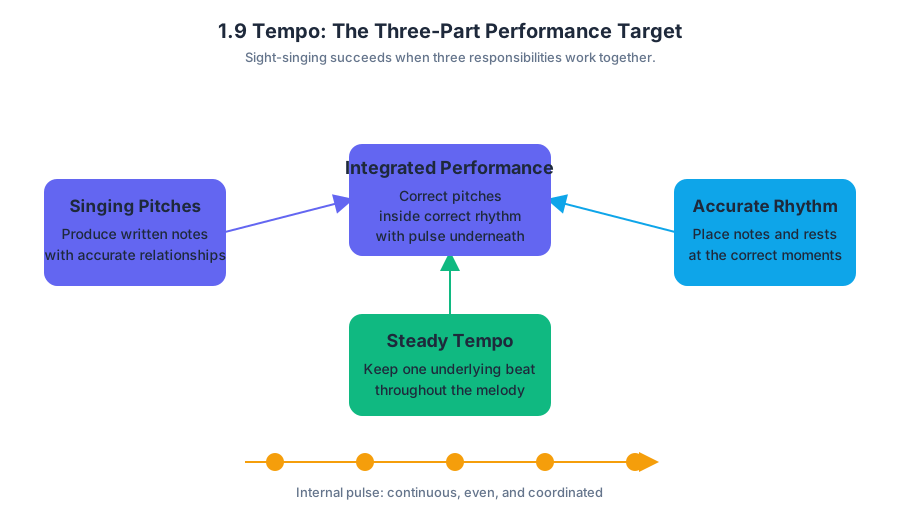
A strong sight-singing performance coordinates three independent responsibilities:
| Responsibility | What it means while singing |
|---|---|
| Singing pitches | Produce the written melodic pitches with accurate relative pitch. |
| Accurate rhythm | Enter each note, rest, and sustained duration at the correct moment. |
| Steady tempo | Preserve the same underlying beat throughout the melody. |
The goal is not to perform these in sequence. You must combine them: the voice should move through the correct pitches inside the correct rhythmic pattern while an internally controlled pulse continues underneath.
Tempo is a framework, not a decoration
Imagine walking while reading street signs. If your walking speed changes every time a sign becomes difficult, you may eventually reach the destination, but your movement becomes hesitant and discontinuous. In sight singing, the pulse is the walk: difficult intervals or unfamiliar rhythms should not cause the beat to collapse.
A tempo marking such as Andante or Moderato gives a general speed character rather than an exact universal number. The practical priority is choosing a manageable starting tempo and maintaining it. A slower, controlled performance is usually more effective than a fast performance that accelerates, hesitates, or stops.
A worked sight-singing example
Suppose an original four-measure melody is in common meter and contains this rhythmic outline:
$$ \text{quarter note} ;|; \text{two eighth notes} + \text{quarter note} ;|; \text{half note} ;|; \text{whole note} $$
Assume its pitches move mostly by step, with one larger leap in measure $3$.
Step 1: Establish the beat. During preparation, silently mark four equal beats per measure. Do not begin by guessing the first pitch repeatedly; first feel the pulse that will organize every entrance and duration.
Step 2: Speak or subdivide the rhythm. Count the two eighth notes as subdivisions within one beat. The half note must last for two beats, and the whole note must continue for all four beats of its measure.
Step 3: Sing the pitches on the pulse. If the leap in measure $3$ feels uncertain, identify its starting pitch and target pitch during the practice period, then sing through it without abandoning the beat.
Step 4: Preserve continuity. If a pitch is missed, continue at the next rhythmic entrance. A brief pitch error does not require a full restart; a stopped performance disrupts both tempo and the rest of the melody.
Sight-singing timing and choices
For the current sight-singing task, each of two melodies receives a practice period of $1$ minute and $15$ seconds and a performance period of $30$ seconds. A starting pitch is provided at the beginning of preparation. You may sing using note names, solfège syllables, scale-degree numbers, or a neutral syllable, and you may transpose the melody to a comfortable key.
Use preparation time strategically: mark difficult pitches, scan the meter and key signature, silently trace the contour, and sing aloud before the timed performance. The chosen tempo must allow the entire melody to fit within the performance period while remaining slow enough for accurate rhythm and pitch.
Misconception check: “Steady tempo means never changing speed”
A steady tempo does not mean that expressive music can never contain a written tempo change. It means that, in the absence of such a direction, your beat should not change accidentally because a leap, chromatic pitch, rest, or complex rhythmic cell feels difficult.
Common error: beginning too quickly, then slowing down at the hardest measure.
Correction: select a sustainable tempo before singing and keep a physical or mental pulse. If necessary, simplify the vocal delivery while preserving the written timing and continuity.
Skill connection and retrieval check
This topic primarily activates Skill 1: Analyze performed music, because you must hear and monitor whether the pulse remains stable; Skill 3: Convert between performed and notated music, because notation must become accurately timed sound; and Skill 4: Complete based on cues, because the given melody supplies pitches and rhythms that you must realize in performance.
Retrieval check: You begin a melody at a comfortable speed, but accelerate during a difficult leap and arrive early at the next bar line. Which target was lost first: pitch, rhythm, or steady tempo? What physical or mental action could restore the pulse without restarting?
Answer: The first loss is steady tempo, followed by rhythmic accuracy. Continue rather than restart, re-establish equal beats internally, and enter the next written event at its correct time.