From the free course AP Music Theory on Lykke
2.2 Relative keys: determining relative minor keys and notating key signatures
Key concepts: Minor keys · Relative major and relative minor keys · Key signatures · Modes: major and minor · Parallel major and minor keys · Notation of minor keys
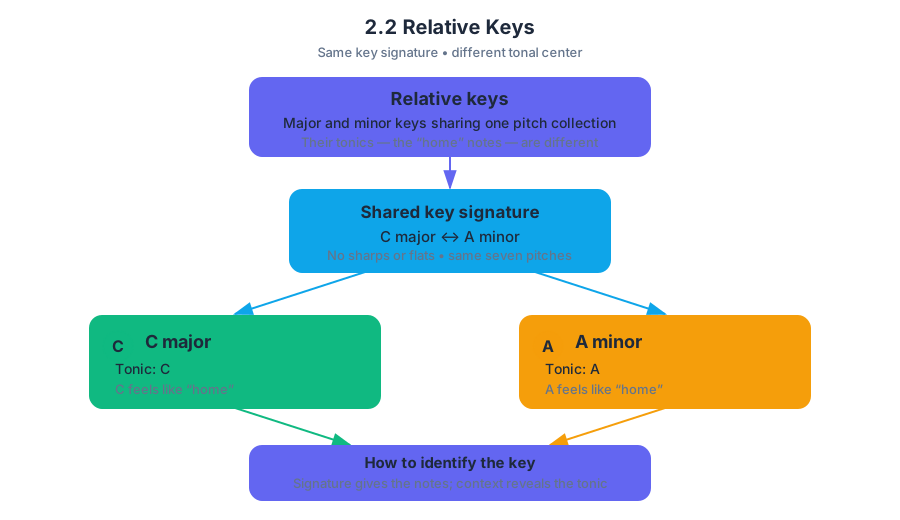
A major key and its relative minor key use the same key signature because they draw their notes from the same seven pitches. The difference is not the collection of notes but the tonal center—the pitch that feels like “home.”
2.2 Relative keys: determining relative minor keys and notating key signatures
A major key and its relative minor key use the same key signature because they draw their notes from the same seven pitches. The difference is not the collection of notes but the tonal center—the pitch that feels like “home.”
Relative major and relative minor keys are major and minor keys that share a key signature but have different tonics.
For example, C major and A minor both use no sharps or flats. C major centers on C, while A minor centers on A. The key signature alone gives you the shared pitch collection; the musical context identifies which pitch functions as the tonal center.
Finding the relative minor from a major key
To find the relative minor of a major key, move downward by a minor third, or equivalently upward by a major sixth. In a standard major/minor analysis, the relative minor begins on scale degree $6$ of the major scale.
| Major key | Scale degree $6$ | Relative minor | Shared key signature |
|---|---|---|---|
| C major | A | A minor | no sharps or flats |
| G major | E | E minor | $1$ sharp: F-sharp |
| B-flat major | G | G minor | $2$ flats: B-flat, E-flat |
| D major | B | B minor | $2$ sharps: F-sharp, C-sharp |
Worked example: Find the relative minor of B major. Count the major scale degrees: B is $1$, C-sharp is $2$, D-sharp is $3$, E is $4$, F-sharp is $5$, and G-sharp is $6$. Therefore, B major’s relative minor is G-sharp minor, and both keys use the four-sharp signature F-sharp, C-sharp, G-sharp, and D-sharp.
Finding the relative major from a minor key
To reverse the process, move upward by a major third from the minor tonic. For instance, B to D spans a major third: B–C–D contains three letter names and four half steps. Therefore, B minor is relative to D major.
A practical shortcut is to locate the minor tonic and count upward through three letter names:
$$ A \rightarrow B \rightarrow C $$
A minor therefore has C major as its relative major. Likewise, E minor has G major, and G minor has B-flat major. Once the relative major is known, its key signature supplies the correct signature for the minor key.
Misconception check: The reverse operation is not an upward minor third. B to D is an upward major third, while D down to B is a downward minor third. Mixing up the direction and interval quality produces the wrong relative key.
Notating a minor key signature
A key signature belongs immediately after the clef and before the meter signature. When notating a minor key, write the key signature of its relative major; do not invent a separate signature merely because the music is minor.
For example:
- A minor: no sharps or flats, matching C major.
- D minor: one flat, matching F major.
- C-sharp minor: four sharps, matching E major.
- F minor: four flats, matching A-flat major.
The raised seventh used in harmonic minor does not normally change the key signature. In A minor, the key signature remains empty, even when G is raised to G-sharp within the melody or harmony. That alteration is written as an accidental at the note, not added permanently to the key signature.
Relative keys versus parallel keys
Relative keys share a key signature but have different tonics: C major and A minor. Parallel keys share the same tonic but use different major/minor collections: C major and C minor.
| Relationship | Same tonic? | Same key signature? | Example |
|---|---|---|---|
| Relative | No | Yes | C major and A minor |
| Parallel | Yes | Usually no | C major and C minor |
A passage can move from a major key to its relative minor without changing the key signature. If a passage begins with C as the tonal center but later establishes A through cadences, repeated emphasis, and melodic arrival, the listener may hear a shift from C major to A minor even though the written signature remains unchanged.
Do not treat the signature as an automatic answer. In standard major/minor key analysis, a signature narrows the likely choices to a major key and its relative minor—for example, no signature suggests C major or A minor. But other modes can use that same pitch collection. A passage centered on D with no sharps or flats may be Dorian rather than either C major or A minor; the signature does not identify the mode by itself.
Retrieval check:
- What is the relative minor of G major?
- What is the relative major of E-flat minor?
- Are A major and A minor relative or parallel keys?
- Why does a raised seventh in harmonic minor usually appear as an accidental rather than in the key signature?
Answers:
- E minor.
- G-flat major, because the minor tonic E-flat lies a major third below G-flat.
- Parallel: both have tonic A, but their key signatures differ.
- The key signature represents the basic major/minor pitch collection; the raised seventh is a temporary alteration used within the music.