From the free course AP Music Theory on Lykke
AP Practice 2
Key concepts: Upward-resolving suspension (retardation) · Suspension, including rearticulated suspension and chain of suspensions · Texture terminology · Pitch and pitch notation · Rhythm, meter, and beat division · Syncopation and rhythmic patterns · Dynamics, articulation, and tempo · Instrument families and standard instruments · Tonic, dominant, and predominant harmonic functions · Recomposing a well-known tonal melody
A harmonic dictation task asks you to turn a heard musical event into a precise notated and analytical account: What pitches and rhythms occurred, what harmonies changed, and how did those harmonies function?
AP Practice 2
A harmonic dictation task asks you to turn a heard musical event into a precise notated and analytical account: What pitches and rhythms occurred, what harmonies changed, and how did those harmonies function? The challenge is not merely naming chords. You must connect pitch, bass motion, rhythm, meter, nonharmonic tones, and harmonic function into one coherent explanation.
Task type: original, unofficial harmonic-analysis and notation practice
Suggested timing: $8$ minutes total
Primary skills: Skill 1: Analyze performed music, Skill 2: Analyze notated music, Skill 3: Convert between performed and notated music, and Skill 4: Complete based on cues. The task also activates 1.B/2.B: Rhythmic Features, 1.D/2.D: Transformation, 1.E/2.E: 18th-Century Voice Leading, and 1.G/2.G: Musical Design.
The musical situation
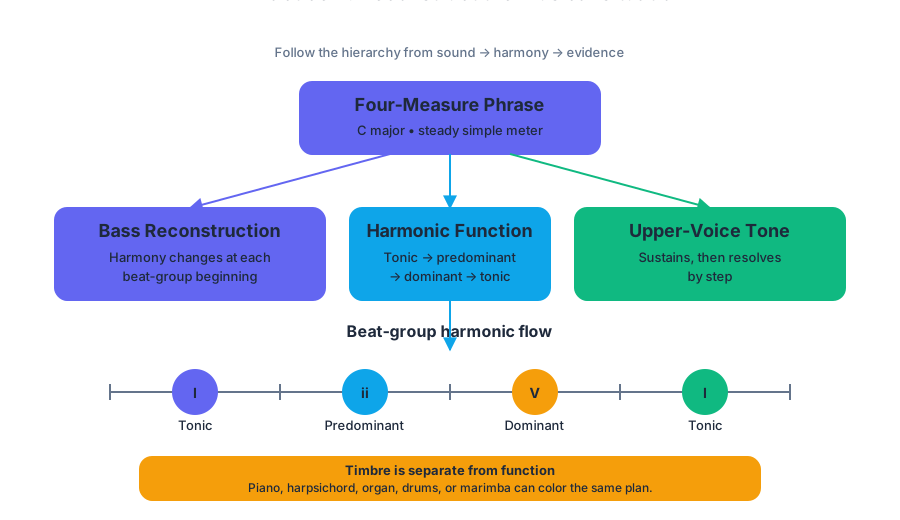
Imagine a four-measure phrase in $C$ major performed by a keyboard instrument. The excerpt uses a steady simple meter. The bass changes harmony at the beginning of each beat-group, while an upper voice sustains and then resolves by step. Your job is to reconstruct the bass, label the harmonic functions, and identify the sustained tone accurately.
The keyboard family includes piano, harpsichord, and organ. In another performance, the same harmonic plan might be colored by drums, cymbals, or marimba; those instruments change the timbre, or tone color, without necessarily changing the harmonic function.
Practice prompt
The performer plays the following harmonic outline in $C$ major. Each harmony occupies one measure unless otherwise indicated:
- Measure $1$: $C$ major
- Measure $2$: $F$ major
- Measure $3$: $G$ major, with an upper voice holding $A$ from the previous harmony and moving upward to $B$
- Measure $4$: $C$ major
On your response, complete these three tasks:
- Notate a bass line representing the changing harmonies.
- Label each harmony with its Roman numeral and function.
- Identify the nonharmonic tone in measure $3$ and describe its resolution.
Worked solution
A practical reconstruction begins with the bass. Because the harmonies are $C$ major, $F$ major, $G$ major, and $C$ major, a convincing root-position bass is:
$$ C \rightarrow F \rightarrow G \rightarrow C $$
In $C$ major, these roots produce the following Roman numerals:
| Measure | Chord tones | Roman numeral | Function |
|---|---|---|---|
| $1$ | $C$–$E$–$G$ | $I$ | Tonic |
| $2$ | $F$–$A$–$C$ | $IV$ | Predominant |
| $3$ | $G$–$B$–$D$ | $V$ | Dominant |
| $4$ | $C$–$E$–$G$ | $I$ | Tonic |
The progression is therefore:
$$ I \rightarrow IV \rightarrow V \rightarrow I $$
The first and last harmonies establish and confirm tonic. The $IV$ chord moves away from tonic and prepares the dominant, while $V$ creates the strongest tension before resolving to $I$.
The suspension—and the important update
The upper voice holds $A$ into the $G$-major harmony. Since $A$ is not a chord tone of $G$ major, it is temporarily dissonant. It then moves upward by step to $B$, which belongs to the dominant chord:
$$ A \rightarrow B $$
This is an upward-resolving suspension, officially recognized in PIT-2.M.5 as a synonym for retardation. The broader classification of nonharmonic tones includes suspension, rearticulated suspension, chain of suspensions, and upward-resolving suspension (retardation).
A suspension is heard as a tone carried from one harmony into the next, where it creates dissonance before resolving by step.
A common misconception is that every suspension must resolve downward. Many suspensions do resolve downward, but an upward-resolving suspension is specifically a retardation. Do not label the $A$ a chord tone merely because it was consonant in the preceding measure; classify it according to its relationship with the harmony sounding at the moment of dissonance.
Rhythm, meter, and texture checks
Rhythm exists in time: it concerns the durations and placement of sounds and silences. Meter organizes beats into recurring hierarchies, and beat division determines whether each beat divides simply or compoundly. If the upper voice enters after the expected beat or sustains across a strong beat, listen for syncopation—a rhythmic emphasis that challenges the regularity of the established meter.
Do not confuse a sustained suspension with syncopation. A suspension is primarily a harmonic and melodic event; syncopation is primarily a rhythmic event. They can occur together, but one does not automatically prove the other.
Texture terminology also matters when describing the excerpt. No new texture vocabulary has been added, and the terms “technical” and “casual” are not required texture descriptors under DES-1.A.2. Use established terms such as homophonic when one prominent melody is supported by accompanying harmonies.
What earns credit
An examiner rewards an answer that is musically complete and internally consistent:
- The bass line changes at the correct harmonic points.
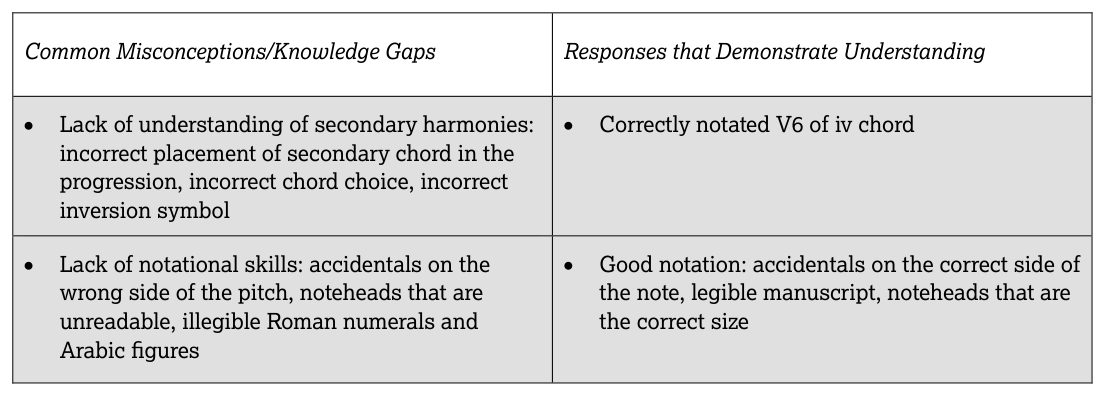
- The pitches are written with accurate notation and appropriate accidentals.
- The Roman numerals match the key of $C$ major.
- Tonic, predominant, and dominant functions are identified correctly.
- The $A$ is recognized as an upward-resolving suspension, or retardation.
- Rhythm, meter, and any syncopation are represented rather than guessed.
- The response distinguishes chord tones from nonharmonic tones.
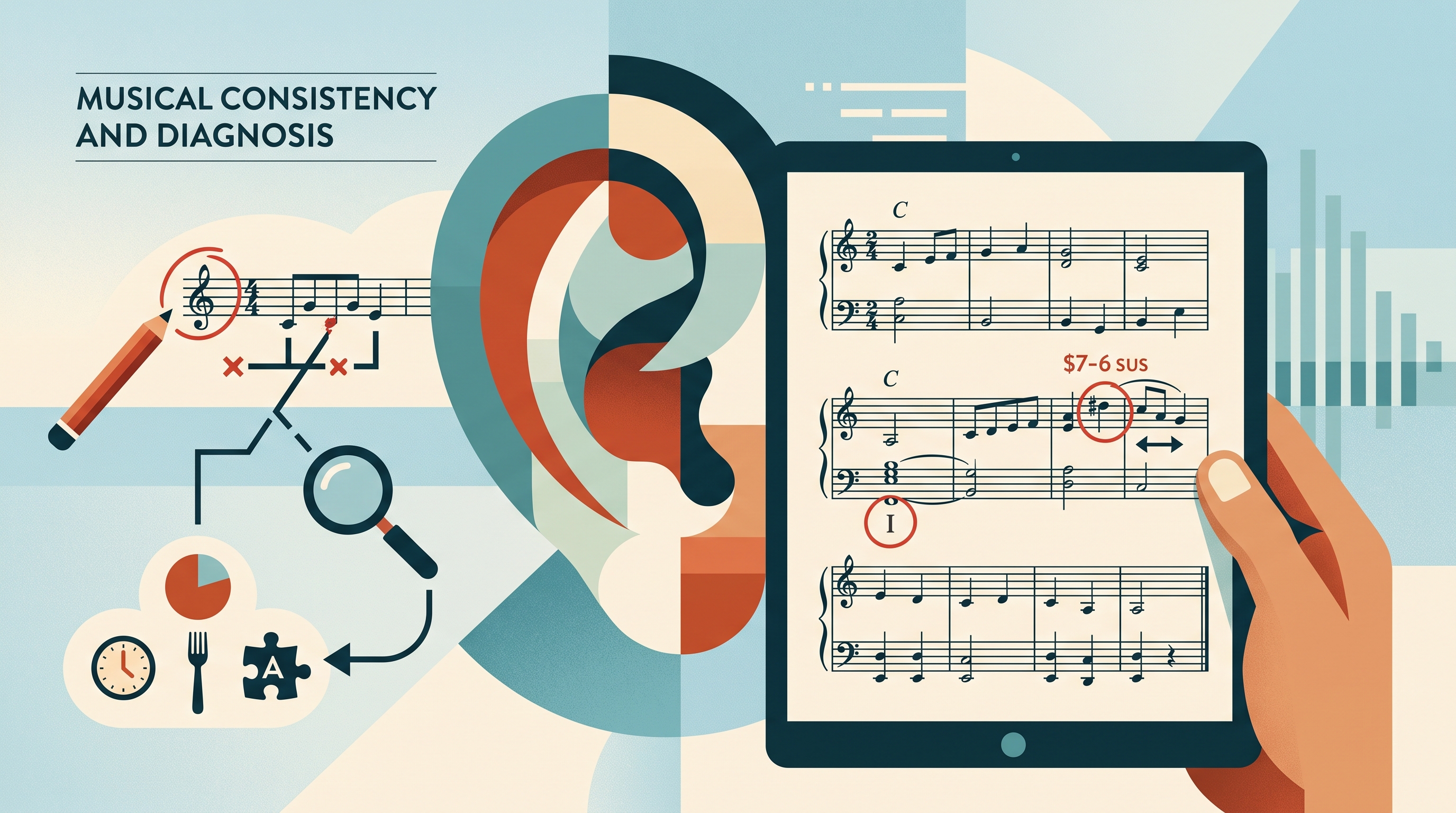
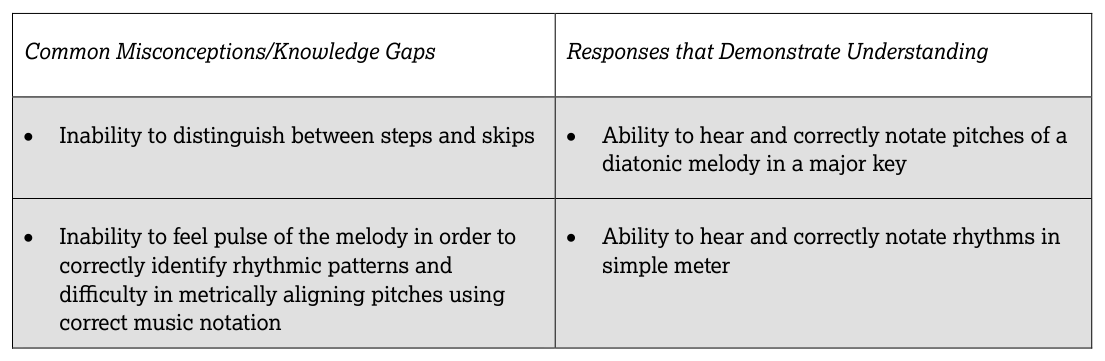
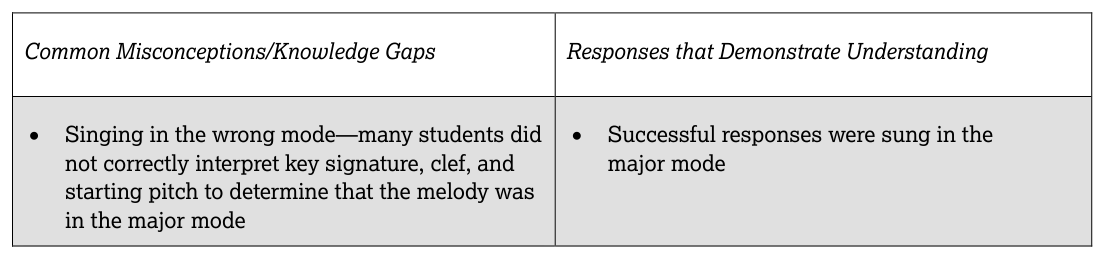
For error review, circle the first incorrect decision rather than only correcting the final label. Ask: Did I lose the beat, mishear the bass, misidentify the key, or classify the nonharmonic tone by its previous harmony? That diagnosis tells you whether to practice rhythm and meter, pitch notation, harmonic function, or suspensions.
The clarifications labeled “To be Implemented for Fall 2026” apply to the $2026$–$2027$ academic year and beyond. Beginning with the later digital implementation, formal questions move to a digital platform, while the exam’s overall timing and content remain unchanged. Practice the musical reasoning—not a particular delivery device.
Source Materials
- Learn More (.pdf)
- AP Music Theory Course and Exam Description
- AP Music Theory Course Overview
- AP Music Theory Course at a Glance
- AP Music Theory Course at a Glance Poster
- Adopt AP Music Theory
- AP Music Theory
- AP Music Theory
- Figure — Chief Reader Report (p. 2)
- Figure — Chief Reader Report (p. 10)
- Figure — Chief Reader Report (p. 23)
- Figure — Music, Directions for Questions 3-4 Transcript (p. 4)