From the free course AP Music Theory on Lykke
AP Practice 6
Sight-singing rewards a performer who keeps the musical line moving while controlling two separate problems: rhythmic accuracy and relative pitch accuracy. In the AP Music Theory sight-singing task, each melody receives a short preparation period of approximately $1$ minute and $15$ seconds, followed by a…
AP Practice 6
Sight-singing rewards a performer who keeps the musical line moving while controlling two separate problems: rhythmic accuracy and relative pitch accuracy. In the AP Music Theory sight-singing task, each melody receives a short preparation period of approximately $1$ minute and $15$ seconds, followed by a performance period of $30$ seconds; continuity matters because a correct recovery is musically stronger than stopping after one mistake.
The task: turn notation into a continuous performance
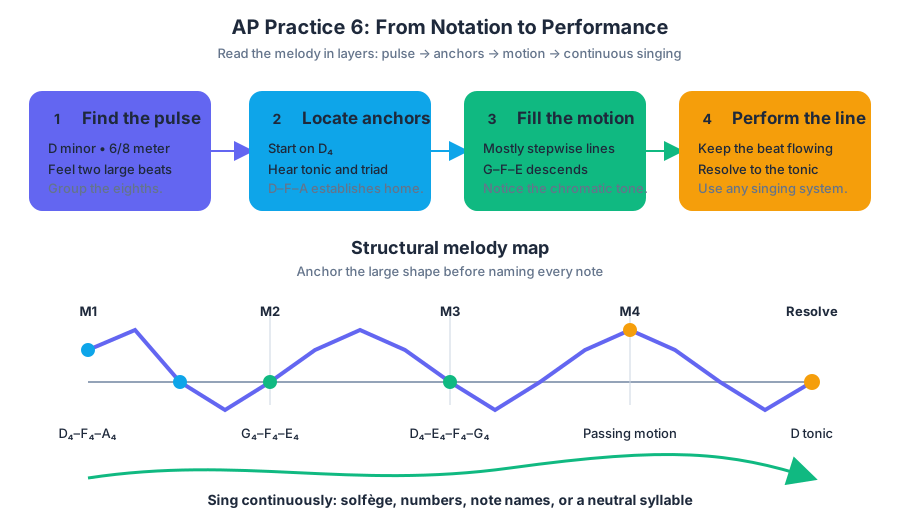
The most reliable strategy is to read the melody in layers rather than trying to name every note independently. First identify the meter and beat grouping, then locate the tonic and major structural notes, and finally fill in the passing motion between those anchors.
For this original, unofficial practice melody, use D minor, $6/8$ meter, and a starting pitch of $D_4$. Sing with solfège, scale-degree numbers, note names, or a neutral syllable. The melody contains mostly stepwise motion, one chromatic tendency tone, and a final tonic resolution.
| Measure | Rhythmic outline | Pitch sequence | Structural purpose |
|---|---|---|---|
| $1$ | dotted quarter, eighth, quarter | $D_4$–$F_4$–$A_4$ | Establishes tonic and the minor triad |
| $2$ | three quarter-note beats | $G_4$–$F_4$–$E_4$ | Descending stepwise motion |
| $3$ | dotted quarter, three eighths | $D_4$–$E_4$–$F_4$–$G_4$ | Returns to and departs from tonic |
| $4$ | quarter, quarter, dotted quarter | $A_4$–$B\flat_4$–$A_4$ | Dominant-region emphasis |
| $5$ | three quarter-note beats | $C^\sharp_5$–$D_5$–$E_5$ | Raised leading tone points toward $D$ |
| $6$ | dotted quarter, three eighths | $F_5$–$E_5$–$D_5$–$C^\sharp_5$ | Descending line with renewed tension |
| $7$ | quarter, quarter, dotted quarter | $D_5$–$C^\sharp_5$–$B\flat_4$ | Prepares the final cadence |
| $8$ | dotted half | $D_4$ | Complete tonic resolution |
Worked preparation: three passes, one minute
Pass 1: scan the rhythm. In $6/8$, the basic beat is the dotted quarter note, and each measure contains two large beats. Count $1$–$la$–$li$, $2$–$la$–$li$ or conduct two broad pulses. Do not let the eighth-note groups turn into three independent beats.
Pass 2: locate the pitch anchors. The opening $D$ establishes tonic. The $A$ in measure $4$ functions as a dominant-area goal, while $C^\sharp$ in measures $5$ and $6$ acts as a leading tone that strongly pulls upward to $D$. The repeated $D$ notes divide the melody into recognizable gestures.
Pass 3: connect the anchors. Sing the skeleton $D \rightarrow A \rightarrow D \rightarrow D$ first. Then insert the interior notes: $D$–$F$–$A$, $G$–$F$–$E$, and so on. This prevents a single difficult interval from destroying the entire performance.
A strong internal counting plan is:
$$ \text{Measure 1: } D\text{--}F\text{--}A \qquad \text{Measure 2: } G\text{--}F\text{--}E $$
The first measure moves upward through the tonic triad; the second descends by step. Hearing those shapes is more dependable than treating $D$–$F$ as an unrelated minor third and $F$–$A$ as another isolated interval.
What earns credit
The performance should be judged through three observable criteria: rhythmic accuracy, relative pitch accuracy, and continuity. A useful self-check is to ask whether the listener can identify the meter, recognize the intended tonal center, and hear a stable phrase even if one pitch is imperfect.
| Criterion | Evidence of control | Common failure |
|---|---|---|
| Rhythmic accuracy | The $6/8$ pulse remains steady; dotted-quarter and eighth-note values retain their proportions | Replacing compound beat division with a flat stream of equal notes |
| Relative pitch accuracy | Scale steps, minor-third shapes, and the raised leading tone move to their intended targets | Singing every note as though it were unrelated to the key |
| Continuity | The performer continues after a slip and reenters at the next stable pitch | Stopping, restarting, or abandoning the meter |
Misconception check: “One wrong note means I should stop”
Stopping usually creates a second error: lost rhythm and broken continuity. If measure $5$ begins incorrectly, keep the $6/8$ pulse, aim for the next structural $D_5$, and resume from that anchor. The scoring evidence is stronger when the musical line remains intelligible.
Another misconception is that the provided starting pitch forces the melody to remain in its printed register. Preparation may include transposing the melody to a comfortable key, but the interval relationships and rhythmic values must remain intact. A comfortable range is useful only if it preserves accurate relative pitch and steady tempo.
Error-review routine
After performing, replay the attempt—or have a partner listen—and classify each problem before correcting it:
- Mark the first place where the pulse changed.
- Circle the first uncertain pitch and identify its scale-degree relationship to the preceding note.
- Label each recovery point, such as the next tonic, dominant, or repeated pitch.
- Rehearse only the damaged measure plus the measure before it.
- Perform the complete melody again without restarting.
If the error occurs at $C^\sharp_5$, do not merely repeat the note mechanically. Sing $C^\sharp_5 \rightarrow D_5$ several times, because the important musical fact is its leading-tone pull. If the error occurs in the eighth-note group of measure $3$, practice the group against the two large compound-meter beats rather than speeding up each syllable.
Final retrieval check
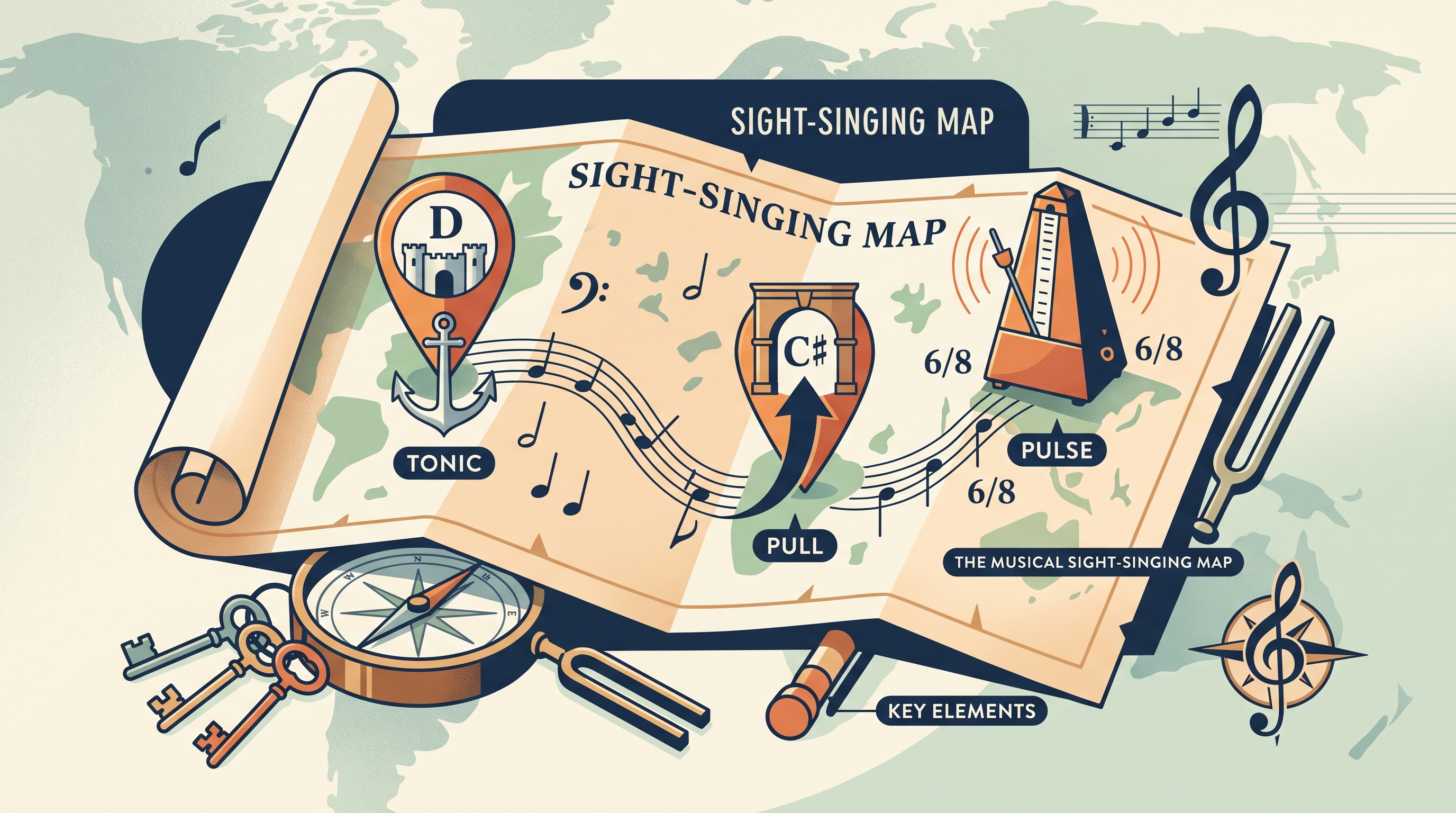
Before performing, answer mentally: In this melody, what establishes the tonic, what note creates the strongest upward pull, and what must remain steady even after a pitch mistake? The essential answers are $D$, $C^\sharp$, and the $6/8$ pulse—together, they form the map that makes continuous sight-singing possible.
Source Materials
- Learn More (.pdf)
- AP Music Theory Course and Exam Description
- AP Music Theory Course Overview
- AP Music Theory Course at a Glance
- AP Music Theory Course at a Glance Poster
- Adopt AP Music Theory
- AP Music Theory
- AP Music Theory
- AP Music Theory-AP Students-College Board
- AP Music Theory-Unit Study Guides
- AP Music Theory-Raidar Choir
- Everything you need to know to get a 5 on AP Music Theory