From the free course AP Music Theory on Lykke
5.7 Additional six-four chords
Key concepts: Additional six-four chords · Roman numeral analysis · Second-inversion dominant seventh chords · Tonic and scale-degree notation · Harmonic progression notation · Regular scoring by segments · Holistic alternate scoring · Pitch and rhythm accuracy · Flow-point scoring · Scoring rules for restarts and transposition
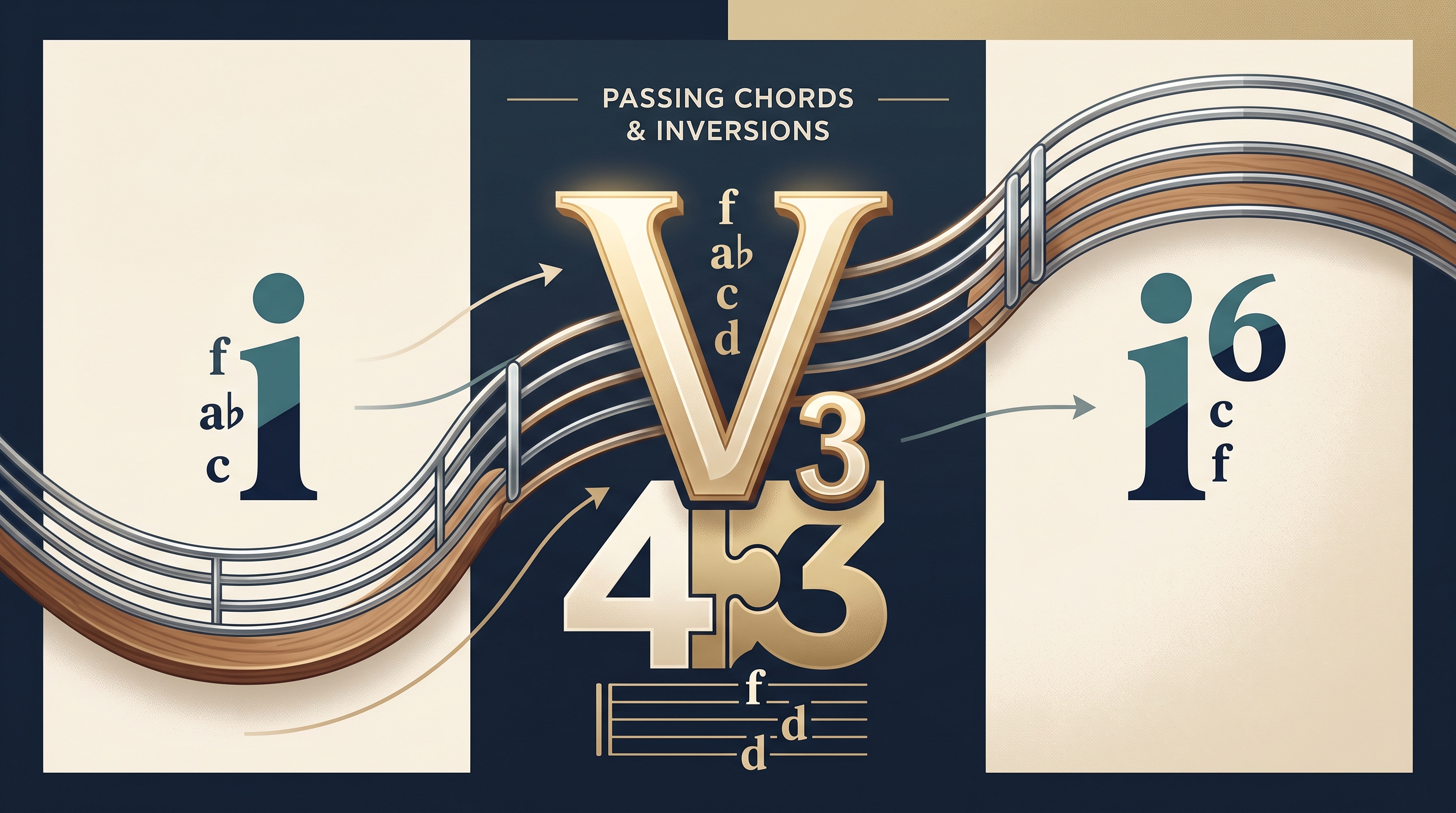
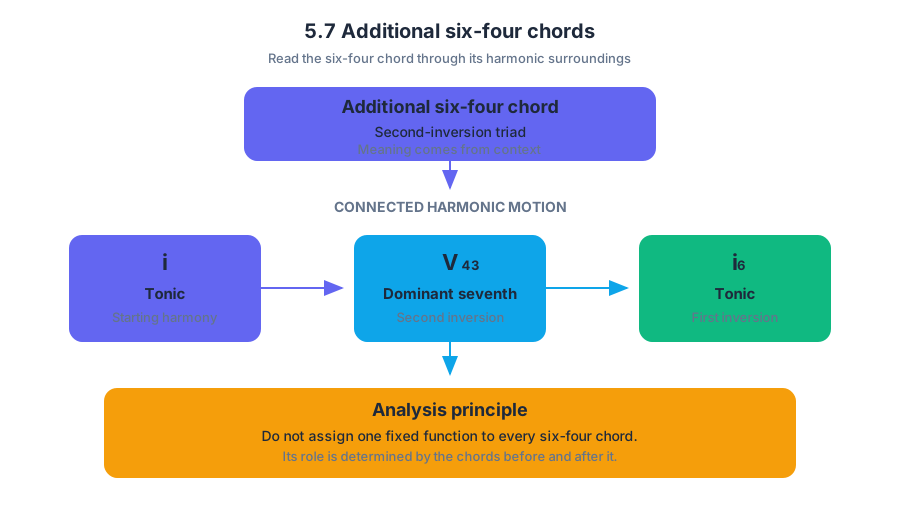
An additional six-four chord is a second-inversion triad whose meaning comes from its harmonic surroundings rather than from a single fixed function. Roman-numeral analysis therefore reads a progression such as
5.7 Additional six-four chords
An additional six-four chord is a second-inversion triad whose meaning comes from its harmonic surroundings rather than from a single fixed function. Roman-numeral analysis therefore reads a progression such as
$$i - V^4_3 - i^6$$
as a connected motion: tonic, dominant seventh in second inversion, then tonic in first inversion.
Reading the harmonic shorthand
Roman numerals identify the chord’s scale-degree root and quality; superscript and subscript figures identify its inversion. In the example above, lowercase $i$ means a minor tonic triad, while $i^6$ means that same tonic triad in first inversion.
Key distinction: $V^4_3$ is a dominant seventh chord in second inversion—not a triad in second inversion.
A seventh chord contains four chord members. In a second inversion, the chord’s fifth is in the bass, so the intervals above the bass are a fourth and a third; that produces the figure $4/3$. By contrast, a triad in second inversion is labeled $6/4$, because its intervals above the bass are a sixth and a fourth.
| Symbol | Chord type | Inversion indicated |
|---|---|---|
| $V^6$ | Dominant triad | First inversion |
| $V^4_3$ | Dominant seventh chord | Second inversion |
| $i^6$ | Tonic triad | First inversion |
| $i^6_4$ | Tonic triad | Second inversion |
The notation $\hat{1}$ means scale degree one, or the tonic. This symbol refers to a pitch position within the established scale; it is not itself a chord label. Thus, if a melody establishes $\hat{1}$ as its tonal center, later transposition or pitch analysis should be judged relative to that tonic.
Worked analysis
Suppose a minor-key passage contains the progression below:
$$i - V^4_3 - i^6$$
Read it in three stages:
- $i$ establishes the tonic harmony.
- $V^4_3$ introduces the dominant seventh chord with its fifth in the bass.
- $i^6$ returns to tonic harmony, but with the third of the tonic chord in the bass.
The dashes are meaningful: they show harmonic progression, not subtraction. A common error is to read $V^4_3$ as “a four-three triad” or to treat $i^6$ as a new key. The Roman numeral remains the harmonic identity; the figures describe only the chord’s vertical arrangement.
Misconception check: The number $6$ in $i^6$ does not mean “scale degree six.” It describes the intervals above the bass and signals first inversion.
Regular scoring by segments
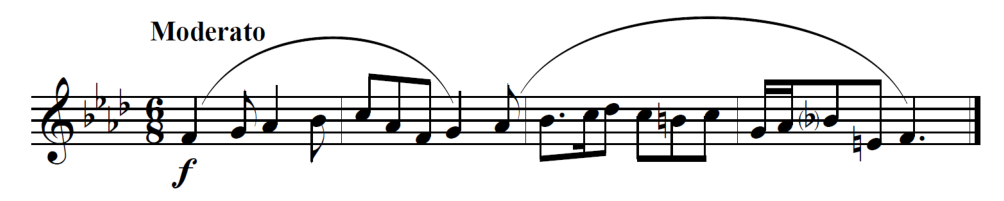
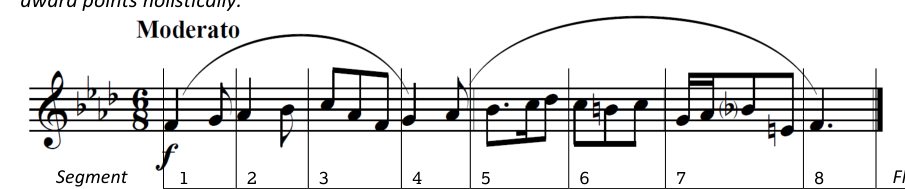
In performance tasks, regular scoring evaluates the response in separate musical segments. For each segment, pitch and rhythm are checked together: a segment earns its point only when both are accurate. The segment scores are then added for a preliminary total, and a separate flow point may be awarded for a continuous response without hesitations or restarts.
For example:
$$1101+1111+1=8$$
Here the eight segment positions contain seven correct segments, followed by one flow point.
If a student restarts, evaluators score the last complete response and do not award the flow point. If no complete response exists, they score the last response available. Evaluators also listen beyond the apparent ending in case the student gives an additional response.
Holistic alternate scoring
Holistic alternate scoring judges the overall response rather than adding one point per segment. It is used when the regular segment score is low enough that a response’s broader consistency may be represented more fairly by a pitch-focused or rhythm-focused guide.
Under an alternate guide, evaluators consider how accurately the student maintains pitch or rhythm across the performance as a whole. The result is not combined with individual segment points or the regular flow point; the regular and alternate guides are separate scoring systems. When applicable, evaluators record the higher complete score, never a mixture of points from different guides.
Edge cases that change the score
For transposition, scoring begins from the tonic established by the student. A response can therefore receive credit for accurately transposed segments when the intervals above that student-established tonic are correct.
An additional point may be awarded for an exceptionally good response or for a response that would otherwise receive zero. This is distinct from the regular flow point. The evaluator should apply the relevant scoring guide completely, record the higher applicable result, and avoid combining guides.
Retrieval check
Identify each item in $i - V^4_3 - i^6$: Which symbol names the dominant seventh chord, what inversion does $V^4_3$ show, and what does $\hat{1}$ name? Then state the regular-scoring rule: must a segment have correct pitch, correct rhythm, or both to earn its segment point?




Source Materials
- Learn More (.pdf)
- AP Music Theory Course and Exam Description
- AP Music Theory Course Overview
- AP Music Theory Course at a Glance
- AP Music Theory Course at a Glance Poster
- Adopt AP Music Theory
- AP Music Theory
- AP Music Theory
- I. Regular Scoring Guide
- I. Regular Scoring Guide
- I. Regular Scoring Guide
- Segment 1 2 3 4 5 6 7 8 Flow Total