From the free course AP Music Theory on Lykke
Course Framework, Skills and Reasoning Processes
Key concepts: AP Music Theory course framework · College-level curriculum alignment · Instructional model and unit sequencing · Essential questions and conceptual understandings · Content and skill development · Aural analysis and listening practice · Score analysis of notated music · Sight-singing and dictation · Composition and production of music · Progress monitoring and actionable assessment feedback
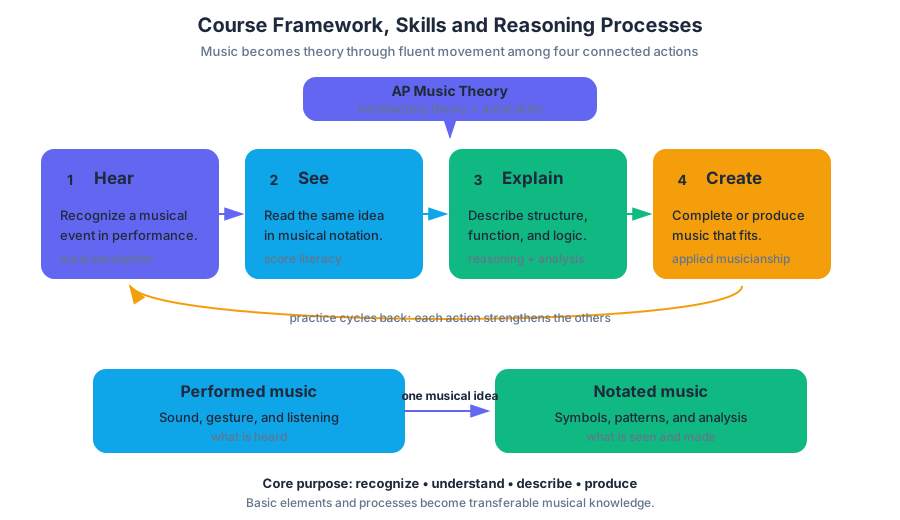
Music becomes theory when a listener can move fluently among four actions: hearing a musical event, seeing it notated, explaining how it works, and creating or completing music that follows its logic.
Course Framework, Skills and Reasoning Processes
Music becomes theory when a listener can move fluently among four actions: hearing a musical event, seeing it notated, explaining how it works, and creating or completing music that follows its logic. AP Music Theory is built around that fluency. It corresponds to approximately one or two semesters of introductory college music theory and aural-skills coursework, while allowing colleges to organize comparable material in different ways.
Core purpose: Students learn to recognize, understand, describe, and produce the basic elements and processes of performed and notated music.
The phrase performed and notated is crucial. A chord heard in a recording, the same chord represented on a score, a Roman-numeral analysis of its function, and a correctly written continuation are connected manifestations of one musical idea—not four unrelated exercises.
Why the framework is college-level
AP courses use challenging, research-based curricula aligned with expectations in higher education. AP teachers and college faculty collaborate in course and exam development, and college faculty review AP teachers’ course syllabi. The framework therefore describes knowledge and skills typical of introductory college music theory without pretending that every college teaches the material in exactly the same sequence or with identical terminology.
College credit or placement depends on the institution, but the underlying preparation is consistent: students work with pitch, rhythm, melody, harmony, voice leading, musical form, notation, listening, and composition. The repertoire used for analysis may include standard Western tonal music, contemporary art music, jazz, popular music, and other diverse musical contexts.
The instructional model: build, connect, assess
The framework’s sequence moves from materials that must be identified accurately toward processes that must be interpreted and produced. Fundamentals support chords; chords support harmonic function; harmonic function supports voice leading, embellishment, secondary function, modes, and form.
| Stage | Musical work | Typical evidence |
|---|---|---|
| Identify | Hear or read pitch, rhythm, scale, chord, or expressive feature | Recognition in performed or notated music |
| Explain | Describe relationships among motives, phrases, chords, or cadences | Aural or score analysis |
| Convert | Move between sound and notation | Dictation, sight-singing, and error detection |
| Produce | Write or perform music that satisfies given constraints | Composition, part writing, harmonization, and sight-singing |
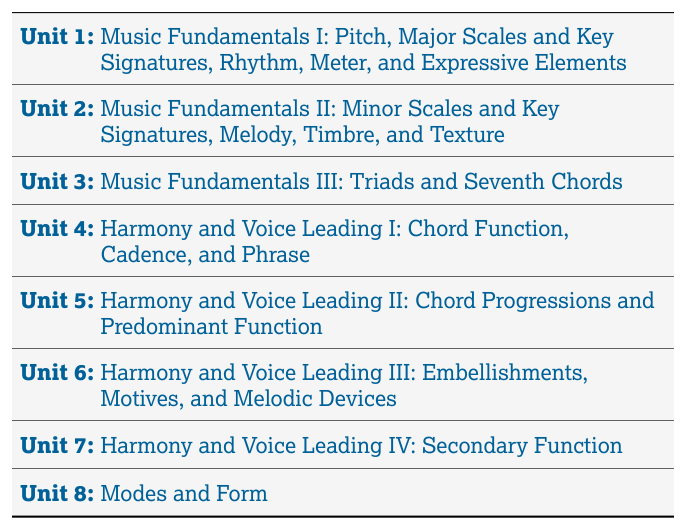
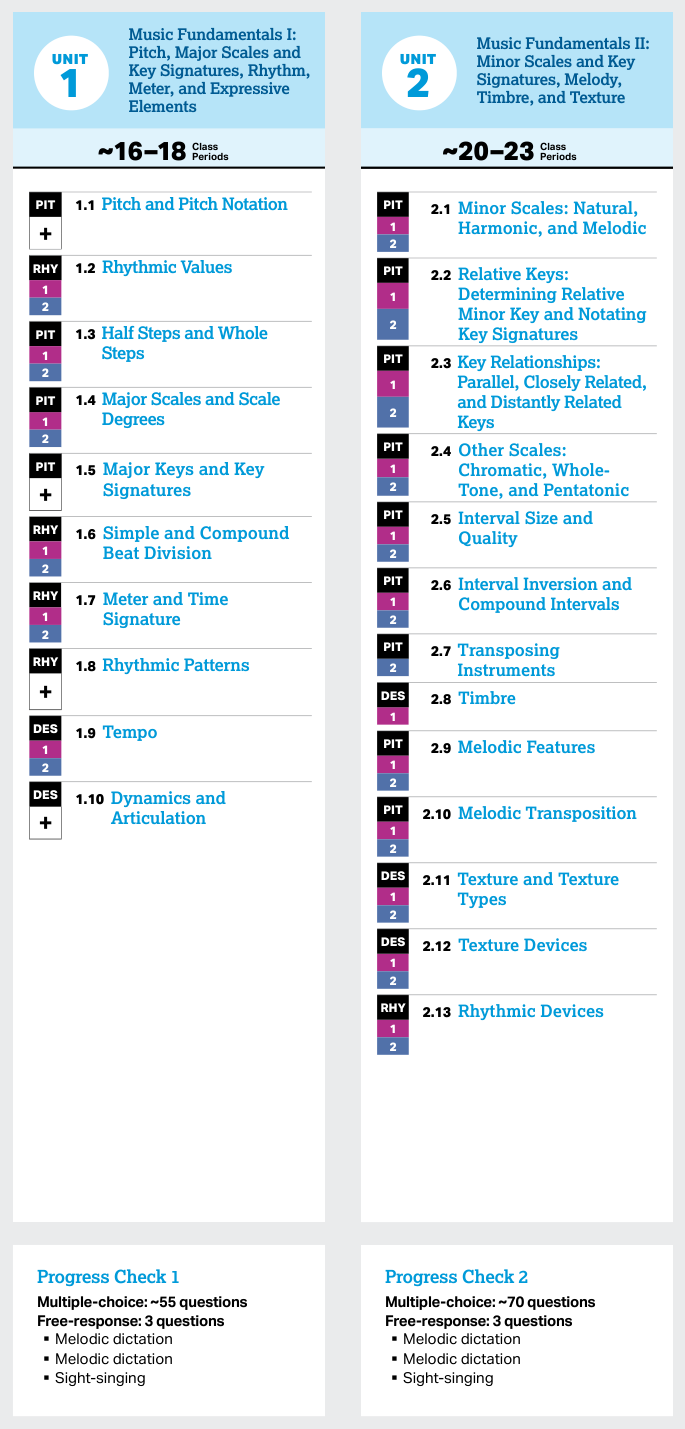
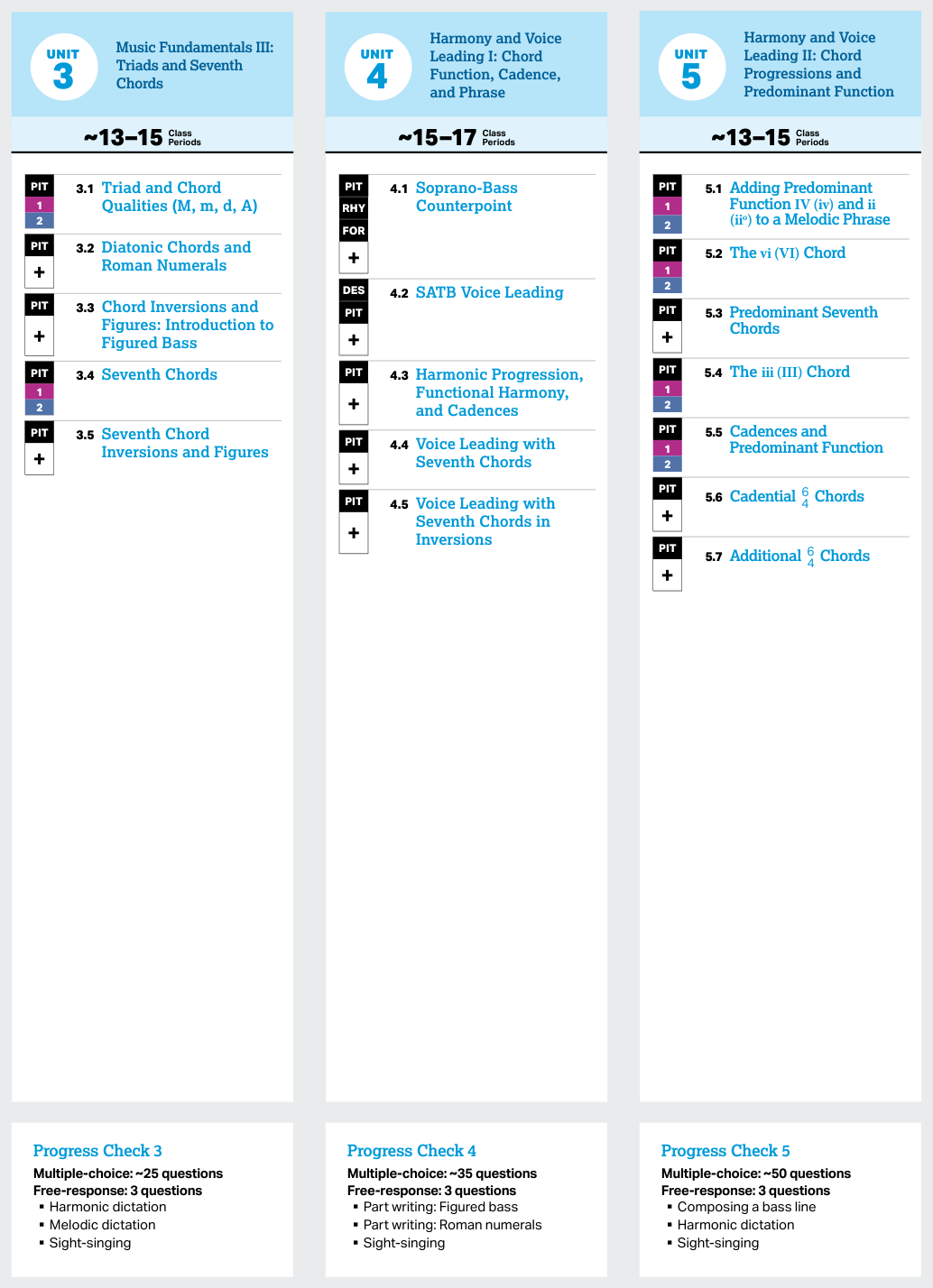
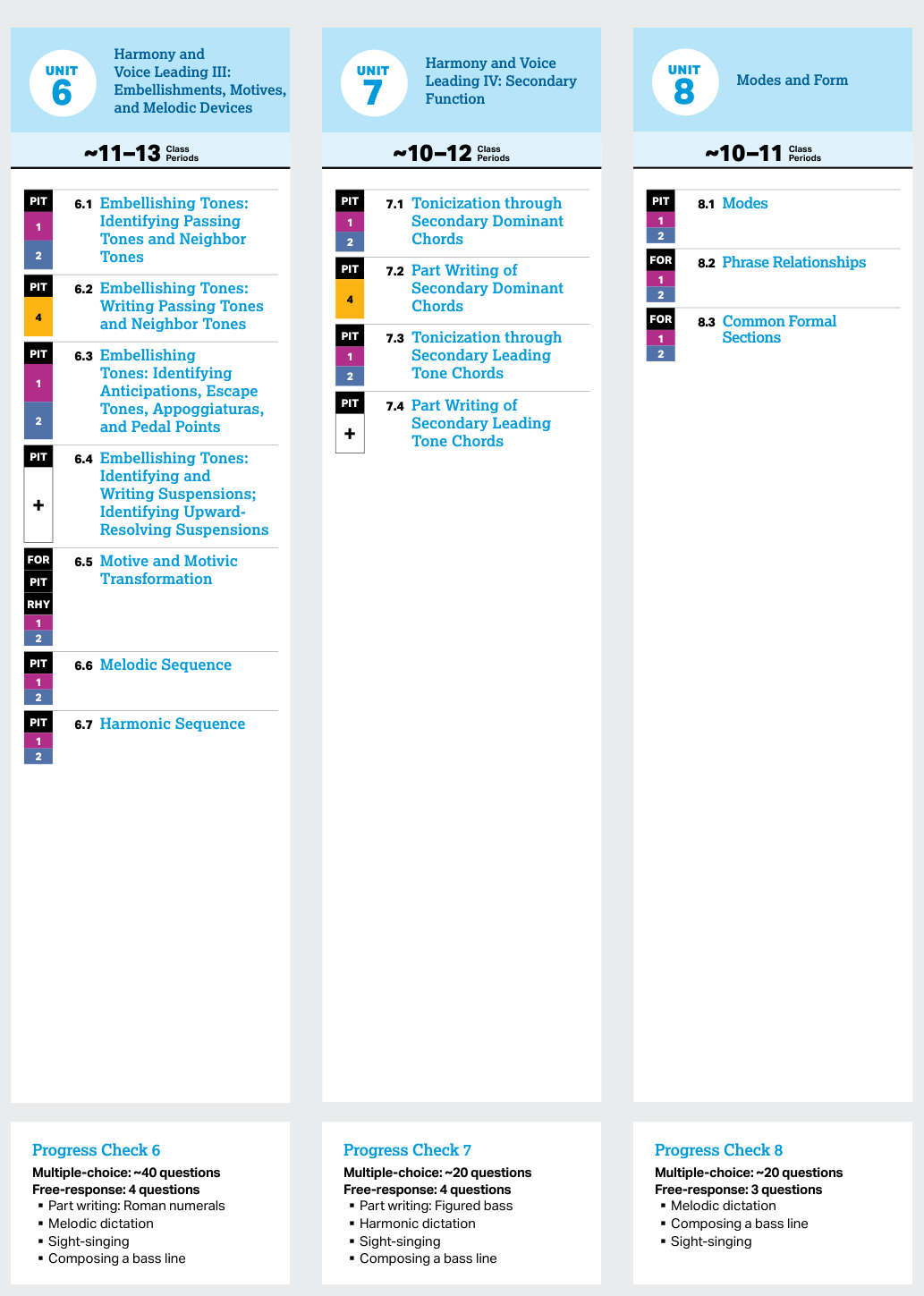
Teachers should review each unit overview for its essential questions, conceptual understandings, and skills. The Unit at a Glance table then shows how topics build toward a common understanding, connects topics to enduring-understanding codes such as pitch, rhythm, form, and musical design, and provides suggested pacing. Pacing is a planning recommendation, not a measure of how quickly a student ought to master a concept.
The four official skill categories
The framework organizes application through four official skill categories. They are not separate “aural” and “written” courses; each is a different direction of travel through the same musical knowledge.
-
Skill 1: Analyze performed music. Students listen for melodic features, chords, harmonic progressions, cadences, motives, phrases, and phrase relationships in music that is heard. The reasoning begins with sound: a listener may identify a cadence by its sense of arrival before labeling the chords that create it.
-
Skill 2: Analyze notated music. Students inspect a score for the same kinds of information, including pitch patterns, rhythmic organization, chord structures, harmonic progressions, cadences, motives, phrases, and relationships among phrases.
-
Skill 3: Convert between performed and notated music. Students translate sound into notation or notation into sound. Melodic and harmonic dictation, sight-singing, and identifying an error in a performed or written passage all require this conversion skill.
-
Skill 4: Complete based on cues. Students produce music from constraints supplied by a prompt: a melody, bass line, figured bass, harmonic progression, stylistic expectation, or other musical cue. Part writing, composition, harmonization, and continuation tasks test whether students can apply conventions rather than merely name them.
Aural analysis is not an accessory
A student who can label a dominant seventh chord on paper but cannot hear its pull toward tonic has learned a symbol without fully understanding the process. Consistent practice should therefore combine aural analysis, score analysis, sight-singing, dictation, and composition.
A productive loop looks like this:
$$ \text{hear} \rightarrow \text{locate or notate} \rightarrow \text{analyze} \rightarrow \text{sing or write} \rightarrow \text{hear again} $$
For example, a listener may hear a melodic leap, locate the corresponding interval in a score, identify the phrase’s cadence, sing the line, and then write a brief continuation. Each pass strengthens a different part of the same musical understanding.
Feedback and the learning cycle
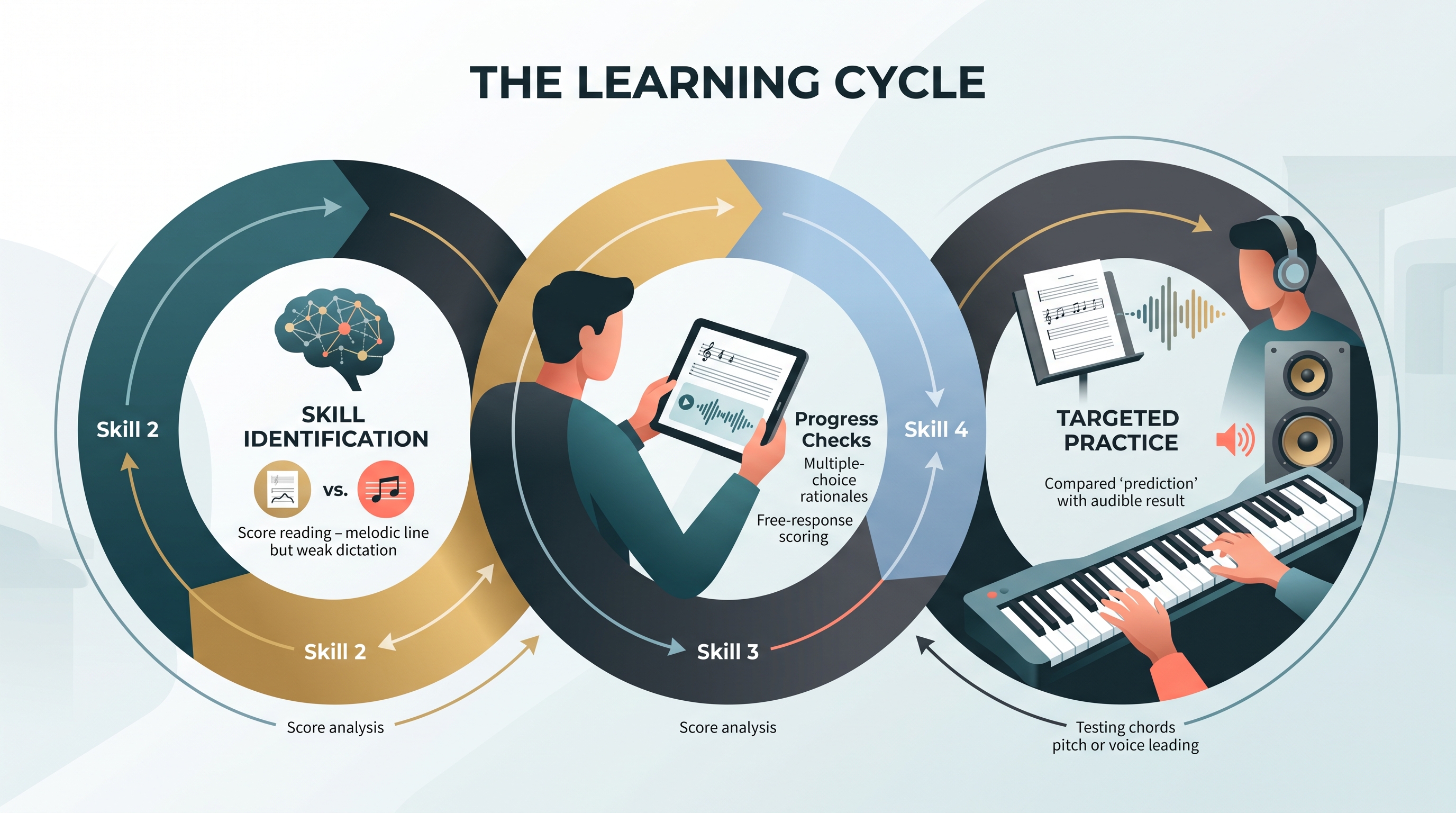
At the end of a unit, Progress Checks combine multiple-choice questions with rationales and free-response questions with scoring information. Question-level feedback identifies the reasoning behind an individual answer; unit- and skill-level feedback helps reveal broader patterns, such as accurate score reading but weak melodic dictation.
A well-equipped classroom supports this cycle with a piano or electronic keyboard, sound-reproduction equipment, and access to audio materials. These are not merely conveniences: reliable sound makes it possible to compare a written prediction with an audible result, while a keyboard makes pitch relationships, chords, and voice leading physically testable.
Retrieval check: If a student hears a cadence, labels it from a score, sings the soprano line, and writes an appropriate bass continuation, which official skills are active? The strongest answer includes Skill 1: Analyze performed music, Skill 2: Analyze notated music, Skill 3: Convert between performed and notated music, and Skill 4: Complete based on cues.

Source Materials
- Learn More (.pdf)
- AP Music Theory Course and Exam Description
- AP Music Theory Course Overview
- AP Music Theory Course at a Glance
- AP Music Theory Course at a Glance Poster
- Adopt AP Music Theory
- AP Music Theory
- AP Music Theory
- Figure — AP Music Theory Course and Exam Description (p. 1)
- Figure — AP Music Theory Course and Exam Description (p. 17)
- Pacing recommendations for each unit are suggestions for how to allocate teaching time and administer the Personal Progress Checks. Class periods are based on a 45-minute class period, meeting five da
- Figure — AP Music Theory Course and Exam Description (p. 29)