From the free course AP Music Theory on Lykke
1.3 Half steps and whole steps
Key concepts: Half steps as the smallest interval between two pitches · Whole steps as intervals equal to two half steps · Identifying half-step and whole-step relationships in performed and notated music · Pitch patterns made up of half and whole steps · Major and minor scales as ordered pitch patterns · Ascending and descending scale motion · Accidentals used when a pitch requires notation outside the naturals · Conjunct melodic motion as stepwise movement · Disjunct melodic motion as movement by leaps
A half step is the smallest possible distance between two pitches in the standard pitch system; a whole step is exactly two half steps. These two distances are the musical “atoms” from which scales and many melodic patterns are built.
1.3 Half steps and whole steps
A half step is the smallest possible distance between two pitches in the standard pitch system; a whole step is exactly two half steps. These two distances are the musical “atoms” from which scales and many melodic patterns are built.
Essential Knowledge PIT-1.C.1: Pitch patterns include intervals, scales, triads, seventh chords, and other short successions of notes. The half step, also called a semitone, is the smallest possible distance between two pitches; the whole step, also called a whole tone, equals two half steps.
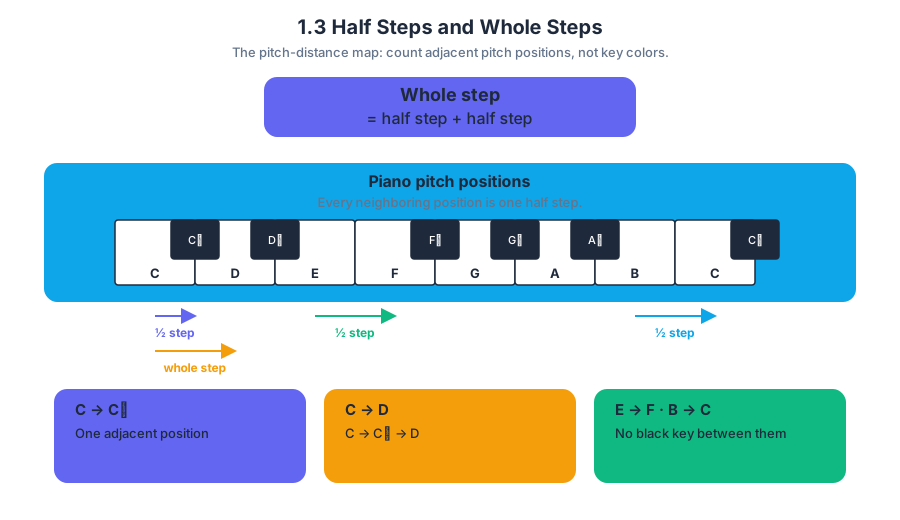
The pitch-distance map
On a piano, a half step moves from one key to the immediately adjacent key, whether that key is black or white. A whole step skips over one half-step position and therefore contains two adjacent half steps.
For example:
- $C$ to $C\sharp$ is a half step.
- $C$ to $D$ is a whole step: $C$ to $C\sharp$, then $C\sharp$ to $D$.
- $E$ to $F$ is a half step, even though no black key lies between them.
- $B$ to $C$ is also a half step.
The visual pattern is therefore not “white key versus black key.” It is adjacent pitch positions:
$$ \text{whole step} = \text{half step} + \text{half step} $$
Accidentals matter
Natural notes—$A$, $B$, $C$, $D$, $E$, $F$, and $G$—do not represent every pitch position. Accidentals alter a natural pitch: a sharp raises it by a half step, a flat lowers it by a half step, and a natural sign cancels a previous sharp or flat.
When a pitch requires an accidental in written music, the accidental appears to the left of the notehead. Thus, $F\sharp$ is one half step above $F$, while $B\flat$ is one half step below $B$. Because $E$ to $F$ and $B$ to $C$ are already half steps, $E\sharp$ sounds like $F$ and $C\flat$ sounds like $B$, although the notation may differ according to musical context.
Common misconception — “A half step always includes a black key.” It does not. $E$–$F$ and $B$–$C$ are decisive counterexamples. The reliable test is adjacency in pitch, not the color of a piano key.
Reading and hearing the distance
PIT-1.C — Learning Objective: Identify half and whole steps presented in:
- performed music;
- notated music.
For notated music, first identify the two pitches by letter name and accidental. Then count the chromatic distance between them. For performed music, listen for the size of the motion: a half step sounds tightly compressed, while a whole step sounds like a slightly wider step. Singing the first pitch and then reproducing the second can be more dependable than relying on visual memory alone.
Worked example: A melody moves upward from $D$ to $E\flat$, then from $E\flat$ to $F$.
- $D$ to $E\flat$ is a half step: $D$–$D\sharp/E\flat$.
- $E\flat$ to $F$ is a whole step: $E\flat$–$E$–$F$.
- The pattern is therefore half step, whole step.
If the same melody is sung rather than written, listen for a narrow first movement followed by a wider second movement. The order matters: reversing the notes produces descending motion, but the distance remains a half step or whole step.
Scale patterns: steps arranged in order
PIT-1.D — Learning Objective: Identify major scales presented in performed music and notated music.
PIT-1.D.1 — Essential Knowledge: Pitches arranged in specific patterns of half and whole steps in ascending or descending order form major and minor scales.
A scale is an ordered pitch pattern. A major scale follows this ascending sequence:
$$ W-W-H-W-W-W-H $$
where $W$ means whole step and $H$ means half step. The pattern is the same when the scale descends, but it is heard and notated in reverse order:
$$ H-W-W-W-H-W-W $$
At this stage, the important task is recognizing the pattern—not yet assigning scale-degree names. Accidentals are often necessary to preserve the required sequence of whole and half steps.
Stepwise motion versus leaps
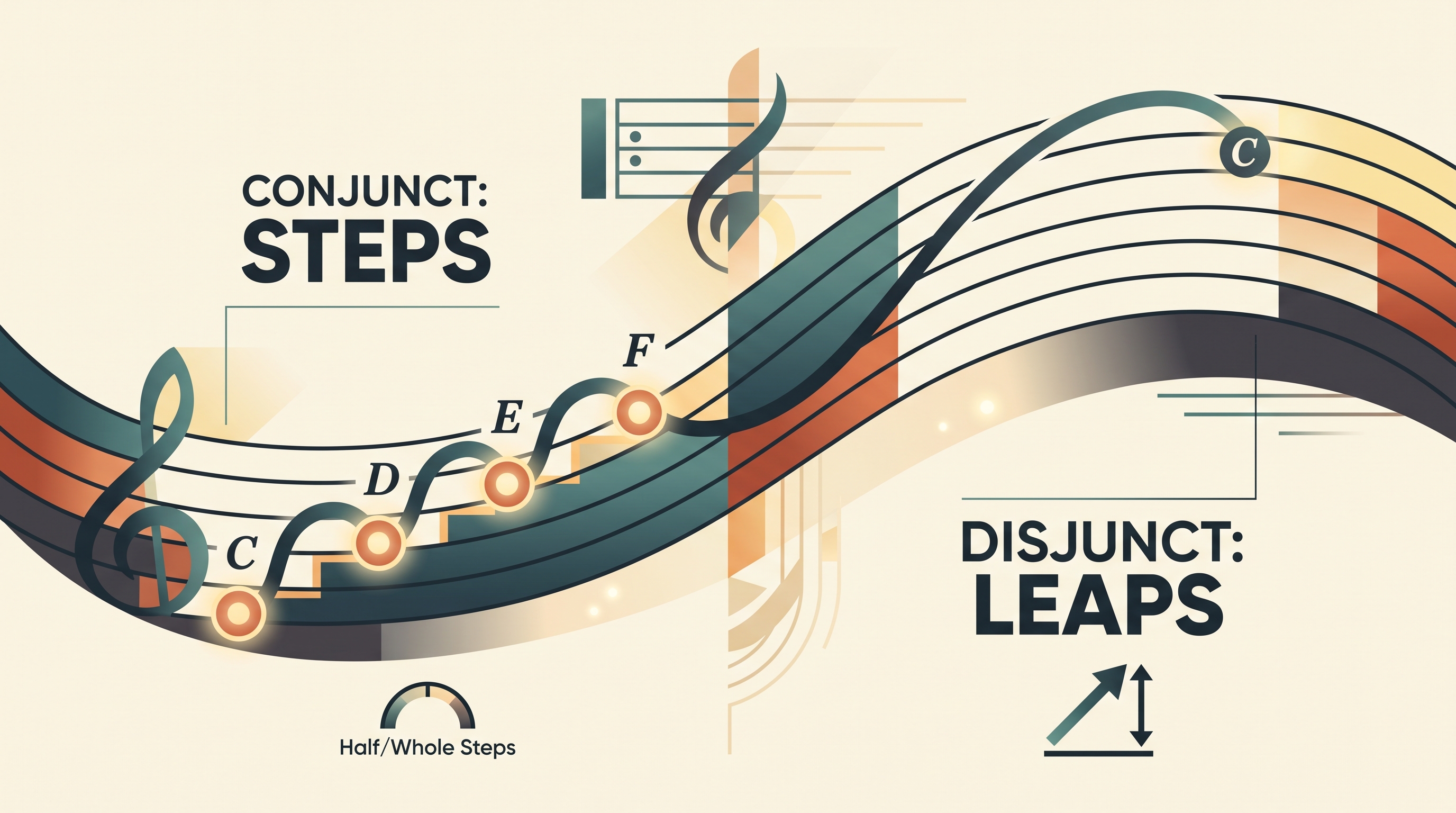
Conjunct motion is stepwise motion, moving by half steps or whole steps. Disjunct motion is leaping motion, moving by an interval larger than a whole step. In the sequence $C$–$D$–$E$, every connection is conjunct; in $C$–$G$, the motion is disjunct. A melody can alternate between the two, so identify each pair of neighboring pitches rather than labeling the entire melody too quickly.
Skill connection: Skill 1: Analyze Performed Music asks you to hear these distances and patterns. Skill 2: Analyze Notated Music asks you to identify them from a score. Skill 3: Convert Between Performed and Notated Music becomes relevant when you hear a step and must represent it with the correct note letter and accidental.
Retrieval check: Classify each motion as a half step, whole step, or leap: $F$ to $G$, $B$ to $C$, and $C$ to $E$. Which accidentals would you need to write if a melody required the pitch one half step above $A$?