From the free course AP Music Theory on Lykke
3.1 Triad and chord qualities
Key concepts: Chord definition and perception · Triads as three distinct pitches stacked in thirds · Seventh chords as four distinct pitches stacked in thirds · Triad qualities determined by major and minor thirds · Major, minor, diminished, and augmented triad qualities · Recognizing chord quality in performed music · Recognizing chord quality in notated music · Root position and inversions of triads · Chord-quality examples in harmonic analysis · Arpeggiation as a way of perceiving a chord
A chord is a group of three or more pitches heard simultaneously—or perceived as a single grouping when the pitches are sounded successively through arpeggiation, a broken-chord performance.
3.1 Triad and chord qualities
A chord is a group of three or more pitches heard simultaneously—or perceived as a single grouping when the pitches are sounded successively through arpeggiation, a broken-chord performance. The ear can therefore recognize a chord even when its notes do not arrive at exactly the same moment.
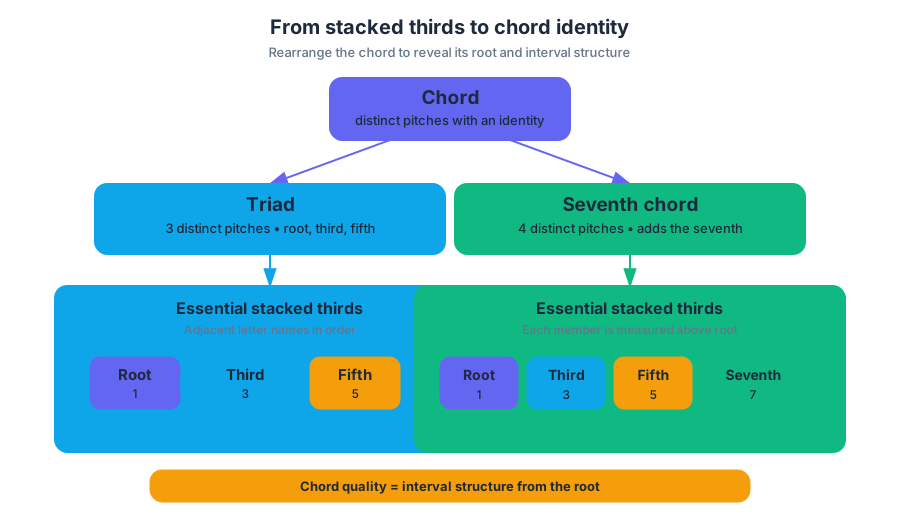
From stacked thirds to chord identity
In Western music, the two basic chord types are triads and seventh chords. A triad contains three distinct pitches arranged as adjacent letter names when placed in its essential stacked-third form; a seventh chord contains four distinct pitches arranged the same way.
When a chord is rearranged into stacked thirds, its lowest pitch is called the root. The other chord members are named by their intervallic position above the root: the third, the fifth, and, in a seventh chord, the seventh. The sounding bass note may be different from the root when the chord is inverted, but the chord’s quality still depends on the intervals measured from its root.
The essential structure can be visualized as follows:
| Chord type | Number of distinct pitches | Stacked-third members |
|---|---|---|
| Triad | 3 | root, third, fifth |
| Seventh chord | 4 | root, third, fifth, seventh |
PIT-1.O.1 defines the chord, triad, and seventh chord; PIT-1.O.2 supplies the names of the chord members; and PIT-1.O.3 explains that chord quality is determined by the chord’s interval structure. These identifiers belong to Learning Objective PIT-1.O: Describe the quality of a chord in performed music and notated music.
How thirds determine triad quality
A triad’s quality is determined by the two thirds formed above its root. The interval from root to third and the interval from third to fifth create a compact “interval recipe.”
| Triad quality | Lower interval | Upper interval | Example |
|---|---|---|---|
| Major | major third | minor third | C–E–G |
| Minor | minor third | major third | F-sharp–A–C-sharp |
| Diminished | minor third | minor third | B–D–F |
| Augmented | major third | major third | C–E–G-sharp |
A major triad sounds bright or stable because its root-to-third span is a major third and its third-to-fifth span is a minor third. A minor triad reverses that order. A diminished triad contains two minor thirds and produces a more tense, compressed sound, while an augmented triad contains two major thirds and has an unusually expanded, unsettled quality.
Worked example: identifying F-sharp minor
Suppose notation shows the pitches F-sharp, A, and C-sharp. First, arrange them as stacked thirds: F-sharp–A–C-sharp. The root is F-sharp, the third is A, and the fifth is C-sharp.
Now measure the intervals: F-sharp to A is a minor third, and A to C-sharp is a major third. The interval recipe is therefore minor third plus major third, so the triad is F-sharp minor.
The same reasoning works when the notes are sounded as an arpeggio. Listen for the implied root and mentally reorder the notes into thirds; do not classify the chord solely from the first pitch performed.
Seventh-chord quality
A seventh chord adds a fourth distinct pitch above the triad’s root. For example, a D major-minor seventh chord contains D, F-sharp, A, and C. Its stacked thirds are major third, minor third, and minor third: D to F-sharp, F-sharp to A, and A to C.
The phrase “major-minor seventh” names the combination of a major triad below and a minor seventh above the root. The quality label describes the complete interval structure, not merely the quality of the triad at the bottom.
Reading and hearing quality
For Skill 1: Analyze performed music, identify chord quality by listening for the characteristic interval pattern. A useful method is to hear the lowest apparent root, sing or imagine the third, and decide whether the third is major or minor; then distinguish the fifth as perfect, diminished, or augmented.
For Skill 2: Analyze notated music, read the pitches, reconstruct the stacked-third arrangement, and compare the intervals with the four triad recipes. These skills meet the learning objective in both required settings: performed music and notation.
Misconception check: The first note heard is not necessarily the root. An arpeggio may begin on the third or fifth, and an inverted chord may place another chord member in the bass. Identify the root from the complete pitch collection and its stacked-third structure.
Quality symbols provide a compact label: major may be marked M, minor m, diminished with $^\circ$ or d, and augmented with $+$ or A. For instance, $B^\circ/D$ means a diminished B triad—B, D, and F—with D in the bass; the symbol $^\circ$ identifies quality, while the bass note after the slash identifies the voicing or inversion.
Retrieval check
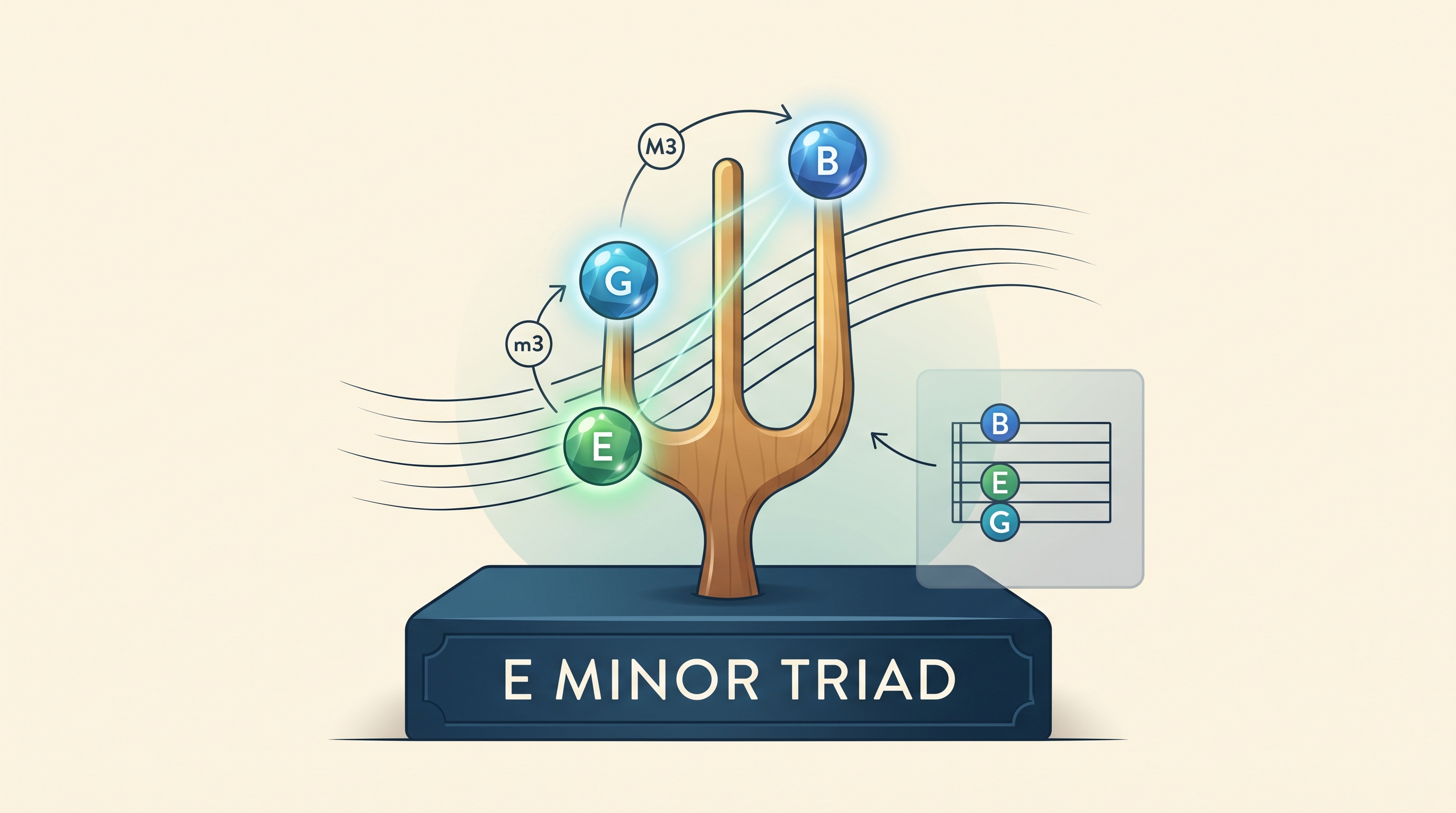
A chord contains E, G, and B. What is its quality? E–G is a minor third and G–B is a major third, so the answer is E minor. If the same pitches are performed in the order B–E–G, the chord’s quality does not change: the sounding order changes, but the pitch collection still forms an E-minor triad.
Source Materials
- Learn More (.pdf)
- AP Music Theory Course and Exam Description
- AP Music Theory Course Overview
- AP Music Theory Course at a Glance
- AP Music Theory Course at a Glance Poster
- Adopt AP Music Theory
- AP Music Theory
- AP Music Theory
- AP Music Theory-AP Students-College Board
- AP Music Theory-Unit Study Guides
- AP Music Theory-Raidar Choir
- Everything you need to know to get a 5 on AP Music Theory