From the free course AP Music Theory on Lykke
5.2 The vi (VI) chord
Key concepts: The vi (VI) chord · Chord progressions · Notated melodies · AP Music Theory harmony questions · Melody playback and listening responses · Exam question timing and pauses
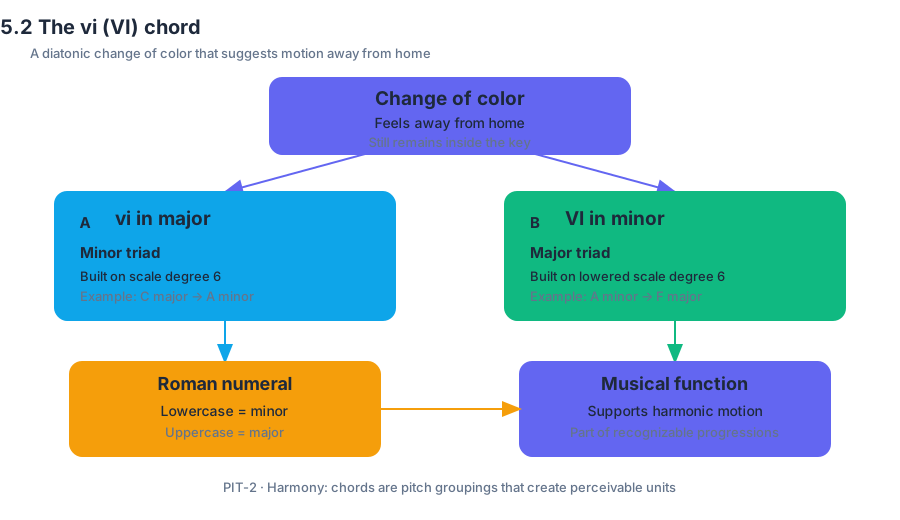
A melody can sound as if it is moving away from home without actually leaving the key: in a major key, the vi chord provides that change of color by beginning on scale degree $6$ while remaining entirely diatonic.
5.2 The vi (VI) chord
A melody can sound as if it is moving away from home without actually leaving the key: in a major key, the vi chord provides that change of color by beginning on scale degree $6$ while remaining entirely diatonic. In Roman-numeral analysis, it is written lowercase vi because its triad is minor; in a minor key, the parallel chord is written uppercase VI because the triad built on scale degree $6$ is major.
vi in a major key = a minor triad built on scale degree $6$.
VI in a minor key = a major triad built on lowered scale degree $6$.
The chord belongs to the harmonic language of PIT-2: Harmony—Groupings of pitches that are successively and/or simultaneously produced form perceivable units known as chords. The related identifiers PIT-2.A.1, PIT-2.A.2, PIT-2.B.1, and PIT-2.B.2 emphasize that chords are not isolated labels: they participate in recognizable progressions and support musical motion.
Building vi from the scale
In C major, scale degree $6$ is A. Stack the other diatonic notes above it by thirds:
$$A-C-E$$
The intervals above A are a minor third, $A$ to $C$, and a perfect fifth, $A$ to $E$. Therefore, the chord is an A-minor triad, labeled vi.
| Key | Scale degree $6$ | Triad | Roman numeral |
|---|---|---|---|
| C major | A | A–C–E | vi |
| G major | E | E–G–B | vi |
| A minor | F | F–A–C | VI |
| E minor | C | C–E–G | VI |
What vi does in a progression
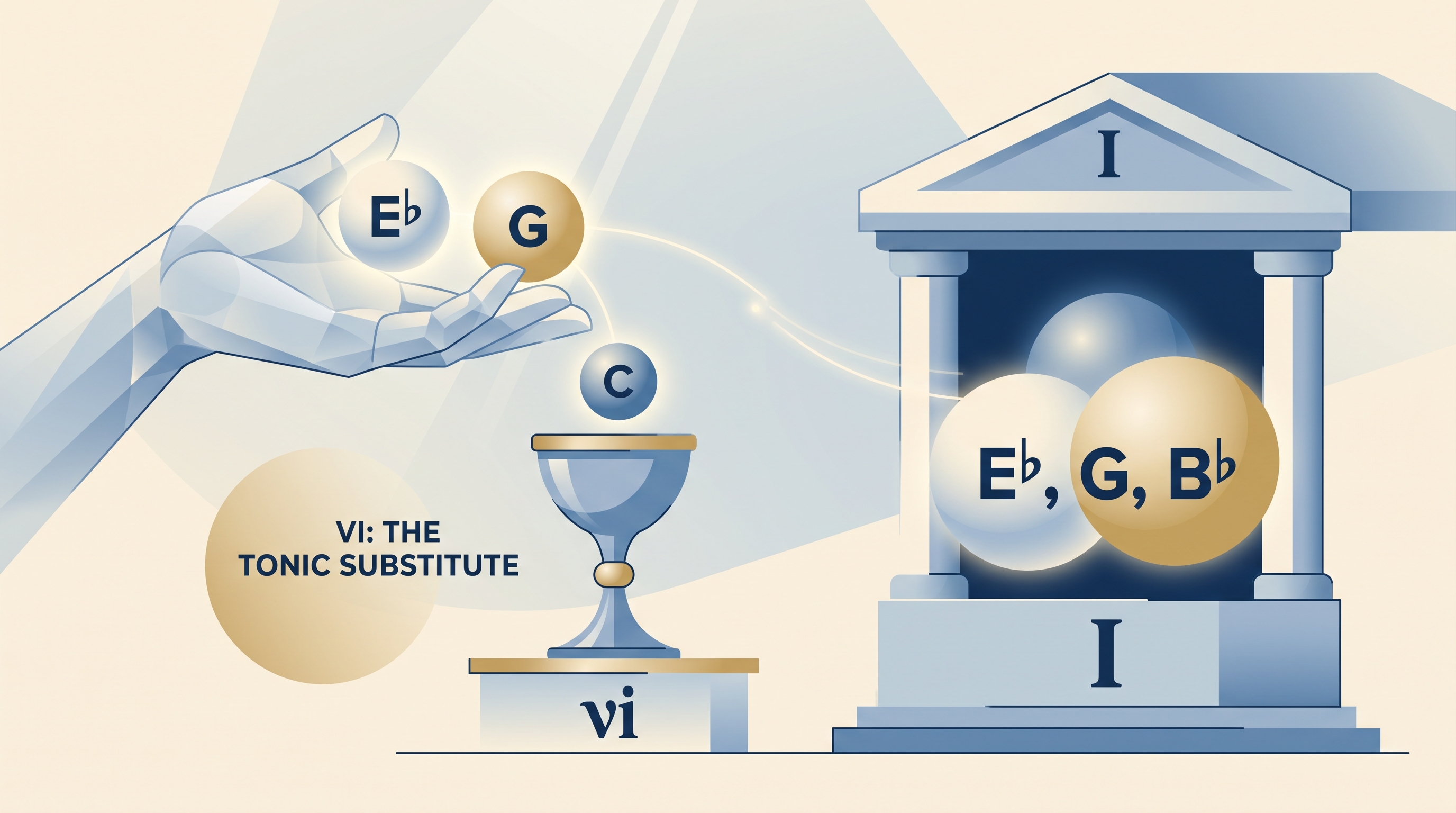
The vi chord often acts as a tonic-function substitute: it shares two pitches with the tonic triad. In C major, C major is $C$–$E$–$G$, while A minor is $A$–$C$–$E$; the common tones $C$ and $E$ make vi sound related to tonic, but its bass note A prevents it from feeling like a complete return home.
A common progression is:
$$ I \rightarrow vi \rightarrow ii \rightarrow V \rightarrow I $$
In C major, that becomes:
$$ C\text{ major} \rightarrow A\text{ minor} \rightarrow D\text{ minor} \rightarrow G\text{ major} \rightarrow C\text{ major} $$
The progression first moves from tonic to a darker, softer substitute, then through predominant-function $ii$ and dominant $V$ toward tonic. The vi chord can also follow $V$: $V \rightarrow vi$ creates a deceptive motion, because the dominant appears to promise tonic but resolves to vi instead.
Worked contextual example: reading labels above a melody
Imagine a notated melody in C major with Roman-numeral labels placed above successive measures:
$$I \qquad vi \qquad ii \qquad V \qquad I$$
Read the labels as a harmonic map rather than as isolated vocabulary. The melody’s notes should be interpreted against each underlying chord: notes such as $A$, $C$, and $E$ are especially stable during vi, while $G$ and $B$ may function as nonchord tones or as preparation for the following harmony.
If the melody ends on E over the vi label, do not automatically call the harmony $I$. E is also a chord member of vi, and the Roman numeral above the melody supplies the intended harmonic context. The labels indicate specific chord progressions, appearing above the notated melody; they tell you which harmonic path the passage takes.
The major–minor distinction
The capitalization is structural, not decorative:
- vi: scale degree $6$ in a major key produces a minor triad.
- VI: scale degree $6$ in a minor key produces a major triad, using the lowered sixth scale degree of the minor collection.
A frequent misconception is that “the sixth chord” always means a major chord because the symbol contains a capital-looking Roman numeral in some contexts. Correct the mistake by identifying the key first, locating scale degree $6$, and stacking the notes diatonically. Chord quality determines capitalization.
Misconception check: In G major, is vi D major or D minor?
G major is $G$–$A$–$B$–$C$–$D$–$E$–$F^\sharp$; scale degree $6$ is E, so vi is $E$–$G$–$B$, an E-minor triad—not D major.
Listening and AP response timing
In AP Music Theory harmony and aural questions, a labeled melody links notated music to performed music. The notation may show Roman-numeral chord labels above the melody, while playback lets you hear how the progression shapes the phrase.
For the referenced listening format, Question 1’s melody is played three times. A 30-second pause follows the first playing. Question 2’s melody is played four times, with a one-minute pause following each subsequent playing. Responses to Questions 2 and 6 are written on the designated response page. The exam clarifications and corrections associated with these instructions appear on pages $225$–$230$; use the current official directions when practicing because timing and page-location instructions control where answers belong.
The four AP skill categories provide the clearest way to describe the work:
- Skill 1: Analyze performed music — hear the melody’s contour, cadence, and harmonic color.
- Skill 2: Analyze notated music — read the key, melody, chord labels, and progression.
- Skill 3: Convert between performed and notated music — connect what you hear with the written Roman numerals and pitches.
- Skill 4: Complete based on cues — use the given key, labels, measures, and playback repetitions to produce the required response.
During the first hearing, establish the key and phrase direction. During the pauses, verify the vi label against the melody’s pitches; do not spend the entire pause replaying a single uncertain note mentally. On later hearings, check rhythm, cadential motion, and whether the written response is on the designated page.
Retrieval check
In E-flat major, identify vi, then explain why it may sound like a tonic substitute. Finally, if a melody is labeled $I$–$vi$–$ii$–$V$–$I$, name the chord-quality pattern.
Answer: E-flat major’s scale degree $6$ is C, so vi is $C$–$E\flat$–$G$, a C-minor triad. It shares two pitches with E-flat major, allowing it to resemble tonic while its bass changes. The quality pattern is major, minor, minor, major, major.
Source Materials
- Learn More (.pdf)
- AP Music Theory Course and Exam Description
- AP Music Theory Course Overview
- AP Music Theory Course at a Glance
- AP Music Theory Course at a Glance Poster
- Adopt AP Music Theory
- AP Music Theory
- AP Music Theory
- Based on your experience at the AP® Reading with student responses, what advice would you offer teachers to help them improve the student performance on the exam?
- Based on your experience at the AP® Reading with student responses, what advice would you offer teachers to help them improve the student performance on the exam?
- Based on your experience at the AP® Reading with student responses, what advice would you offer teachers to help them improve the student performance on the exam?
- Based on your experience at the AP® Reading with student responses, what advice would you offer teachers to help them improve the student performance on the exam?