From the free course AP Music Theory on Lykke
AP Practice 1
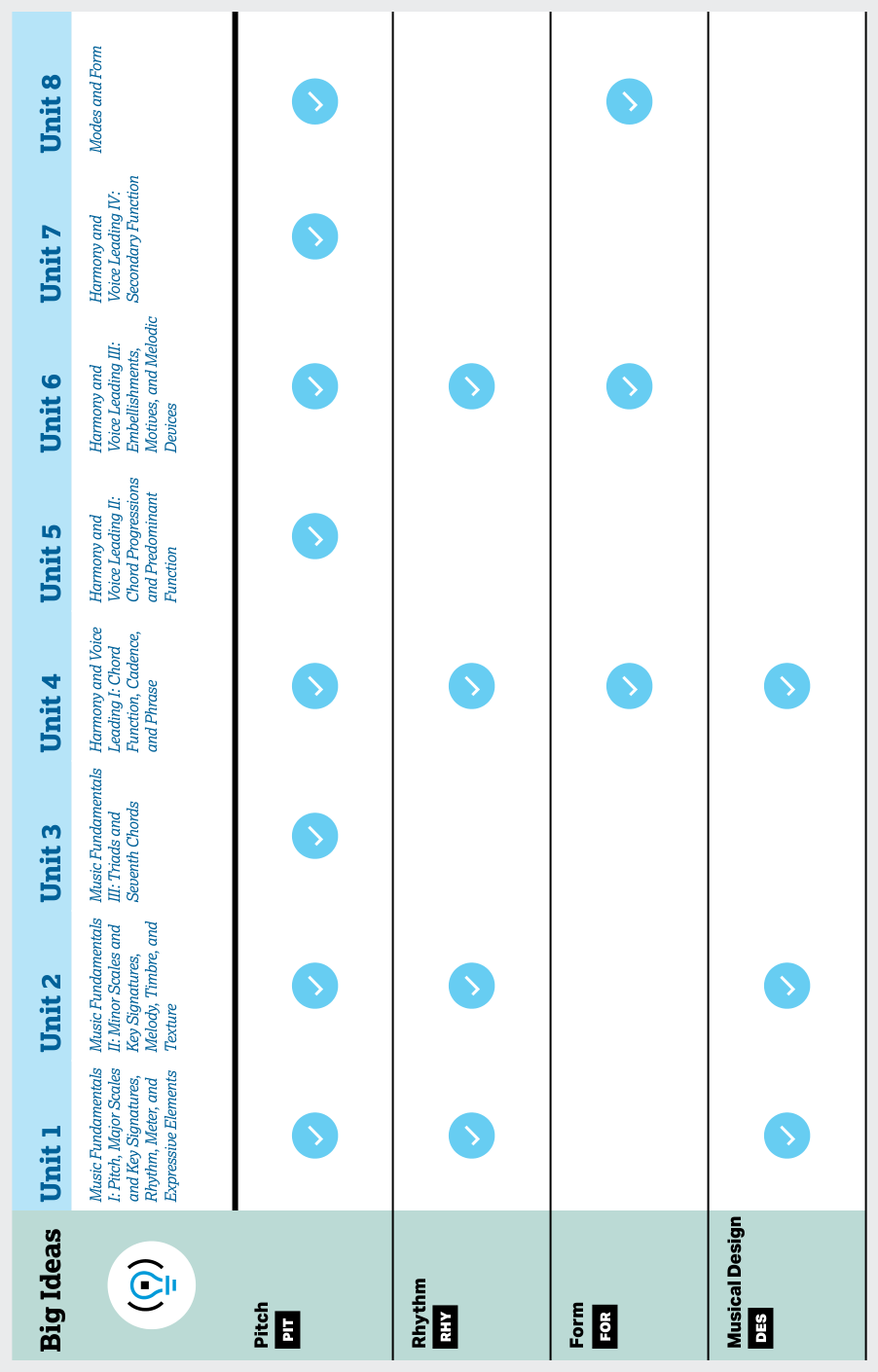
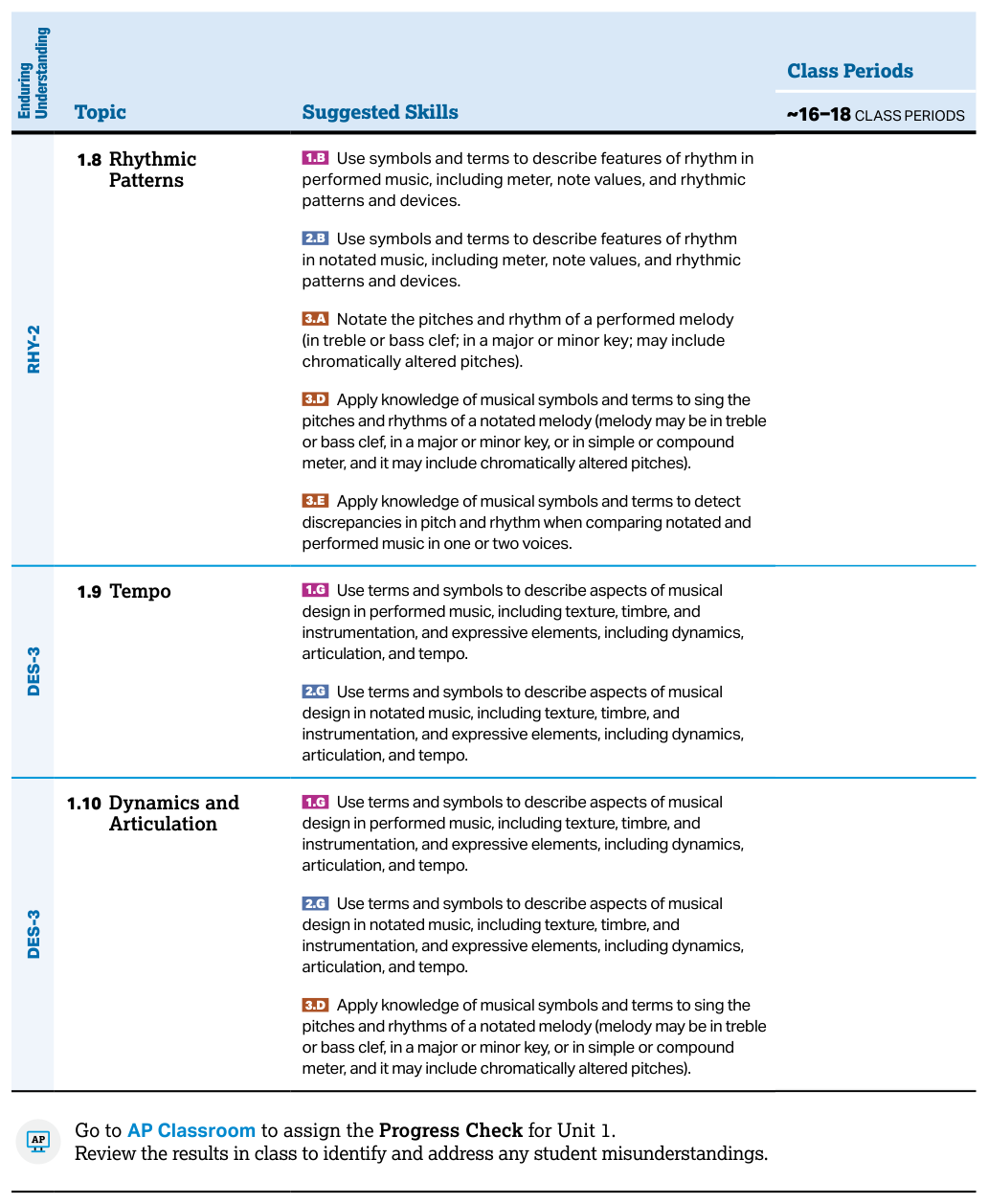
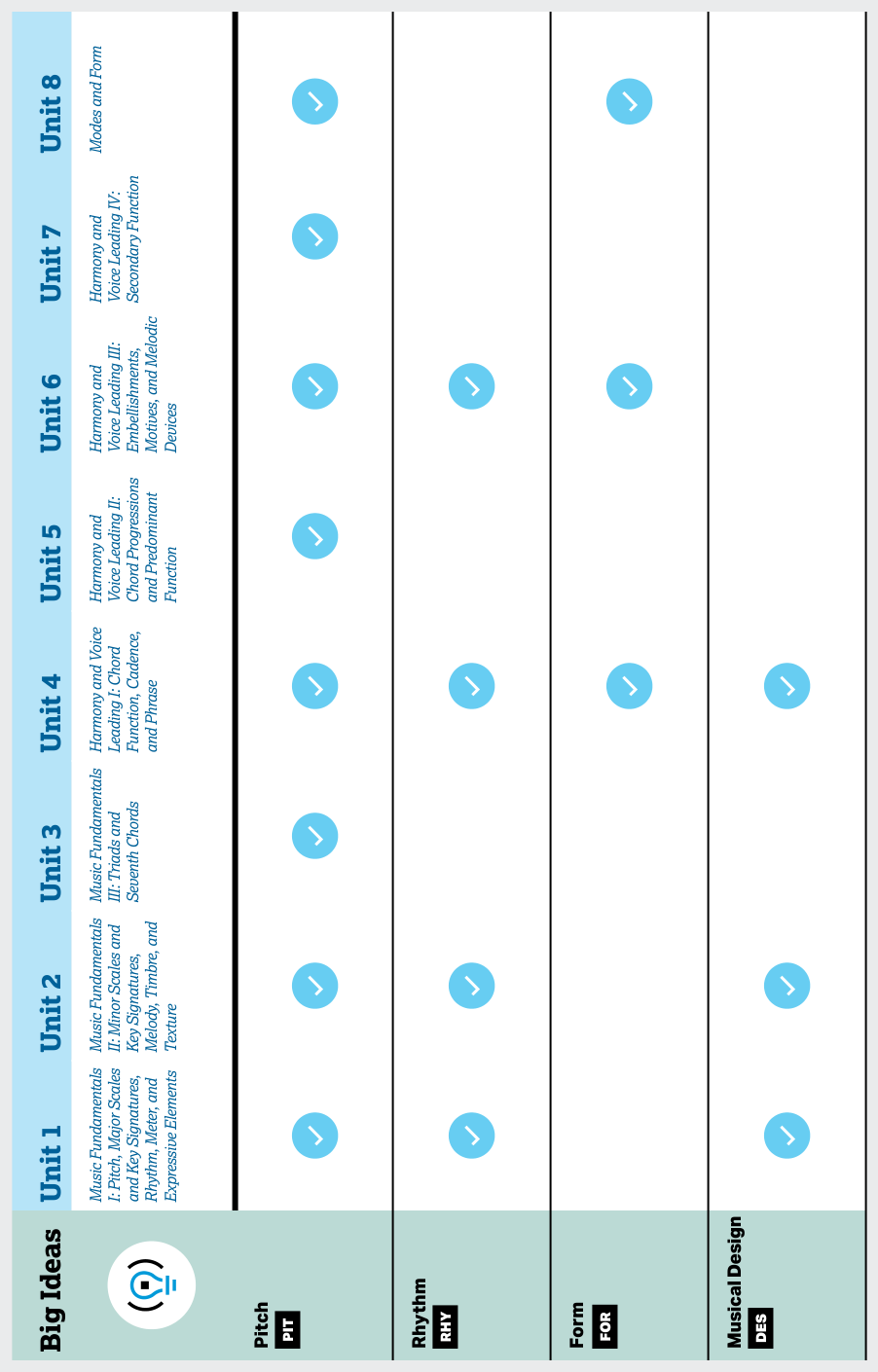
Key concepts: AP Music Theory Course and Exam Description updates effective Fall 2026 · Retardation and upward-resolving suspension as the same musical concept · Texture terminology clarification: removal of “technical” and “casual” descriptors · AP Exams, qualifying scores, college credit, and course placement · AP’s emphasis on evidence, scientific reasoning, and independent thinking · AP’s opposition to censorship and support for respectful debate · Access, opportunity, and readiness for students enrolling in AP courses · My AP activation and access to AP resources · Aural skills, listening, harmony, and sight-singing in AP Music Theory · Diverse musical repertoire in AP Music Theory
A strong AP Music Theory answer begins with evidence: what is heard, what is notated, and which musical process best explains it. This original practice set uses multiple-choice reasoning to rehearse the exam’s terminology updates, course purpose, and academic expectations while keeping the central habit of mind…
AP Practice 1
A strong AP Music Theory answer begins with evidence: what is heard, what is notated, and which musical process best explains it. This original practice set uses multiple-choice reasoning to rehearse the exam’s terminology updates, course purpose, and academic expectations while keeping the central habit of mind clear: identify the evidence before choosing a conclusion.
Timing guidance: Allow approximately $10$–$12$ minutes for the questions below, including a brief review. On the actual AP Exam, multiple-choice questions may test performed music, notated music, terminology, harmony, form, aural recognition, and analysis. AP Exams are administered each year in May; a qualifying score is typically used by colleges for credit, placement into advanced courses, or both, although policies vary by institution.
Question 1: Nonharmonic-tone terminology
A voice sustains a consonant note into a new harmony. That note becomes dissonant against the new chord and then resolves upward by step to a consonant note. Which statement best identifies the terminology required by the AP Music Theory materials effective beginning Fall 2026?
A. The note is an accented passing tone only.
B. The note is a retardation, also called an upward-resolving suspension.
C. The note is a lower neighbor tone because it resolves upward.
D. The note is a rearticulated suspension because every suspension must be repeated.
Answer: B. The decisive evidence is the delayed resolution of a note that was sustained into a new harmony, followed by upward stepwise resolution. Under PIT-2.M.5, “upward-resolving suspension” is recognized as a formal synonym for retardation. A rearticulated suspension and a chain of suspensions are also recognized classifications, but neither is required by the description in the question.
Key distinction: “Retardation” and “upward-resolving suspension” name the same musical concept; they are not two different nonharmonic tones.
Misconception check: Do not classify a tone solely by the direction of resolution. A neighbor tone moves away from and back to a single structural pitch, whereas a suspension or retardation is understood through its relationship to the harmony and its preparation, dissonance, and resolution.
Question 2: Texture terminology
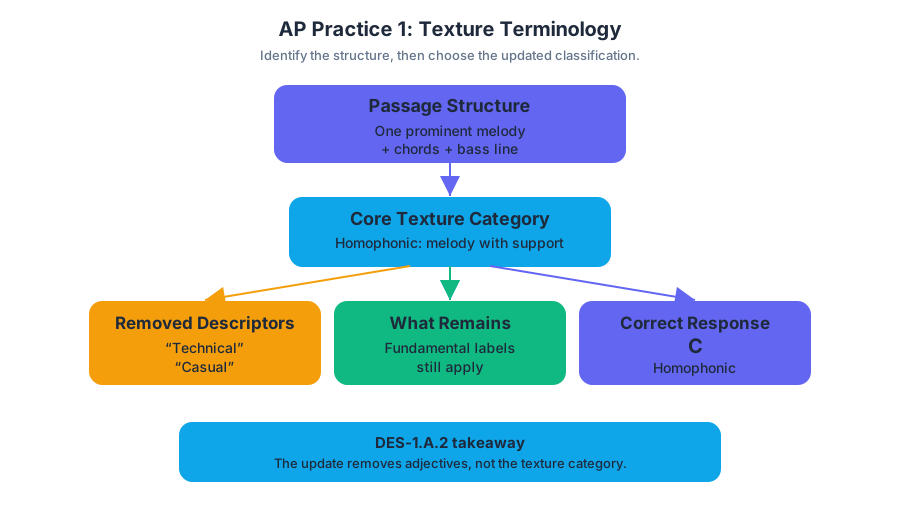
A student describes a passage by identifying one prominent melody, supporting chords, and a bass line. Which response uses the updated texture terminology most appropriately?
A. “The passage is technically homophonic.”
B. “The passage is casually homophonic.”
C. “The passage is homophonic because one melody is supported by accompanying material.”
D. “The passage cannot be classified because the updated terminology removes all texture labels.”
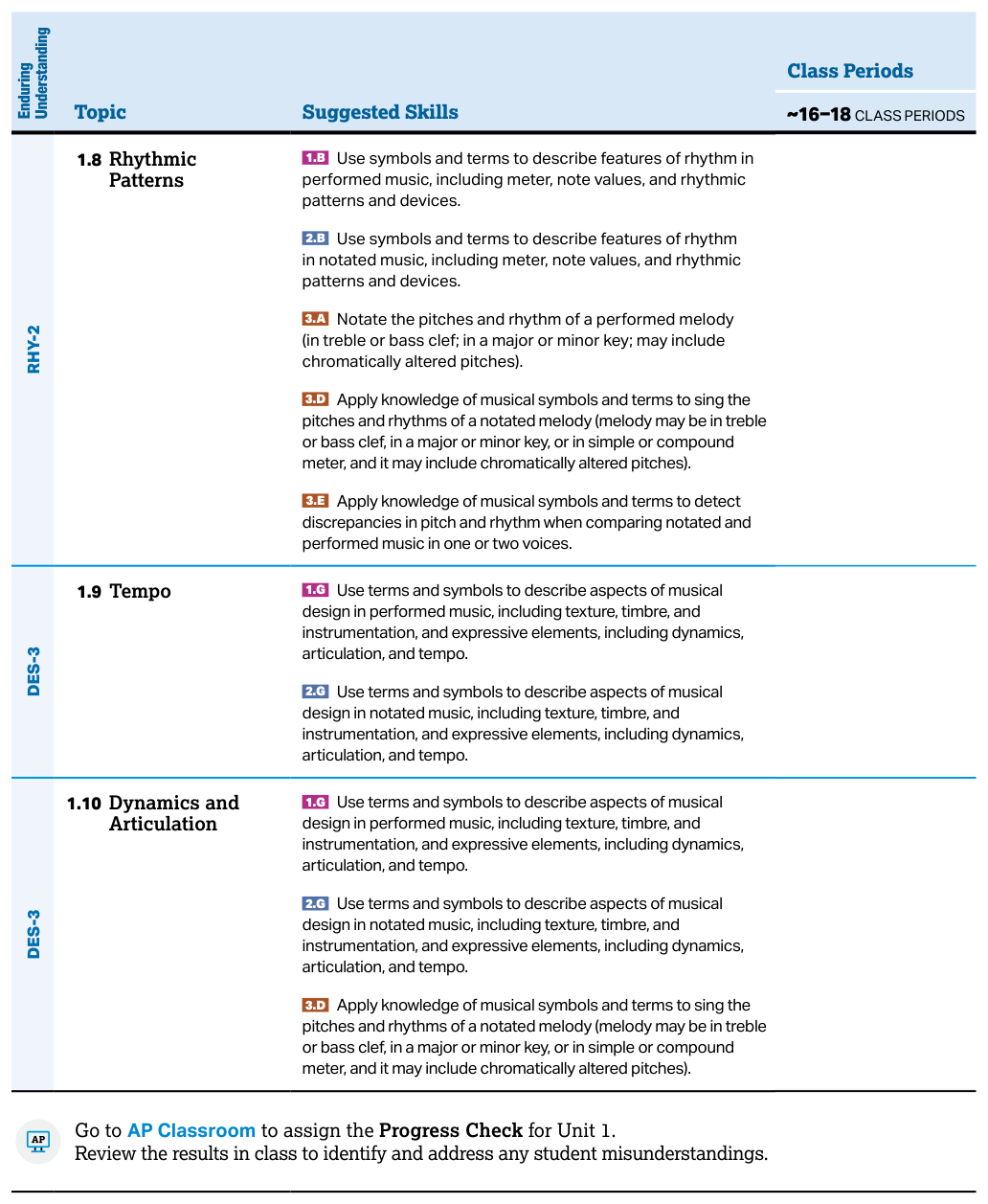
Answer: C. DES-1.A.2 removes the descriptors “technical” and “casual” from the classification of texture terminology. The update does not remove the fundamental category homophonic and does not replace the deleted adjectives with new required terms.
Question 3: What AP Music Theory measures
Which activity most directly represents the primary emphasis of AP Music Theory?
A. Memorizing composers’ biographies without listening to their music
B. Recognizing, understanding, and describing tonal materials through performed and notated music
C. Reproducing one cultural or political interpretation of every musical work
D. Studying only Western art music through silent score reading
Answer: B. AP Music Theory develops recognition, understanding, and description of the basic materials and processes of tonal music as they are heard or presented in a score. Aural skills are a primary objective, and the course also includes sight-singing, notation, harmony, and performance-based work. Musical examples may come from Western tonal repertoire, contemporary art music, jazz, popular music, and non-Western cultures.
The course does not require students to adopt a particular cultural or political viewpoint. AP’s stated approach begins with evidence and scientific reasoning: students examine what can be heard or observed, evaluate interpretations, and draw their own conclusions. Respectful debate is encouraged; personal attacks, censorship, and indoctrination are not substitutes for analysis.
Question 4: Administration and preparation
Which statement is most accurate about preparation for the updated AP Music Theory assessment?
A. Students begin accessing AP support only after submitting the exam.
B. The audio portion remains dependent on CDs, and course timing changes with the terminology updates.
C. Teachers and students activate My AP at the beginning of the school year, and updated materials are implemented beginning Fall 2026.
D. Because colleges use the same placement policy, every qualifying score guarantees identical credit.
Answer: C. My AP is activated at the beginning of the school year so students can access AP resources and prepare for exam-day procedures. The Fall 2026 clarifications revise selected terminology, including PIT-2.M.5 and DES-1.A.2; the audio-delivery clarification moves listening portions from CDs to the Bluebook application while the exam’s content and timing remain unchanged. College credit and placement decisions remain institution-specific.
Examiner-rewarded reasoning
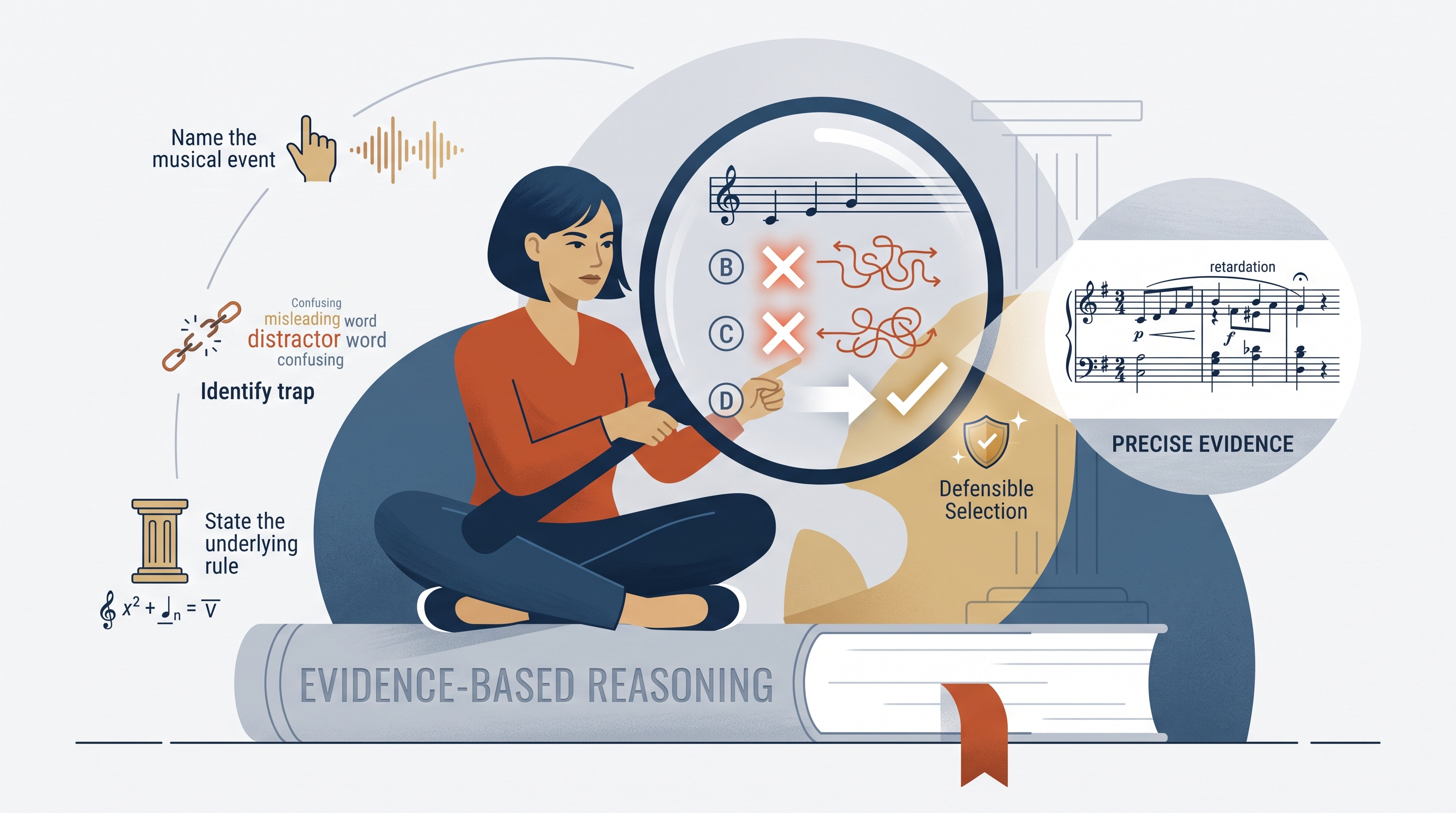
For a multiple-choice task, the rewarded performance is not a written rubric point but a defensible selection based on precise evidence. Review each missed item using this routine:
- Name the evidence: What musical event, wording, or policy detail controlled the answer?
- Name the distractor trap: Did you confuse resolution direction with tone classification, or assume a deleted adjective was replaced?
- State the rule: For example, “A retardation is an upward-resolving suspension under PIT-2.M.5.”
- Re-answer without looking: Explain why each incorrect option fails.
Retrieval check: In one sentence, explain why a retardation and an upward-resolving suspension receive the same classification, and in a second sentence identify the two texture descriptors removed by DES-1.A.2.
Source Materials
- Learn More (.pdf)
- AP Music Theory Course and Exam Description
- AP Music Theory Course Overview
- AP Music Theory Course at a Glance
- AP Music Theory Course at a Glance Poster
- Adopt AP Music Theory
- AP Music Theory
- AP Music Theory
- Course Framework V.1 | 20 AP Music Theory Course and Exam Description
- Course Framework V.1 | 34 AP Music Theory Course and Exam Description
- Course Framework V.1 | 20 AP Music Theory Course and Exam Description
- Course Framework V.1 | 34 AP Music Theory Course and Exam Description