From the free course AP Music Theory on Lykke
4.4 Cadences and phrases
A cadence is a musical punctuation point: a pattern of harmony and melody that creates closure, continuation, or surprise. A phrase is a complete musical thought, often ending at a cadence.
4.4 Cadences and phrases
A cadence is a musical punctuation point: a pattern of harmony and melody that creates closure, continuation, or surprise. A phrase is a complete musical thought, often ending at a cadence. Just as spoken language uses commas and periods, tonal music uses cadences to shape the listener’s sense of arrival.
Official topic identifier: 4.4 Cadences and phrases
Associated big idea: PIT—Pitch
Associated skill emphasis: PIT +, especially identifying harmonic and melodic evidence in performed or notated music.
Four broad cadence types
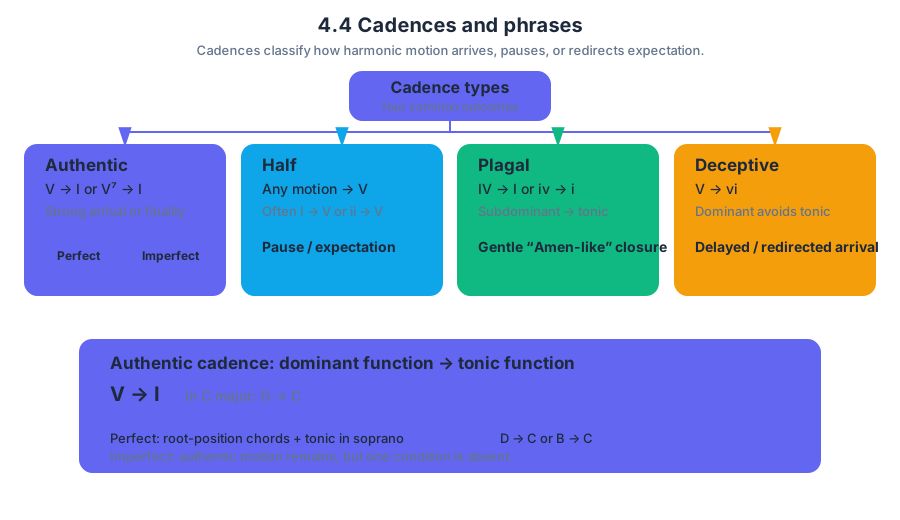
There are four broad cadence types: authentic, half, plagal, and deceptive. Perfect authentic and imperfect authentic cadences are not separate broad categories; they are two subtypes of the authentic cadence.
| Broad type | Typical harmonic motion | Effect |
|---|---|---|
| Authentic | Dominant to tonic, $V$–$I$ or $V^7$–$I$ | Strong arrival or finality |
| Half | Any progression ending on dominant, often $I$–$V$ or $ii$–$V$ | Pause or expectation |
| Plagal | Subdominant to tonic, $IV$–$I$ or $iv$–$i$ | Gentle, often “Amen-like” closure |
| Deceptive | Dominant to a chord other than tonic, commonly $V$–$vi$ | Delayed or redirected arrival |
An authentic cadence moves from dominant function to tonic function. In C major, the basic pattern is
$$ V \rightarrow I = G \rightarrow C. $$
A perfect authentic cadence requires especially strong confirmation: both chords are in root position, the final tonic is in the soprano, and the soprano moves from scale degree $\hat{2}$ to $\hat{1}$ or from $\hat{7}$ to $\hat{1}$. Thus, a soprano motion $D \rightarrow C$ over $G \rightarrow C$ produces a perfect authentic cadence.
An imperfect authentic cadence still uses dominant-to-tonic motion, but one or more conditions for perfection is absent. The dominant or tonic may be inverted, or the soprano may end on scale degree $\hat{3}$ rather than $\hat{1}$. For example, $V^6 \rightarrow I$ or $V \rightarrow I$ with soprano motion $G \rightarrow E$ is authentic but imperfect.
Hearing the difference
A half cadence ends on the dominant. In C major, $I \rightarrow V$ produces a clear stopping point without tonal completion:
$$ C \rightarrow G. $$
The music may pause on $G$, but the listener expects continuation toward $C$. A half cadence can therefore occur at the end of a phrase even when the entire composition continues immediately afterward.
A plagal cadence moves from subdominant to tonic, such as $IV \rightarrow I$ in a major key or $iv \rightarrow i$ in a minor key. It sounds less urgent than an authentic cadence because it lacks the leading-tone-to-tonic attraction of $V \rightarrow I$.
A deceptive cadence begins like an authentic cadence but avoids tonic. The common pattern is $V \rightarrow vi$ in major or $V \rightarrow VI$ in minor:
$$ G \rightarrow A\text{-minor} $$
in C major. The dominant creates an expectation of $I$, while the following chord redirects the phrase. The cadence is “deceptive” because the harmonic goal is withheld, not because the progression is random.
Phrases and phrase boundaries
A phrase is identified by several kinds of evidence working together:
- a cadential harmonic pattern;
- a sustained or repeated final note;
- a rest or breath;
- a change in melodic direction or rhythmic activity;
- a sense that one musical idea has ended before another begins.
A phrase does not have to end with a perfect authentic cadence. A question-like opening phrase may end with a half cadence, while its answering phrase may end with an authentic cadence. This creates a common antecedent–consequent relationship: the first phrase sounds incomplete, and the second responds with greater closure.
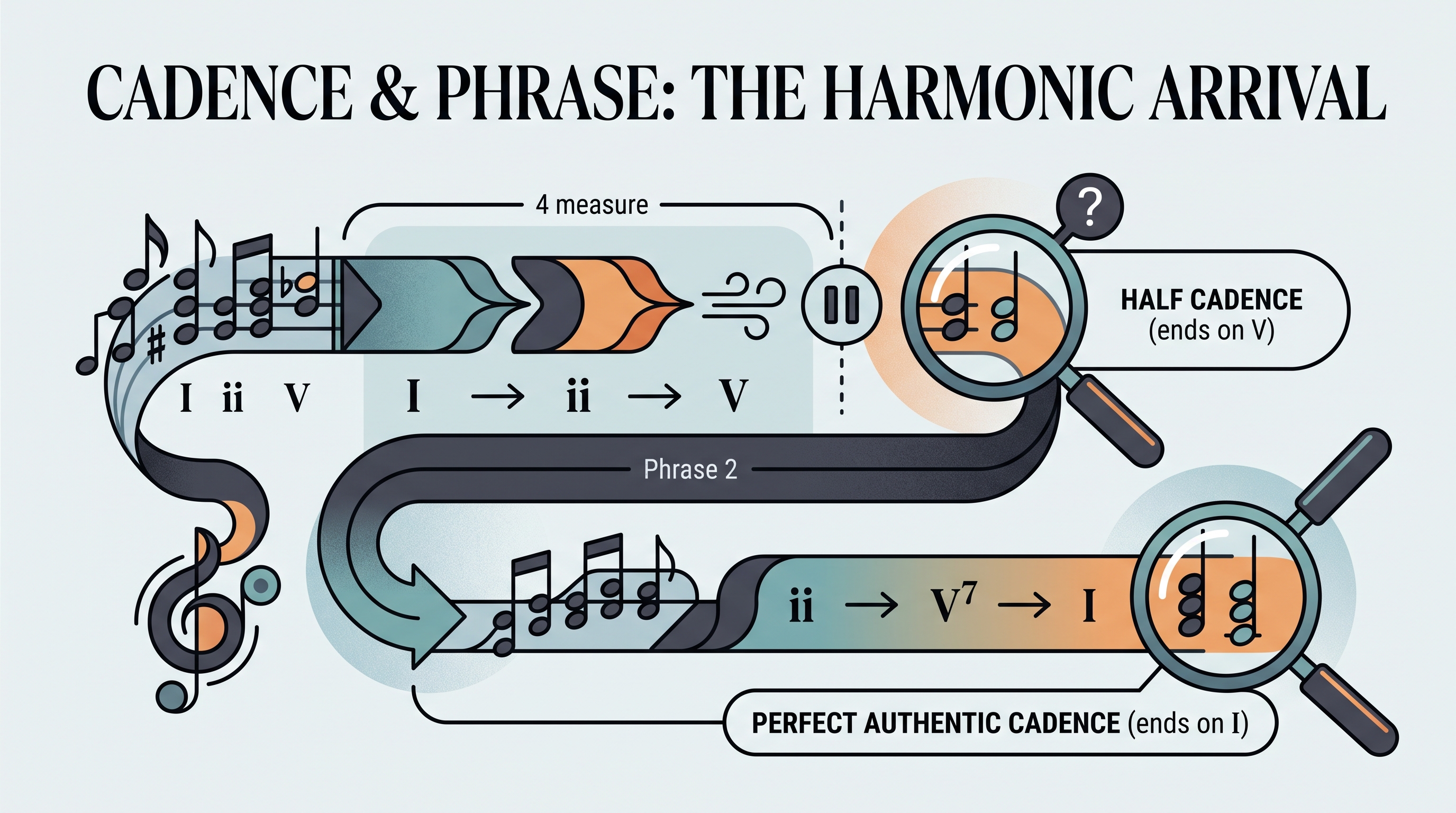
Worked example: Imagine an eight-measure melody in C major. Measures $1$–$4$ contain the progression $I$–$ii$–$V$ and stop on a sustained $G$. The phrase boundary occurs after measure $4$, and the cadence is a half cadence because the phrase ends on $V$. Measures $5$–$8$ repeat part of the opening idea, then move $ii$–$V^7$–$I$ with soprano $D$ resolving to $C$. The final boundary is a perfect authentic cadence.
When analyzing a score or recording, first locate likely phrase endings by listening for breath, length, or silence. Then inspect the final bass and soprano pitches, identify the final chord with Roman numerals, and classify the harmonic motion. This prevents a common mistake: labeling a cadence from the final chord alone. A phrase ending on $I$ is not automatically authentic; the preceding harmony must establish whether the arrival came from $V$, $IV$, or another chord.
Misconception check: “Every $V$–$I$ ending is a perfect authentic cadence.”
Correction: $V$–$I$ is authentic, but perfection also depends on root position and the soprano’s final pitch and motion.
Retrieval check: In G major, classify each ending: $I$–$V$, $IV$–$I$, $V$–$I$ with soprano $B$–$G$, and $V$–$vi$. The answers are, respectively, half, plagal, perfect authentic, and deceptive cadences.