From the free course AP Music Theory on Lykke
4.3 Harmonic progression and function
Key concepts: Harmonic function and progression in performed and notated music · Harmony as successively and simultaneously produced pitches forming chords that relate within a musical style · Harmonic rhythm: the rate at which chords change and its effect on musical pace · Chord roles and functional areas: tonic, predominant, dominant, and tonic · The tonic–predominant–dominant–tonic functional progression · Predominant harmonies, especially subdominant IV or iv and supertonic ii or ii° · Inconclusive and conclusive cadences · Perfect authentic cadence (PAC) and imperfect authentic cadence (IAC) · Second-inversion triads (6/4 chords) and their permitted contexts · Cadential, neighboring or pedal, passing, and arpeggiated 6/4 patterns
A chord progression is not merely a chain of sonorities: each chord creates an expectation about what may come next. In tonal music, a tonic chord can feel like home, a dominant chord can create pressure to return home, and a predominant chord can prepare that pressure.
4.3 Harmonic progression and function
A chord progression is not merely a chain of sonorities: each chord creates an expectation about what may come next. In tonal music, a tonic chord can feel like home, a dominant chord can create pressure to return home, and a predominant chord can prepare that pressure.
Enduring Understanding PIT-2: Harmony consists of pitches produced successively and/or simultaneously that form perceivable chords. Within an established musical style, those chords relate to one another through harmonic context.
Hearing harmony as a system
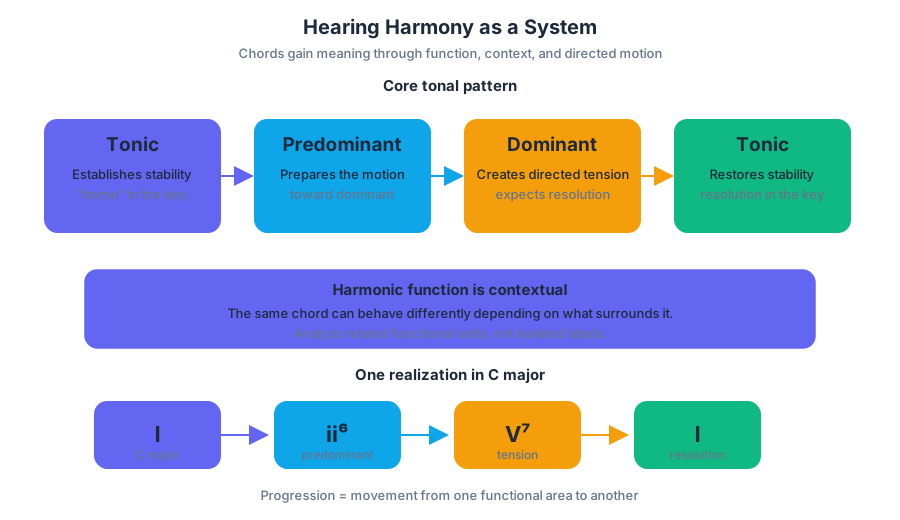
Harmonic function means the contextual role a chord plays within a key. The same chord may behave differently depending on what surrounds it, so analysis should treat chords as related functional units rather than isolated labels. Harmonic progression is the movement from one functional area to another in performed or notated music.
The core tonal pattern is:
$$ \text{tonic} \rightarrow \text{dominant} \rightarrow \text{tonic} $$
Tonic establishes stability, dominant creates directed tension, and tonic provides resolution. Composers frequently expand this pattern by inserting a predominant area:
$$ \boxed{\text{Tonic} \rightarrow \text{Predominant} \rightarrow \text{Dominant} \rightarrow \text{Tonic}} $$
This is the standard progression identified by PIT-2.H.5 and PIT-2.H.7. In C major, one possible realization is:
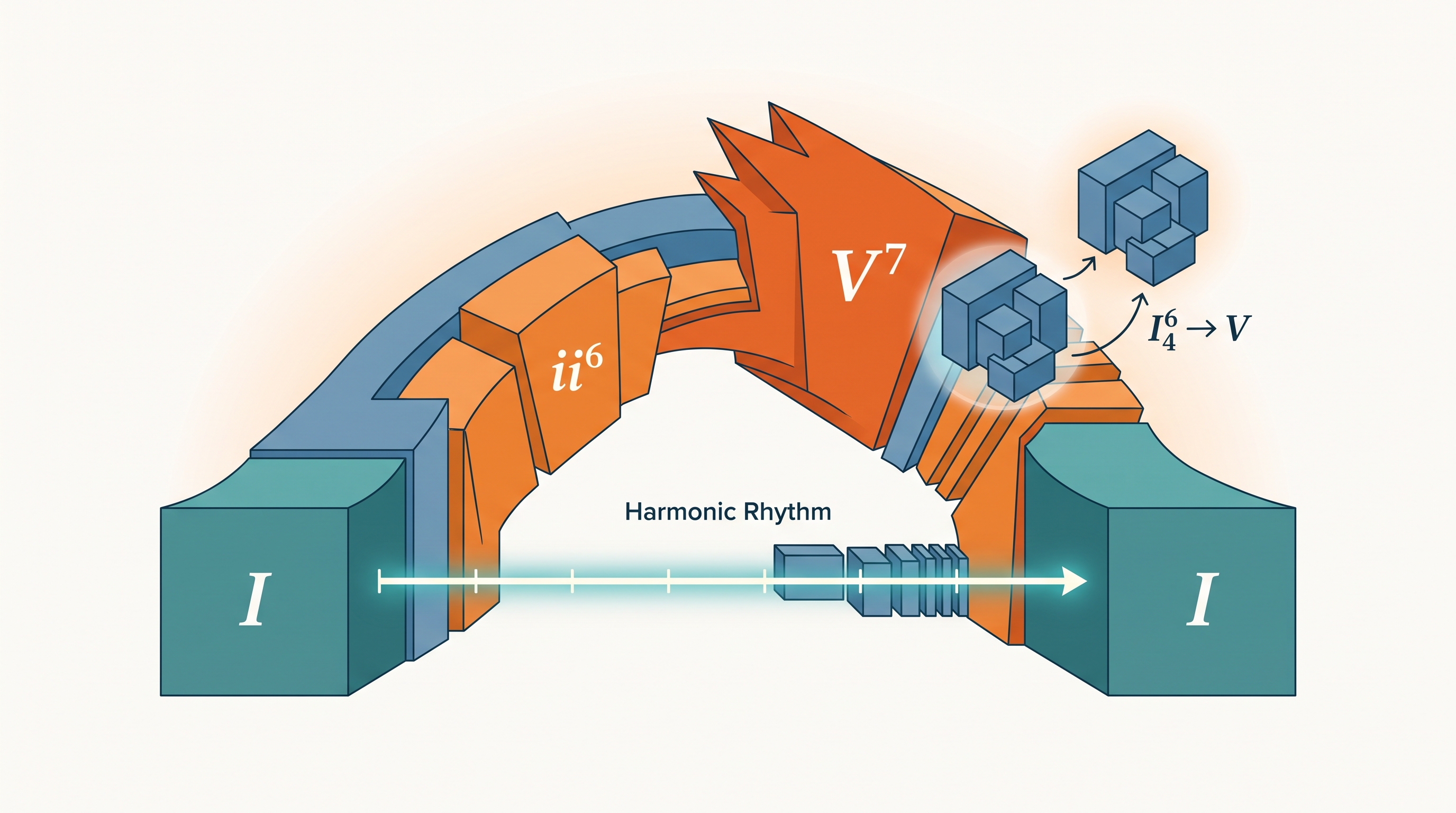
$$ I \rightarrow ii^6 \rightarrow V^7 \rightarrow I $$
The $I$ chord establishes C major. The $ii^6$ chord belongs to the predominant functional area and directs attention toward $V^7$. The dominant seventh chord intensifies the expectation of $I$, which restores tonal stability.
Predominant and dominant areas
Predominant harmonies commonly include the subdominant chord, $IV$ or $iv$, and the supertonic chord, $ii$ or $ii^\circ$. They often precede the dominant functional area because their scale-degree content and voice-leading tendencies prepare dominant harmony.
For example, in C major:
$$ I \rightarrow IV \rightarrow V \rightarrow I $$
or
$$ I \rightarrow ii \rightarrow V \rightarrow I $$
In C minor, the corresponding predominant choices may include $iv$ and $ii^\circ$. The lowercase Roman numeral identifies minor quality; the diminished symbol identifies the diminished supertonic triad.
Misconception check: A chord’s Roman numeral does not automatically determine its function in every context. Functional analysis depends on the chord’s relationship to surrounding harmonies, melodic motion, and tonal emphasis.
Common-practice progressions establish expectations, but composers can deliberately depart from them. A motion such as $V \rightarrow IV$ is called a retrogression under PIT-2.H.6 because it reverses the expected dominant-to-predominant direction. It may sound unusual in a strict tonal progression, yet it can be meaningful as a stylistic or expressive choice.
Harmonic rhythm: the pace of change
Harmonic rhythm is the rate at which chords change. It is independent of the notated meter: a piece in $4/4$ may change harmony once per measure, twice per measure, or on every quarter-note beat.
| Chord-change pattern | Perceived effect |
|---|---|
| One chord per measure | Broad, stable harmonic pace |
| Two chords per measure | Increased motion |
| One chord per half note | Noticeable acceleration |
| One chord per quarter note | Rapid harmonic activity |
Imagine four measures that begin with one chord per measure. If the composer changes to two chords per measure, then to quarter-note changes near a climax, the harmonic rhythm accelerates even if the tempo marking remains unchanged. The music can feel as though it is moving faster because the harmonic landscape changes more frequently.
Worked analysis: performed and notated music
Suppose a notated bass line and Roman-numeral analysis show the following progression in G major:
$$ I ;|; ii^6 ;|; V^7 ;|; I $$
Read it functionally: tonic establishes G major, $ii^6$ supplies predominant motion, $V^7$ creates dominant tension, and $I$ resolves it. Now listen to the same progression performed: even without seeing the notation, the first chord should sound stable, the third chord active and urgent, and the final chord settled.
This directly develops Learning Objective PIT-2.H: “Identify and describe harmonic function within a chord progression in performed music and notated music.” It also applies Skill 1: Analyze performed music by hearing stability, preparation, tension, and release; Skill 2: Analyze notated music by reading Roman numerals, inversions, and bass motion; and Skill 3: Convert between performed and notated music by connecting what is heard to the written progression.
The cadential six-four as dominant preparation
Second-inversion triads, written as $^6_4$ chords, should not be treated as freely interchangeable with root-position triads. Under PIT-2.K.1, they occur in four standard contexts: cadential, neighboring or pedal, passing, and arpeggiated $^6_4$ patterns.
A cadential $^6_4$ precedes the dominant. In C major, the notes of $I^6_4$ are G, C, and E, but the bass G and the surrounding motion make the sonority function as a preparation of $V$:
$$ I^6_4 \rightarrow V \rightarrow I $$
Under PIT-2.K.2, its tonic-triad contents do not make it an ordinary tonic arrival; in this context, it intensifies the dominant area.
Key insight: Analyze the role a chord performs, not only the notes it contains.
Cadence labels describe degrees of closure. Inconclusive types include half and imperfect authentic cadences; conclusive types include perfect authentic and plagal cadences under PIT-2.I.1. A perfect authentic cadence is $V \rightarrow I$ with both chords in root position and scale degree $1$ in the soprano. An imperfect authentic cadence is also $V \rightarrow I$, but an inversion or a soprano note other than scale degree $1$ prevents the strongest closure.
Retrieval check
In a major key, classify the functional areas in $I \rightarrow ii^6 \rightarrow V^7 \rightarrow I$, identify the likely harmonic-rhythm change if the chords shift from one per measure to one per quarter note, and explain why a cadential $I^6_4$ before $V$ functions as dominant preparation rather than an ordinary tonic chord.