From the free course AP Music Theory on Lykke
6.4 Suspensions
Key concepts: Suspensions
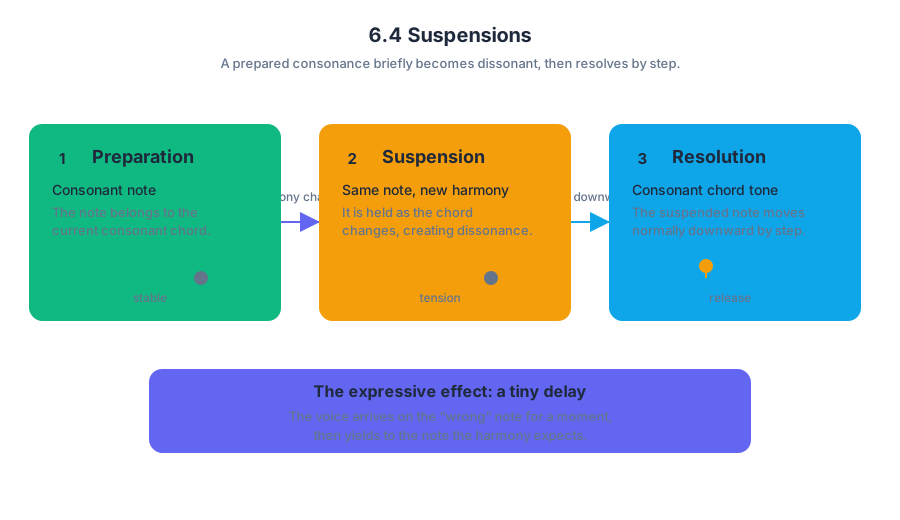
A suspension is a nonharmonic tone that is prepared as a consonance, held while the harmony changes, becomes dissonant against the new harmony, and then resolves by step—normally downward—to a consonant chord tone.
6.4 Suspensions
A suspension is a nonharmonic tone that is prepared as a consonance, held while the harmony changes, becomes dissonant against the new harmony, and then resolves by step—normally downward—to a consonant chord tone. Its expressive power comes from a tiny delay: the voice arrives at the “wrong” note for a moment before yielding to the note the harmony expects.
Preparation → Suspension → Resolution
consonant note → same note over new harmony, now dissonant → stepwise motion to a consonant note
The three stages
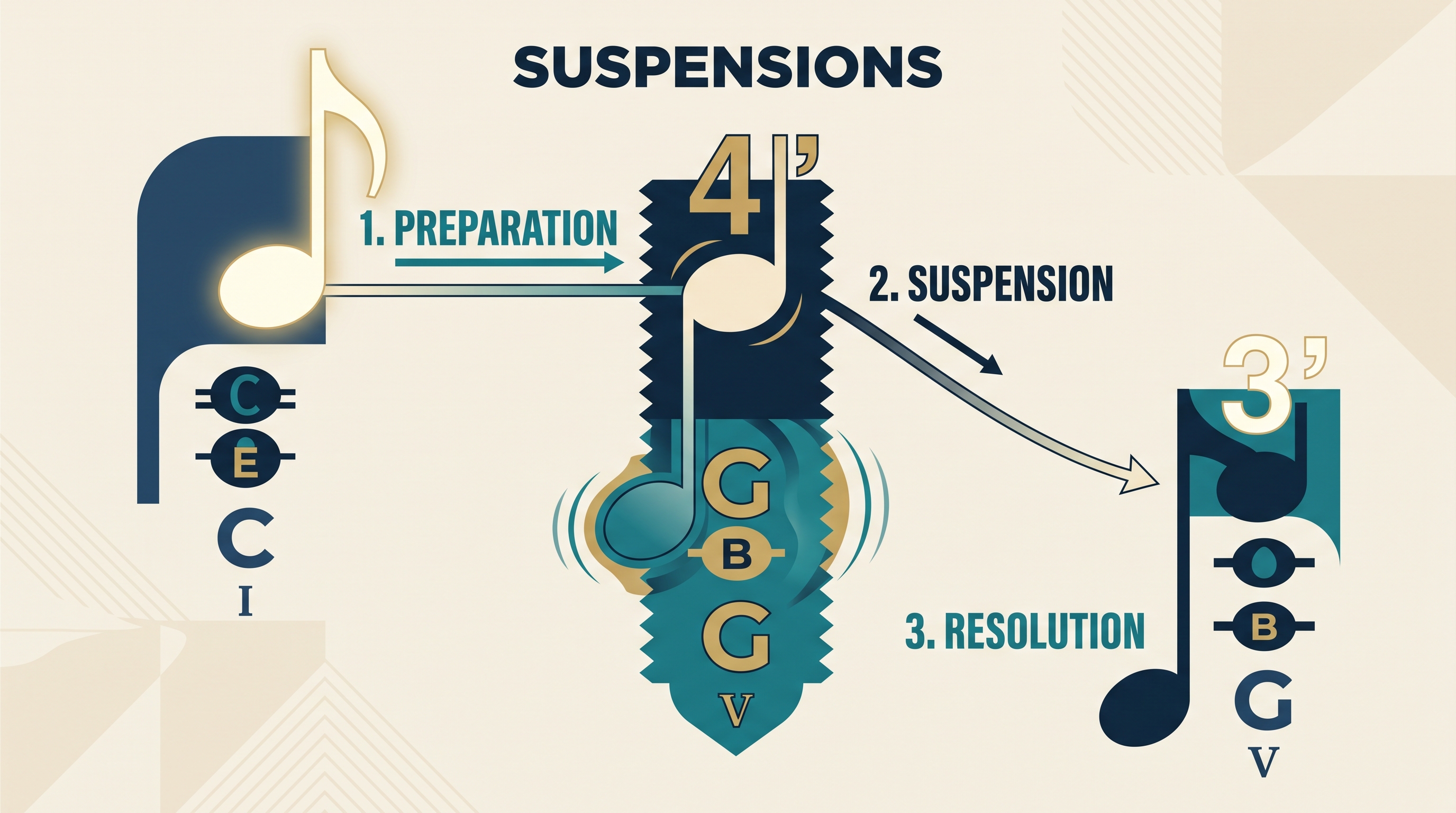
Consider a soprano moving through a cadence in C major. The soprano begins on C while the harmony is tonic, changes to dominant while the soprano remains on C, and finally moves down to B.
| Stage | Bass and harmony | Soprano | Interval above bass | Function |
|---|---|---|---|---|
| Preparation | Bass C, I: C–E–G | C | Unison with bass, or octave depending on register | Consonant chord tone |
| Suspension | Bass G, V: G–B–D | C | Perfect fourth | Dissonant suspended tone |
| Resolution | Bass G, V: G–B–D | B | Major third | Consonant chord tone |
The soprano C is consonant during the preparation because it belongs to the tonic triad, C–E–G. When the bass changes to G and the harmony becomes V, the soprano remains C. C is not part of the dominant triad G–B–D, and the interval between soprano C and bass G is a fourth, which functions as a dissonance in this contrapuntal context. The C then resolves downward by step to B, a chord tone of V, producing the familiar 4–3 suspension.
Suspension patterns
Suspensions are often identified by the interval above the bass during the dissonant stage and the interval formed after resolution. Common patterns include:
| Pattern | Dissonant interval | Resolution interval | Typical motion |
|---|---|---|---|
| 4–3 | Fourth | Third | Upper voice moves down by step |
| 7–6 | Seventh | Sixth | Upper voice moves down by step |
| 9–8 | Ninth | Octave | Upper voice moves down by step |
| 2–3 | Second | Third | Lower voice moves down by step |
The numbers describe intervals above the bass, not scale-degree numbers and not chord labels. In a 7–6 suspension, for example, the suspended voice forms a seventh above the bass and then descends to form a sixth. In a 2–3 suspension, the dissonance is usually created by a lower voice that moves downward while the upper voice remains stable.
Direction and special classifications
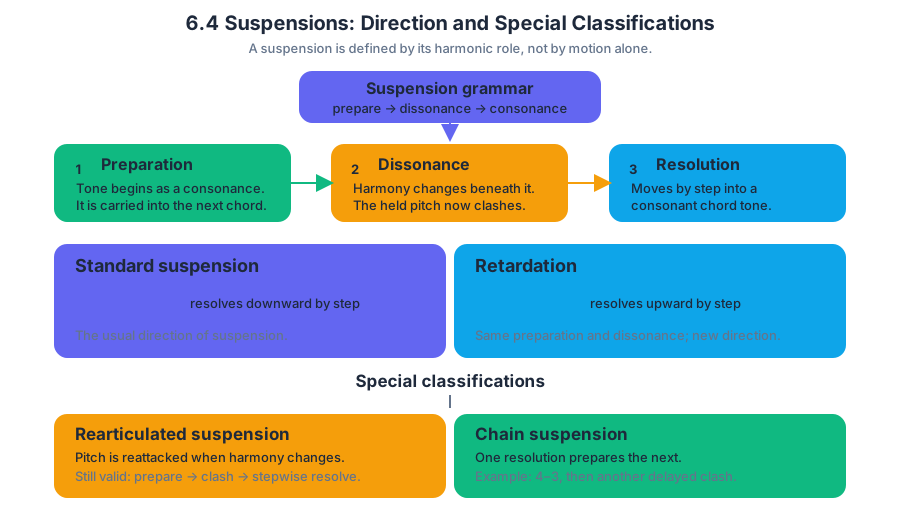
The standard suspension resolves downward by step. An upward-resolving suspension, also called a retardation, holds the same prepared-and-suspended pattern but resolves upward by step instead. The crucial distinction is not simply the direction of motion: the tone must still be prepared as a consonance, become dissonant when the harmony changes, and resolve into a consonant chord tone.
A rearticulated suspension repeats or reattacks the suspended pitch at the moment the harmony changes rather than sustaining it continuously. The pitch still functions as a suspension if its preparation, dissonance, and stepwise resolution are clear. A chain suspension occurs when the resolution of one suspension becomes the preparation for another, allowing a descending line such as $4$–$3$, followed by another delayed dissonance, to unfold across several harmonies.
Worked analysis
Suppose the bass sounds the following harmonic roots:
$$ \text{I} \longrightarrow \text{V} \longrightarrow \text{I} $$
The soprano sounds:
$$ C \longrightarrow C \longrightarrow B \longrightarrow C $$
Analyze the first three soprano notes rather than labeling the repeated C automatically. Over I, C is a consonant chord member and therefore supplies the preparation. Over V, the harmony changes to G–B–D, but C is retained; C is now a fourth above the bass G and is dissonant. The motion C down to B is stepwise and resolves the suspension. The later B-to-C motion belongs to the return to tonic and is not part of the suspension itself.
What exam readers commonly catch
Misconception: “Any repeated note over changing chords is a suspension.” Repetition alone is insufficient. The retained note must be consonant before the harmony changes and dissonant afterward.
Misconception: “A fourth is always consonant.” In common-practice contrapuntal analysis, a fourth above the bass is treated as dissonant when it functions against the bass, as in the C-over-G example.
Misconception: “Every stepwise resolution is a suspension.” A suspension requires the complete three-stage pattern: preparation, suspension, and resolution. A passing motion or neighbor motion may be stepwise but does not necessarily involve a prepared tone held across a harmonic change.
CED skills and identifiers
Topic 6.4: Suspensions is assessed primarily through the Big Idea DES (Musical Design) and the official skill categories Skill 1: Analyze performed music, Skill 2: Analyze notated music, Skill 3: Convert between performed and notated music, and Skill 4: Complete based on cues. In analysis, identify the three stages and classify the interval pattern; in aural work, hear the delayed resolution; in notation, label or write the suspension accurately; and in completion tasks, preserve the preparation, dissonance, and resolution.
Retrieval check: In C major, a soprano C is consonant over tonic I. The bass then changes to G for V while the soprano remains C, and the soprano resolves to B. What is the suspension pattern, and why? The answer is 4–3: C is prepared as a consonance over I, becomes a fourth above G and dissonant over V, then descends by step to B, a consonant chord tone of V.