From the free course AP Music Theory on Lykke
AP Practice 4
A sight-singing response turns silent notation into a continuous musical performance: the score gives pitch and rhythm, but the singer must supply accurate execution under severe time pressure.
AP Practice 4
A sight-singing response turns silent notation into a continuous musical performance: the score gives pitch and rhythm, but the singer must supply accurate execution under severe time pressure. On the current AP Music Theory sight-singing task, each melody receives $1$ minute and $15$ seconds of preparation and must be performed within $30$ seconds.
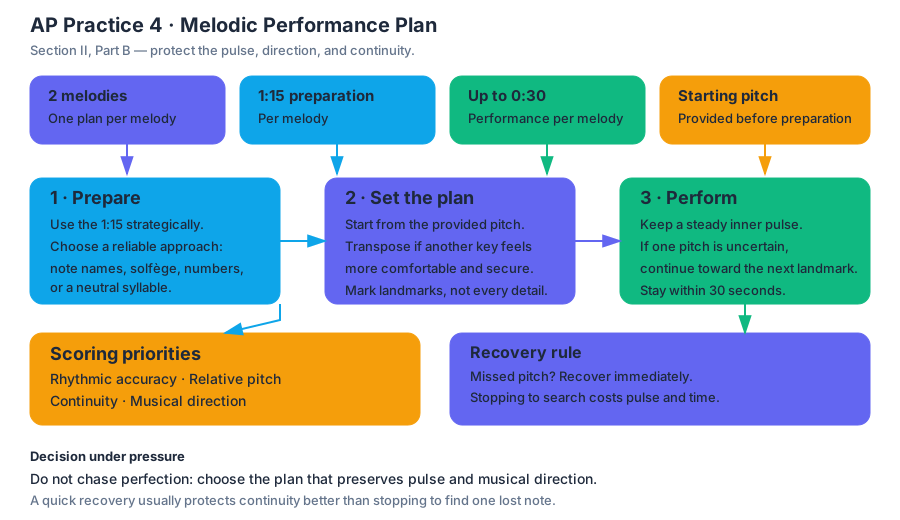
Task snapshot
| Feature | What to expect |
|---|---|
| Section | Section II, Part B |
| Number of melodies | $2$ |
| Preparation | $1$ minute and $15$ seconds per melody |
| Performance | Up to $30$ seconds per melody |
| Starting pitch | Provided at the beginning of preparation |
| Allowed approach | Note names, solfège, scale-degree numbers, or a neutral syllable |
| Optional choice | You may transpose to a comfortable key |
| Main scoring priorities | Rhythmic accuracy, relative pitch accuracy, and continuity |
The central exam decision is not “Can I sing every note perfectly?” but “What plan lets me preserve the pulse and musical direction when one note becomes uncertain?” A missed pitch followed by immediate recovery can preserve continuity; stopping to search for the lost note usually damages both the musical line and the time limit.
Original practice melody
Unofficial practice prompt. Prepare and sing the following melody. Use a steady quarter-note pulse. The melody is in common meter, begins on scale degree $\hat{1}$, and uses a major tonal center.
| Measure | Beats 1–4 |
|---|---|
| $1$ | $C$ quarter, $D$ quarter, $E$ half |
| $2$ | $G$ quarter, $F$ quarter, $E$ quarter, $D$ quarter |
| $3$ | $C$ half, $E$ quarter, $F$ quarter |
| $4$ | $G$ half, $E$ quarter, $C$ quarter |
In scale-degree form, the same melody is:
$$ \hat{1}\ \hat{2}\ |\ \hat{3}!-\ |\ \hat{5}\ \hat{4}\ \hat{3}\ \hat{2}\ |\ \hat{1}!-\ \hat{3}\ \hat{4}\ |\ \hat{5}!-\ \hat{3}\ \hat{1} $$
Here, the dash indicates that the preceding pitch is sustained. The important musical shape is an opening ascent toward $\hat{3}$, a descent through $\hat{5}$–$\hat{2}$, and a final expansion toward $\hat{5}$ before returning to tonic.
The $75$-second preparation algorithm
First $15$ seconds: establish the tonal map. Locate the key signature, identify the tonic, and sing or internally hear the tonic and dominant. For this melody, anchor $C$ as $\hat{1}$ and $G$ as $\hat{5}$. Do not spend preparation time naming every interval before you know where the melody belongs tonally.
Next $20$ seconds: secure the rhythm. Tap or silently conduct four beats per measure. Notice that measure $1$ contains two attacks followed by a two-beat sustain, while measure $2$ contains four equal quarter-note attacks. Rhythm is not decoration: if the pulse collapses, even correct pitches become difficult to evaluate.
Next $20$ seconds: rehearse the danger points. The largest leap is the upward perfect fifth from $C$ to $G$ at the start of measure $2$. Hear it as $\hat{1}$ to $\hat{5}$, then use the stepwise descent $G$–$F$–$E$–$D$ to reestablish the tonal center.
Final $20 seconds: perform once without stopping. Sing aloud if possible, using solfège, numbers, or a neutral syllable. If a pitch slips, continue the pulse and reconnect at the next secure landmark rather than restarting.
Worked performance reasoning
Start with a clear internal $C$ and maintain a four-beat pattern. The first measure should feel stable: $C$–$D$–$E$, with $E$ held through beats $3$ and $4$. In measure $2$, aim directly for $G$ rather than climbing step by step; the following $F$–$E$–$D$ gives you a reliable descending route.
At the beginning of measure $3$, return to $C$ and sustain it for two beats. The final two measures create a controlled rise to $G$, followed by a stepwise return through $E$ to tonic. Keep the tempo moving even if the final $C$ is not perfectly centered.
Examiner-rewarded reasoning: preserve the written rhythm, maintain relative pitch relationships, and perform continuously with a steady tempo. A response is not strengthened by stopping after an error; it is strengthened by recovering musically.
Common misconception check
Misconception: “The starting pitch locks me into that key.” The provided starting pitch is a reference, not a command to use an uncomfortable register. The sight-singing procedure permits transposition to a comfortable key, provided the melodic relationships remain intact.
Misconception: “I should silently analyze until every note is certain.” Analysis helps only when it leads to performance. Use the $75$ seconds to secure tonal center, meter, major leaps, and phrase shape; then sing.
Error-review routine
After recording, listen once without looking at the notation. Mark only three items: the first rhythmic disruption, the first pitch error, and the point where continuity was either preserved or lost. Then repeat the melody with one specific correction, such as “hold measure $1$ longer” or “hear $\hat{1}$ before leaping to $\hat{5}$.”
Quick check: If you lose the pitch at the beginning of measure $2$, which two landmarks can restore you—its arrival on $\hat{5}$ or the later return to $\hat{1}$? A strong response uses either landmark without stopping the beat.
Source Materials
- Learn More (.pdf)
- AP Music Theory Course and Exam Description
- AP Music Theory Course Overview
- AP Music Theory Course at a Glance
- AP Music Theory Course at a Glance Poster
- Adopt AP Music Theory
- AP Music Theory
- AP Music Theory
- AP Music Theory-AP Students-College Board
- AP Music Theory-Unit Study Guides
- AP Music Theory-Raidar Choir
- Everything you need to know to get a 5 on AP Music Theory