From the free course AP Music Theory on Lykke
3.4 Seventh-chord qualities
Key concepts: Seventh-chord qualities · Chord definitions · Triads and seventh chords as structures built in thirds · Fully diminished seventh chord (viid7) · Minor seventh chord (ii7 or vi7) · Dominant seventh chord (V7) · Cadential 6/4 chord · Voice-leading before resolution · Contextual listening · Harmony as relationships among chords within a musical style
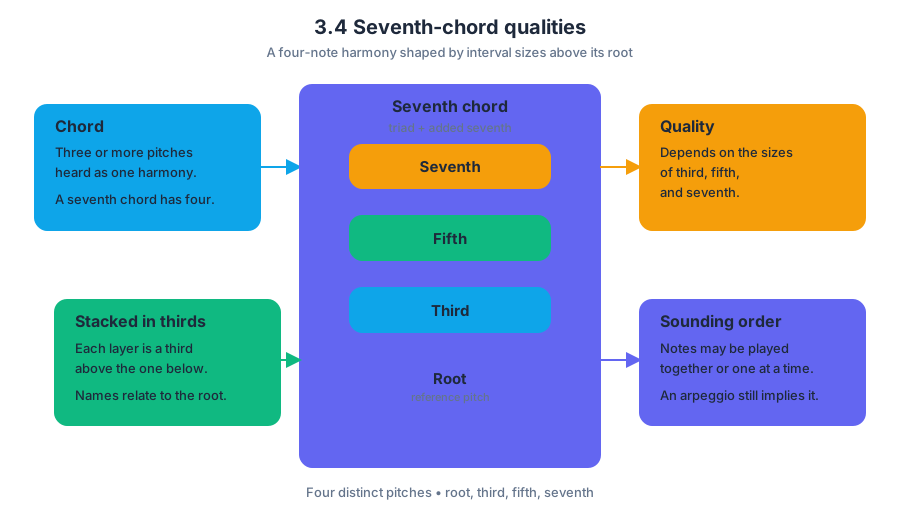
A seventh chord contains four distinct pitches arranged as a triad plus an added seventh, so its sound depends not only on the chord’s root but also on the precise sizes of its third, fifth, and seventh.
3.4 Seventh-chord qualities
A seventh chord contains four distinct pitches arranged as a triad plus an added seventh, so its sound depends not only on the chord’s root but also on the precise sizes of its third, fifth, and seventh.
A chord is three or more pitches sounding simultaneously. The term can also describe successive pitches that the ear groups as one harmony, as in an arpeggio. A seventh chord therefore remains identifiable even when its notes are heard one at a time rather than as a single vertical sonority.
PIT-1.O.1 — Chord Definitions: A triad contains three distinct pitches stacked in thirds; a seventh chord contains four distinct pitches stacked in thirds.
Imagine stacking objects in alternating layers: each new layer is a third above the one beneath it. In a seventh chord, the layers are the root, third, fifth, and seventh. These names describe each chord member’s intervallic relationship to the root, not necessarily the order in which the notes appear in a performance.
The structural recipe
To identify a seventh-chord quality, first reorganize the pitches conceptually into a stack of thirds. Then inspect the triad quality and the interval from the root to the seventh.
| Chord quality | Triad below | Seventh above root | Example |
|---|---|---|---|
| Fully diminished seventh | Diminished triad | Diminished seventh | $F\sharp$–A–C–$E\flat$ |
| Minor seventh | Minor triad | Minor seventh | $F\sharp$–A–$C\sharp$–E |
| Dominant seventh | Major triad | Minor seventh | $F\sharp$–$A\sharp$–$C\sharp$–E |
| Major seventh | Major triad | Major seventh | F–A–C–E |
The quality label is not a Roman numeral. Fully diminished seventh, minor seventh, and dominant seventh describe the chord’s internal interval structure. Roman numerals such as $\mathrm{vii}^{\circ 7}$, $\mathrm{ii^7}$, $\mathrm{vi^7}$, and $\mathrm{V^7}$ describe the chord’s scale-degree location and harmonic context.
Worked identification: three chords built from $F\sharp$
Start with the notes $F\sharp_4$–$A_4$–$C_5$–$E\flat_5$. Reading upward gives a diminished third structure: $F\sharp$ to A is a minor third, A to C is a minor third, and C to $E\flat$ is a minor third. The result is a fully diminished seventh chord, written here as $\mathrm{vii}^{\circ 7}$.
Now change only two pitches: $F\sharp_4$–$A_4$–$C\sharp_5$–$E_5$. The bottom three notes form a minor triad, $F\sharp$–A–$C\sharp$, and the outer interval from $F\sharp$ to E is a minor seventh. This is a minor seventh chord, which may function as $\mathrm{ii^7}$ in E major or $\mathrm{vi^7}$ in A major.
Finally, use $F\sharp_4$–$A\sharp_4$–$C\sharp_5$–$E_5$. The lower three notes form a major triad, while $F\sharp$ to E remains a minor seventh. This combination is a dominant seventh chord, $\mathrm{V^7}$, in the key of B major.
Hearing quality in context
Vertical inspection is essential, but seventh-chord qualities should also be identified through contextual listening. An arpeggiated chord may present its root, third, fifth, and seventh successively; your task is to hear the four-note grouping and infer its quality rather than treating each note as an isolated event.
A seventh often creates a tendency toward downward motion. For example, in a dominant seventh chord, the chordal seventh may move down by step as the harmony resolves. The voice carrying that seventh may move before the chord resolves fully, so do not assume that every chord member must remain in place until the next vertical sonority.
Harmonic context: $\mathrm{ii^7}$ and the cadential $6/4$
A minor seventh such as $\mathrm{ii^7}$ can participate in a progression toward a cadential $6/4$ chord. The cadential $6/4$ is not being identified here as a seventh-chord quality; it is part of the surrounding harmonic context that helps explain why a seventh chord sounds directed toward resolution.
For example, in C major, a progression may move from $\mathrm{ii^7}$, D–F–A–C, toward a cadential $6/4$ built over G, C–E–G, and then to $\mathrm{V^7}$, G–B–D–F. The important analytical question is twofold: What is the chord’s internal quality? and How does that quality behave in the progression?
Misconception check
Misconception: “A chord’s Roman numeral tells me its quality automatically.” Roman numerals provide a strong clue, but the pitches must confirm the quality. In particular, $\mathrm{ii^7}$ and $\mathrm{vi^7}$ are both minor seventh chords, while $\mathrm{V^7}$ is a dominant seventh because its triad is major.
Retrieval check
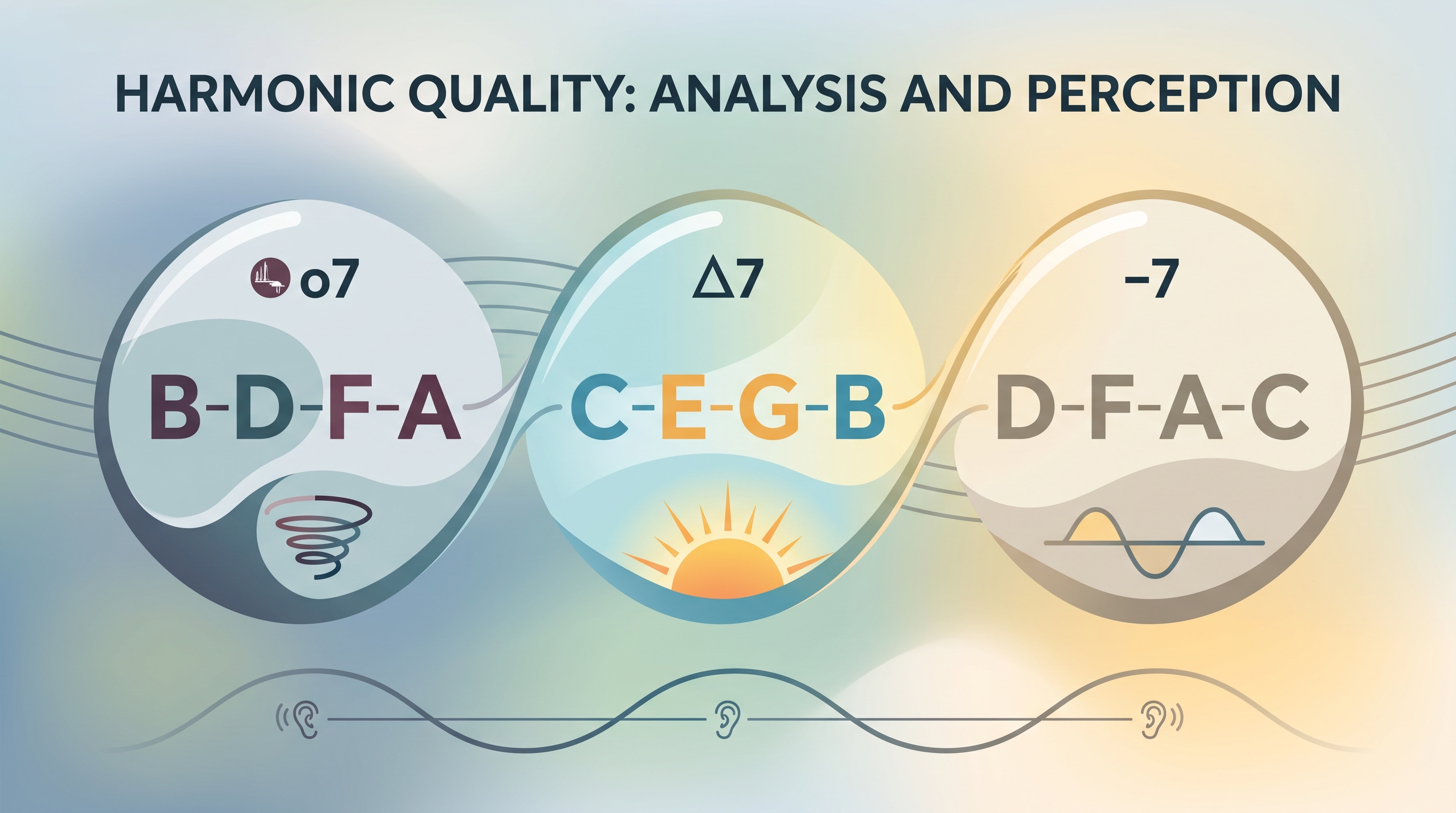
Identify each quality without changing the order of the notes: $B$–D–F–$A$, $C$–E–G–B$, and D–F–A–C. Which one is fully diminished, which one is major seventh, and which ones are minor seventh? Then explain why a listener hearing the notes as an arpeggio can still perceive each as a chord.
This work develops PIT-2.C — “Describe the quality of a seventh chord in— a. performed music, b. notated music.” It draws on Skill 1: Analyze performed music, Skill 2: Analyze notated music, and Skill 3: Convert between performed and notated music: hear the sonority, inspect its pitch content, and connect both forms of evidence to the correct chord-quality label.