From the free course AP Music Theory on Lykke
4.6 Voice leading with inverted seventh chords
Key concepts: Voice leading with inverted seventh chords · Stepwise bass motion in extended progressions · Smooth voice leading with minimal leaps · Spacing between the bass and its nearest upper voice · Complete spelling of inverted seventh chords · Approach and resolution of chordal sevenths · Descending-step resolution of chordal sevenths · Approaching chordal sevenths by step or leap · Inverted diminished seventh chords in tonicization · Secondary dominant and leading-tone seventh-chord voice leading
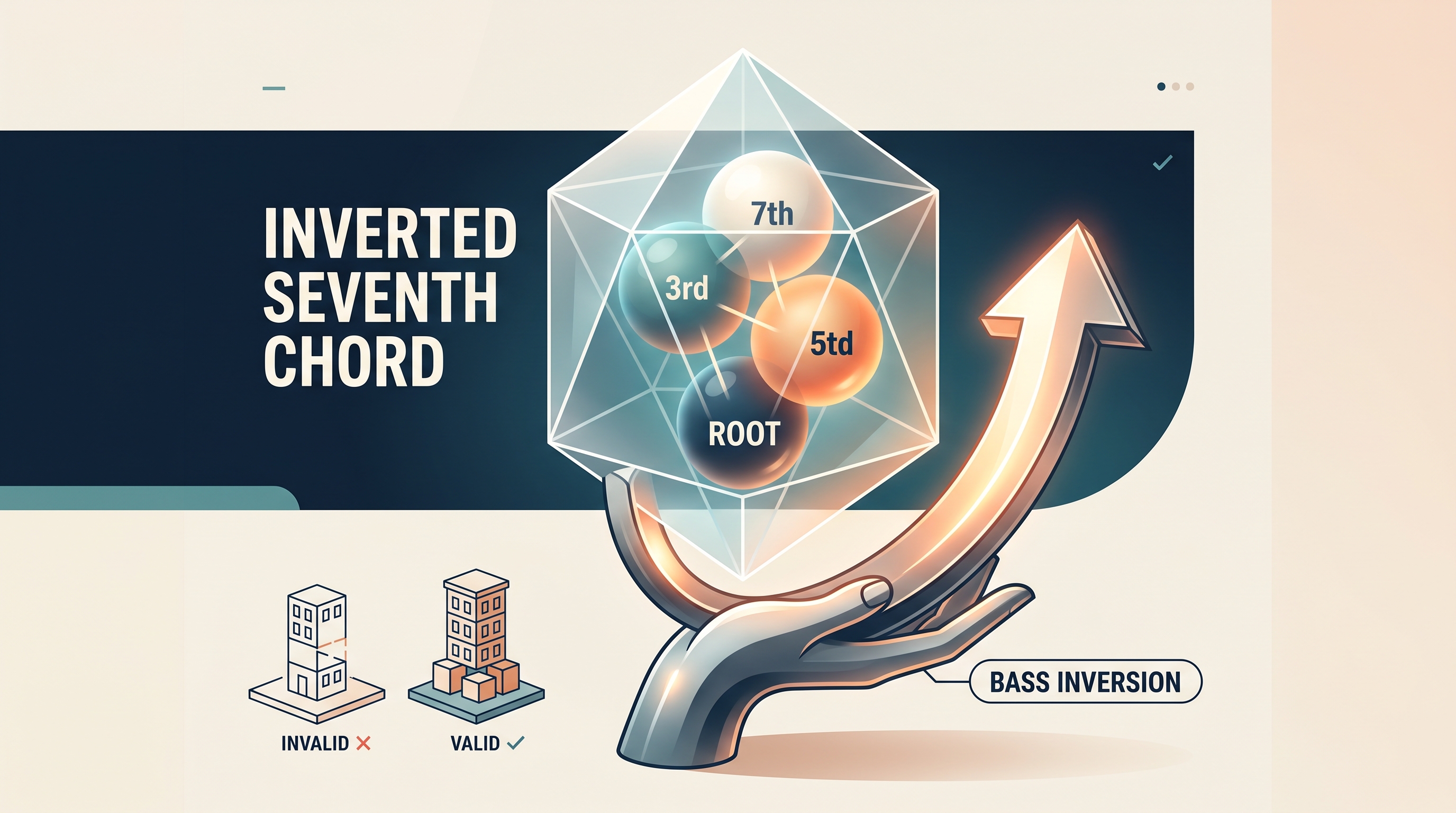
An inverted seventh chord can make a bass line sound like a melody rather than a sequence of harmonic leaps. In an extended progression, its bass note often moves by step while the upper voices shift as little as possible—a compact musical “hinge” between larger harmonic goals.
4.6 Voice leading with inverted seventh chords
An inverted seventh chord can make a bass line sound like a melody rather than a sequence of harmonic leaps. In an extended progression, its bass note often moves by step while the upper voices shift as little as possible—a compact musical “hinge” between larger harmonic goals.
Learning Objective: Identify and apply the procedures of eighteenth-century voice leading.
Essential Knowledge: PIT-4.A.10, PIT-4.A.11, PIT-4.A.12, and PIT-4.A.13.
Suggested Skill: Skill 1.E: Analyze Performed Music—use symbols and terms to describe and apply harmonic, melodic, and rhythmic procedures of eighteenth-century voice leading in performed music.
The inverted-seventh-chord principle
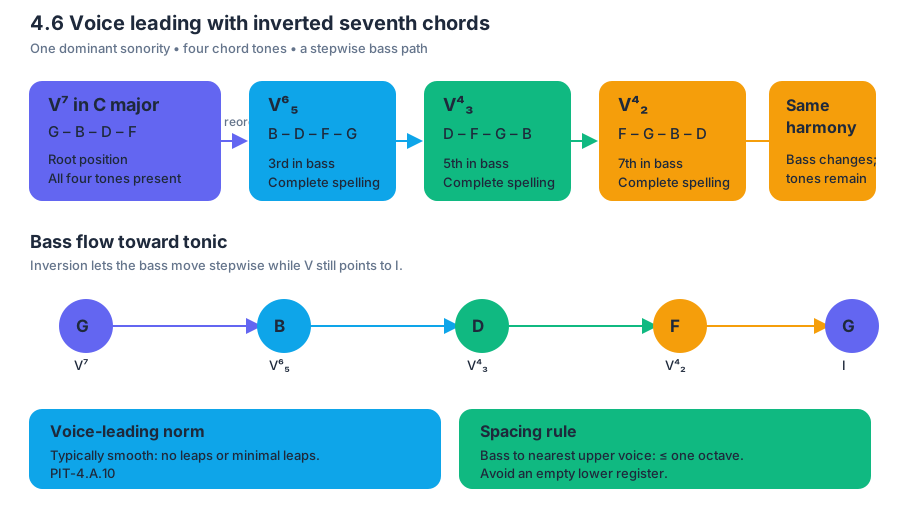
A seventh chord in inversion contains the same four chord tones as its root-position form, but a chord tone other than the root occupies the bass. In writing, inversion does not license omission: every inverted seventh chord must be spelled completely.
For example, in C major:
- $V^7$ is $G$–$B$–$D$–$F$.
- $V^6_5$ places $B$ in the bass: $B$–$D$–$F$–$G$.
- $V^4_3$ places $D$ in the bass: $D$–$F$–$G$–$B$.
- $V^4_2$ places $F$ in the bass: $F$–$G$–$B$–$D$.
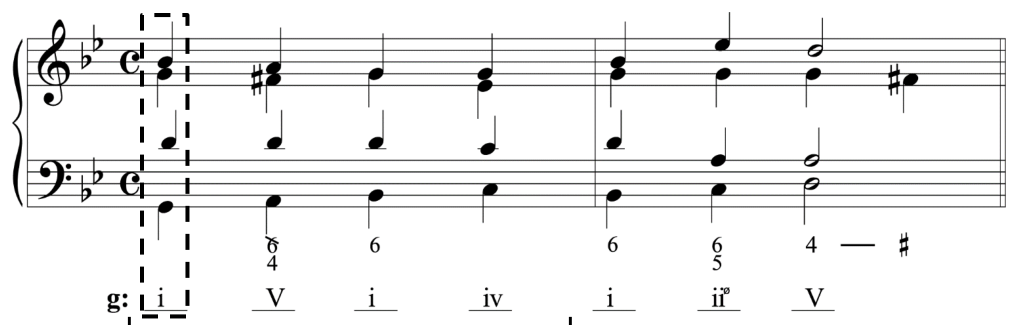
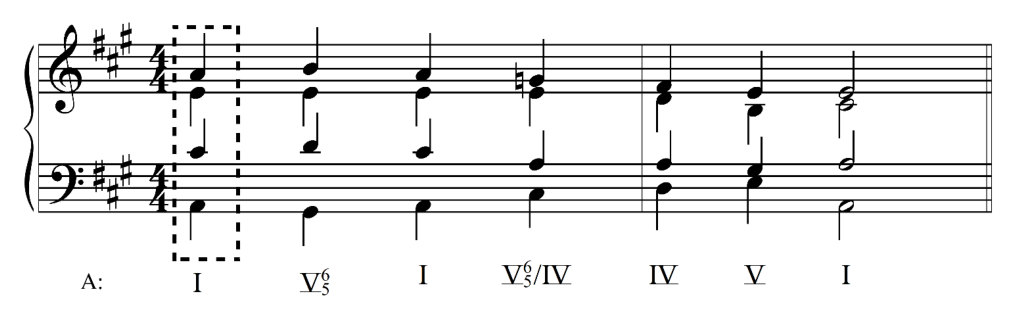
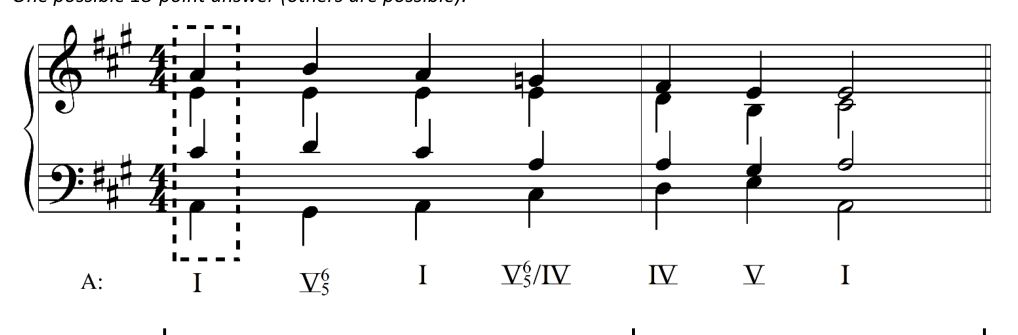
The bass can therefore move stepwise through an extended progression even while the harmony remains directed toward tonic. PIT-4.A.10 states that voice leading into and out of inverted seventh chords is typically smooth, with no leaps or only minimal leaps. The distance between the bass and its nearest upper voice should be no more than an octave; wider spacing creates an unnecessarily empty lower register.
Worked example: a stepwise bass and $V^4_3$
Consider the progression $I-V^4_3-I^6$ in C major:
$$ \begin{array}{c|c|c} I & V^4_3 & I^6 \ \hline C\text{–}E\text{–}G & D\text{–}F\text{–}G\text{–}B & E\text{–}G\text{–}C \end{array} $$
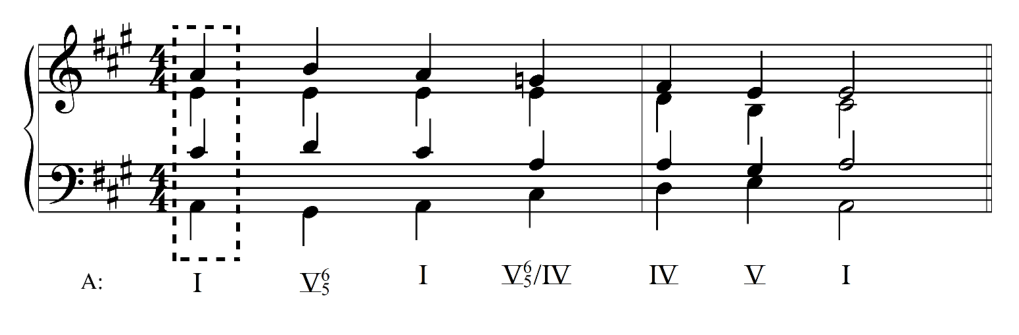
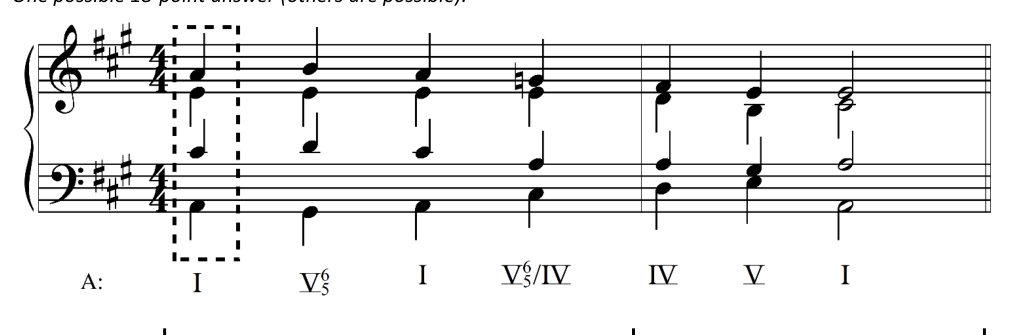
The bass moves $C\rightarrow D\rightarrow E$, creating a clear ascending stepwise line. In the middle chord, $D$ is the bass of $V^4_3$, while the chordal seventh $F$ normally resolves downward to $E$ in the final $I^6$ chord. The upper voices can retain common tones or move by step, so the chord feels like a smooth connection rather than a sudden harmonic block.
The seventh has one important exception. In a $V^4_3$ chord within $I-V^4_3-I^6$, the chordal seventh may move up by step instead of down. In other contexts, however, the default remains firm: a chordal seventh should resolve downward by step whenever possible. It may remain temporarily in the same voice—for example, when $ii^7$ moves to a cadential $^6_4$—before descending.
Approaching and resolving chordal sevenths
A chordal seventh should normally be approached by common tone or by step. If the musical context makes those approaches impossible, an ascending leap may be used; a descending leap of a third is rare but possible. Once present, the seventh should descend by step to prevent an unresolved dissonance.
| Situation | Preferred treatment |
|---|---|
| Approach to the chordal seventh | Common tone or step |
| Approach when those are impossible | Ascending leap |
| Rare alternative | Descending leap of a third |
| Resolution of the chordal seventh | Descending step |
| Special exception | $V^4_3$ in $I-V^4_3-I^6$ may resolve upward by step |
| Temporary retention | Possible before later downward resolution |
Leading-tone seventh chords in inversion
The leading-tone seventh chords used for tonicization are $vii^{\circ 7}$, the fully diminished seventh chord, and $vii^{\varnothing 7}$, the half-diminished seventh chord. A secondary leading-tone seventh chord is labeled according to the chord it tonicizes: for example, $vii^{\circ 7}/V$ means “the leading-tone seventh chord of the dominant.”
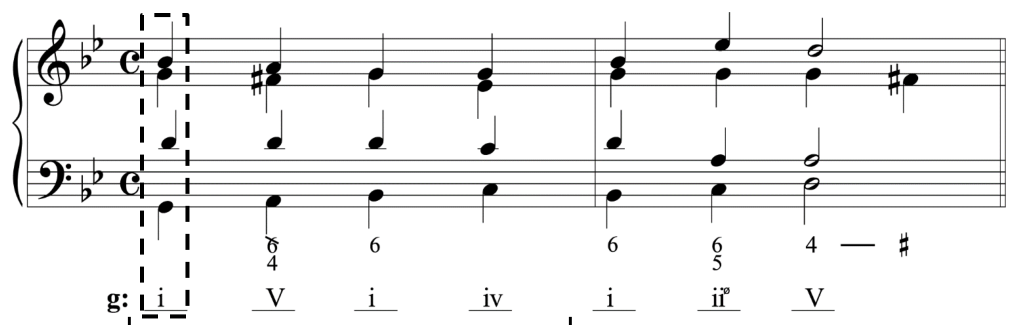
These chords have two related functions under PIT-4.A.11. They can substitute for $V$ or $V^7$ as part of the dominant function, or they can appear between tonic chords to prolong tonic through stepwise voice leading. Their tendency tones must appear individually—not doubled—and resolve according to their tendencies, as required by PIT-4.A.12.
Misconception check
Misconception: “Because the chord is inverted, I can leave out the root or seventh.” Inversion changes the bass position, not the chord’s identity. A written inverted seventh chord must contain all four chord tones. The exception concerning omission applies to the fifth of a root-position dominant seventh chord, not to inverted seventh chords.
Retrieval check: In C major, identify the chord and the expected resolution of the bass and chordal seventh in $F$–$G$–$B$–$D$. Answer: it is $V^4_2$; the bass $F$, which is the chordal seventh, normally moves down by step to $E$, while the remaining voices resolve smoothly toward $I$ or its appropriate inversion.
Source Materials
- Learn More (.pdf)
- AP Music Theory Course and Exam Description
- AP Music Theory Course Overview
- AP Music Theory Course at a Glance
- AP Music Theory Course at a Glance Poster
- Adopt AP Music Theory
- AP Music Theory
- AP Music Theory
- Chord spelling:
- I. Chord Spelling, Spacing, and Doubling
- Chord spelling:
- Chord spelling: