From the free course AP Music Theory on Lykke
2.11 Texture and texture types
Key concepts: Texture · Monophony · Homophony · Chordal homophony · Melody with accompaniment · Polyphony · Timbre · Pitch density and spacing · Pitch range · Performed and notated music
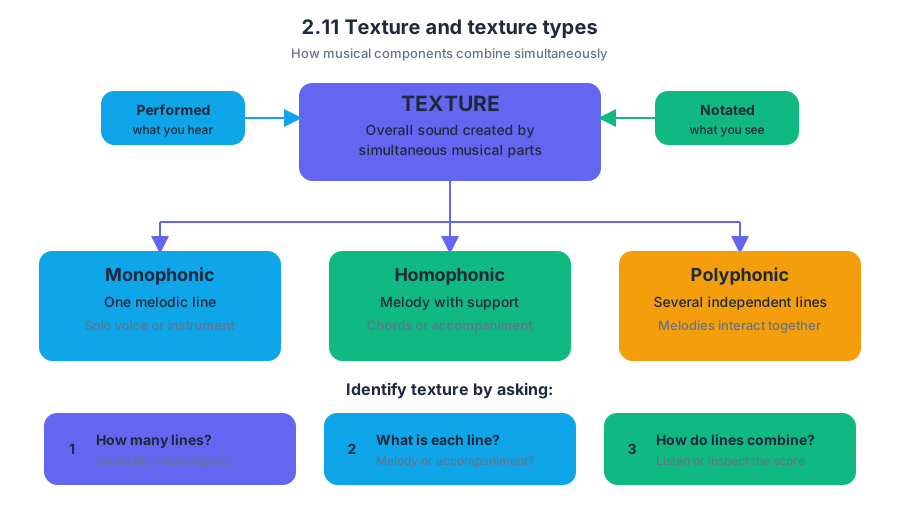
Texture is the way musical components combine simultaneously to create the listener’s overall sound. A solo singer, a melody supported by chords, and several independent melodies can use the same notes yet produce radically different musical experiences because their textures differ.
2.11 Texture and texture types
Texture is the way musical components combine simultaneously to create the listener’s overall sound. A solo singer, a melody supported by chords, and several independent melodies can use the same notes yet produce radically different musical experiences because their textures differ.
Texture applies to both performed music—what you hear—and notated music—what you see in a score. To identify texture, listen or look for three questions: How many musical lines are present? What is the melodic character of each line? How are those lines combined at the same time?
Essential Knowledge DES-1.A.1: Texture refers to how musical components combine simultaneously to form an overall sound. It is influenced by how music is produced, the density and spacing of pitches, and the pitch range encompassed.
What shapes the overall sound?
The number of lines is only the beginning. Timbre—the distinctive quality of a sound—can make two identical textures sound unlike each other: one melody sung by a child, played by a flute, or performed by a brass ensemble produces different perceptual layers. Texture is also affected by pitch density and spacing: widely separated pitches may sound transparent, while many closely packed pitches may sound thick. Finally, pitch range matters; a texture spanning several octaves can feel broader than one confined to a narrow register.
For example, four instruments may perform four distinct pitches, but if all four sustain a single chord, the result is not automatically polyphony. The musical lines’ independence and melodic behavior matter more than simply counting sounding notes.
The main texture types
The principal texture types are monophony, homophony, and polyphony. The CED also identifies heterophony as a texture type, although the most central contrasts for this topic are the three types below.
| Texture | What happens simultaneously | Listening or score clue |
|---|---|---|
| Monophony | One melodic line sounds alone, either in one voice or doubled at another octave | Everyone performs the same melody; there is no independent accompaniment |
| Homophony | One part is primary while other parts support it | A recognizable melody moves with chordal support or a coordinated chordal rhythm |
| Polyphony | Two or more relatively independent melodic lines sound together | Several melodies retain their own contours and rhythmic identities |
Monophony: one line
Monophony means a single melodic line without independent harmonic support. A person singing alone is monophonic. Several people singing the same melody in unison or octaves can still create monophony because they perform one musical line rather than separate melodies.
Misconception check: “More than one performer means polyphony.” Not necessarily. If every performer follows the same melody, the texture remains monophonic.
Homophony: coordinated support
Homophony contains a primary musical line supported by other parts. Its two important forms are chordal homophony and melody with accompaniment.
In chordal homophony, the parts move together in a similar rhythm, producing a sequence of coordinated chords. A hymn in which soprano, alto, tenor, and bass change notes together often has chordal homophony. The voices are separate lines in notation, but their rhythmic alignment makes the chordal unit the dominant impression.
In melody with accompaniment, one line stands out as the melody while the remaining parts provide harmonic or rhythmic support. A singer carrying the tune over piano chords is an obvious example. The accompaniment may be active—such as a repeating broken-chord pattern—yet it remains subordinate if it does not behave like an independent competing melody.
A useful diagnostic is to temporarily remove the supporting parts. If one line remains clearly identifiable as the musical foreground and the others mainly explain its harmony, the texture is probably homophonic.
Polyphony: independent lines
Polyphony combines two or more melodic lines that possess meaningful independence. Each line may have its own contour, rhythm, and points of imitation. Polyphony can be nonimitative, in which the lines use contrasting material, or imitative, in which one line repeats or echoes material introduced by another.
Counterpoint is closely related to polyphony. It refers specifically to the practice of composing polyphonic music, often according to historical conventions, as well as to the resulting contrapuntal texture. Terms such as canon or canonic describe imitative relationships in which a melody is answered by a delayed copy; they are texture-related descriptions, not replacements for the broader category of polyphony.
Worked analysis: three versions of one idea
Imagine the tune $C-D-E-G$:
- One singer performs $C-D-E-G$ alone: monophony.
- A singer performs $C-D-E-G$ while a piano plays supporting chords: homophony, specifically melody with accompaniment.
- A second voice enters with its own version of the tune while the first continues independently: polyphony.
The pitch material has not changed enough to explain the difference. The decisive factor is how the musical lines interact simultaneously.
AP analysis skills
This topic develops Skill 1: Analyze Performed Music by requiring you to hear line count, independence, timbre, register, and accompaniment relationships. It develops Skill 2: Analyze Notated Music by requiring you to inspect simultaneous parts, rhythmic alignment, pitch spacing, and relative melodic prominence in a score. When moving between an audio realization and its notation, Skill 3: Convert Between Performed and Notated Music supports the same judgment across representations.
Essential Knowledge DES-1.A.2: Texture types are determined by the number of musical lines, the melodic character of those lines, and the ways in which the lines combine simultaneously. The major categories include monophony, homophony—including chordal homophony and melody with accompaniment—and polyphony.
Retrieval check
A choir sings one melody in octaves while a low voice sustains a separate drone. Is the texture automatically polyphonic? Answer: Not automatically. If the drone functions as sustained support rather than an independent melodic line, the texture is best heard as homophonic or a monophonic melody supported by a drone. Count lines, but then judge their melodic independence.