From the free course AP Music Theory on Lykke
5.5 Cadences and predominant function
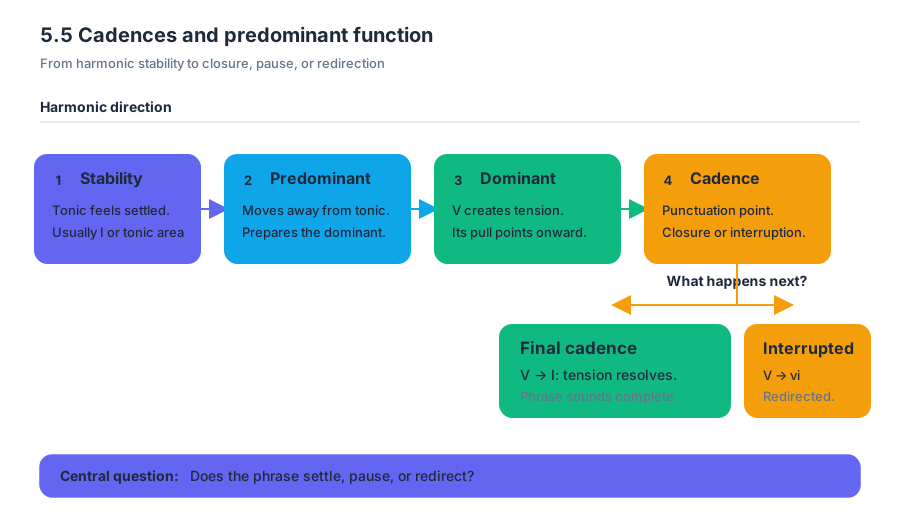
A cadence is a point of musical punctuation: the harmony and melody create enough closure—or enough interruption—to make a phrase sound finished, paused, or redirected.
5.5 Cadences and predominant function
A cadence is a point of musical punctuation: the harmony and melody create enough closure—or enough interruption—to make a phrase sound finished, paused, or redirected. A predominant function is the harmonic role that prepares a dominant chord, usually by moving from tonic toward $V$.
The central question is: How does a phrase move from stability toward a cadence, and what makes that cadence sound final or unfinished?
The harmonic route to a cadence
In common-practice tonal harmony, a complete phrase often follows this broad trajectory:
$$ \text{Tonic} \rightarrow \text{Predominant} \rightarrow \text{Dominant} \rightarrow \text{Tonic} $$
In C major, the progression might be:
$$ I \rightarrow ii^6 \rightarrow V^7 \rightarrow I $$
Here, $I$ establishes C major. The predominant chord $ii^6$ creates forward motion, the dominant $V^7$ intensifies that motion through its leading tone and seventh, and the final $I$ supplies tonal arrival.
The most common predominant chords are $ii$ and $IV$ in major, and $ii^\circ$ and $iv$ in minor. Their shared job matters more than their chord labels: they generally lead toward dominant-function harmony.
| Function | Common major-key chords | Common minor-key chords | Typical destination |
|---|---|---|---|
| Tonic | $I$, sometimes $vi$ | $i$, sometimes $VI$ | Stability or departure |
| Predominant | $ii$, $IV$ | $ii^\circ$, $iv$ | $V$ or $V^7$ |
| Dominant | $V$, $V^7$, $vii^\circ$ | $V$, $V^7$, $vii^\circ$ | $I$ or $i$ |
This functional reading explains why $ii^6$ is especially useful before $V$: its bass note is scale degree $\hat{4}$, which moves smoothly to scale degree $\hat{5}$, while the upper voices can proceed by step.
Cadence types
A cadence is identified by the harmonic goal and by the melodic and bass behavior at the phrase ending—not by the final chord alone.
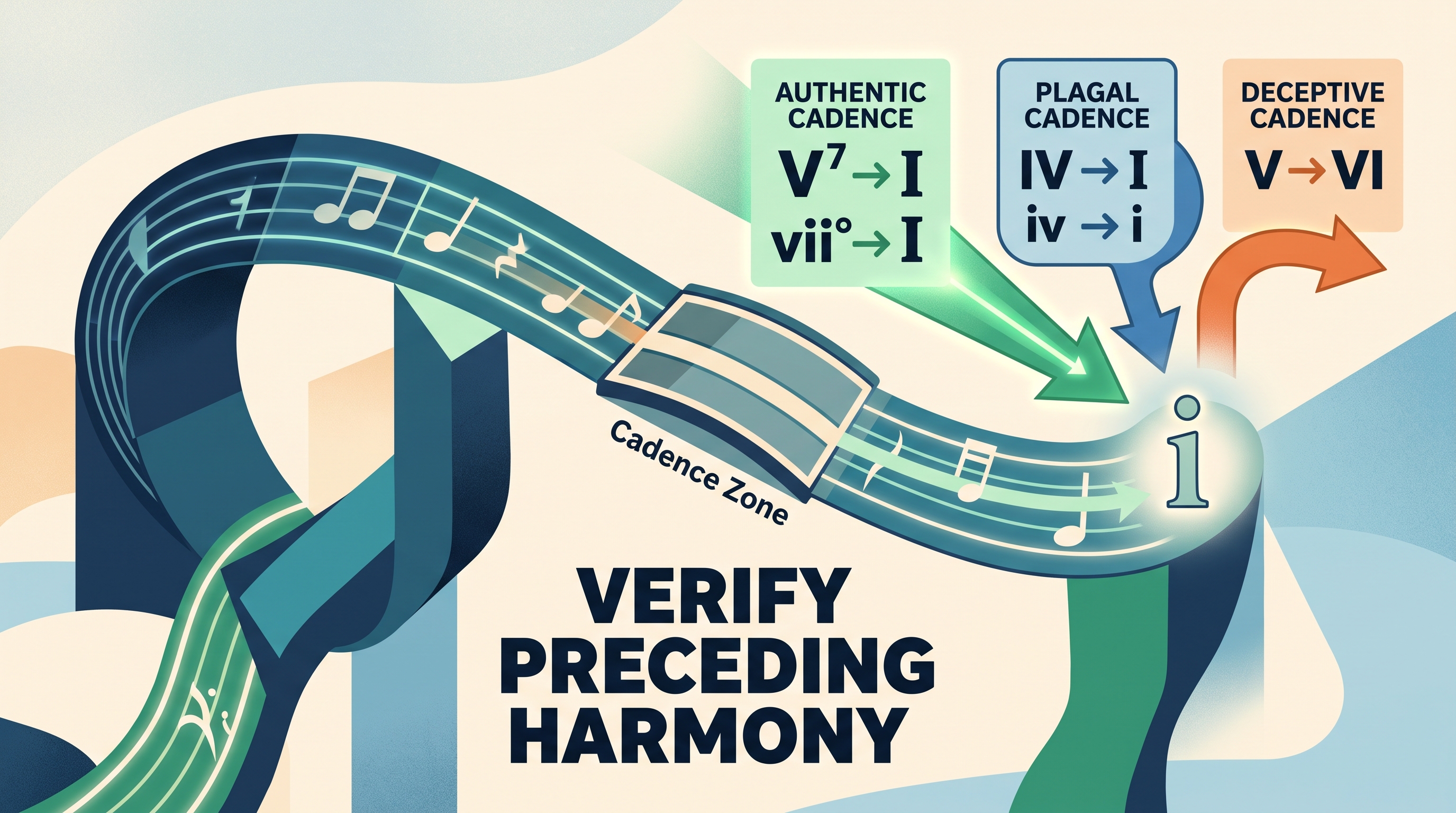
- Authentic cadence: dominant-function harmony moves to tonic, usually $V$ or $V^7$ to $I$ in major or $i$ in minor.
- Half cadence: the phrase ends on dominant harmony. It sounds like a comma rather than a period.
- Deceptive cadence: dominant-function harmony moves somewhere other than tonic, most commonly $V$ to $vi$ in major or $VI$ in minor.
- Plagal cadence: predominant-function harmony moves directly to tonic, commonly $IV$ to $I$ or $iv$ to $i$.
An authentic cadence can be further described as perfect authentic when the final harmony is $V$ to $I$, both chords are in root position, and the soprano ends on tonic. If one or more of those conditions is absent, the cadence is generally imperfect authentic. The phrase may still sound conclusive, but its closure is less emphatic.
Worked example: hearing the function
Suppose a phrase in G major ends with the progression:
$$ | I \quad | IV \quad | ii^6 \quad V^7 \quad | I | $$
First, identify the tonal center: the opening and closing $I$ chords establish G major. Next, classify the middle chords: $IV$ and $ii^6$ are predominant-function chords, and $V^7$ is dominant-function harmony.
The final $V^7 \rightarrow I$ creates an authentic cadence. If the bass ends on G and the soprano also ends on G, with both chords in root position, the cadence qualifies as perfect authentic. If the soprano instead ends on B, the cadence remains authentic but is imperfect.
Now change only the final tonic chord:
$$ | ii^6 \quad V^7 \quad | vi | $$
The $V^7$ still sounds as though it wants to resolve to $I$, but $vi$ replaces the expected tonic. This is a deceptive cadence: the dominant function is present, yet the arrival avoids the expected goal.
What exam analysis rewards
For PIT 1: Analyze Performed Music, listen for the sensation of arrival, interruption, or suspension at the phrase ending. A dominant chord followed by a minor submediant often produces the characteristic “expected ending that did not happen” of a deceptive cadence.
For PIT 2: Analyze Notated Music, inspect the final two or three harmonies, determine the key, and check both the Roman numerals and the bass. For PIT +, several observations may be needed together: harmonic function, cadence type, phrase placement, and melodic closure.
Key insight: The last chord does not identify a cadence by itself. The cadence is the relationship between the harmonies immediately before the ending and the chord that actually arrives.
Misconception check
Misconception: “Any phrase ending on $I$ is an authentic cadence.” Not necessarily. A tonic chord may follow a plagal progression such as $IV \rightarrow I$, or it may appear after a weak or non-dominant progression. To call a cadence authentic, verify that dominant-function harmony—typically $V$, $V^7$, or $vii^\circ$—precedes the tonic.
Retrieval check: In the key of D minor, classify $iv \rightarrow i$, $V^7 \rightarrow i$, and $V \rightarrow VI$. Which one is plagal, which is authentic, and which is deceptive?
Answer: $iv \rightarrow i$ is plagal; $V^7 \rightarrow i$ is authentic; $V \rightarrow VI$ is deceptive.