From the free course AP Music Theory on Lykke
1.7 Meter and time signatures
Key concepts: Simple and compound meter · Time signatures and their upper and lower numbers · Beat division and pulse levels · Triple meter · Compound triple meter · Asymmetrical or irregular meter · Unequal beat groupings · Changing or mixed meter · Identifying irregular beat division · Identifying irregular beat grouping in performed and notated music
A time signature is a compact map of musical time: its upper number tells you how many beats or pulse levels occupy a measure, while its lower number identifies the note value used as the beat or division.
1.7 Meter and time signatures
A time signature is a compact map of musical time: its upper number tells you how many beats or pulse levels occupy a measure, while its lower number identifies the note value used as the beat or division. Read together, the two numbers reveal whether the meter is simple or compound and whether its basic grouping is duple, triple, or quadruple.
Learning Objective RHY-1.D: Describe the time signature in performed music and notated music.
Essential Knowledge RHY-1.D.1: Time signatures indicate the organization of beats, pulse levels, and divisions, including whether the meter is simple or compound.
Reading the two numbers
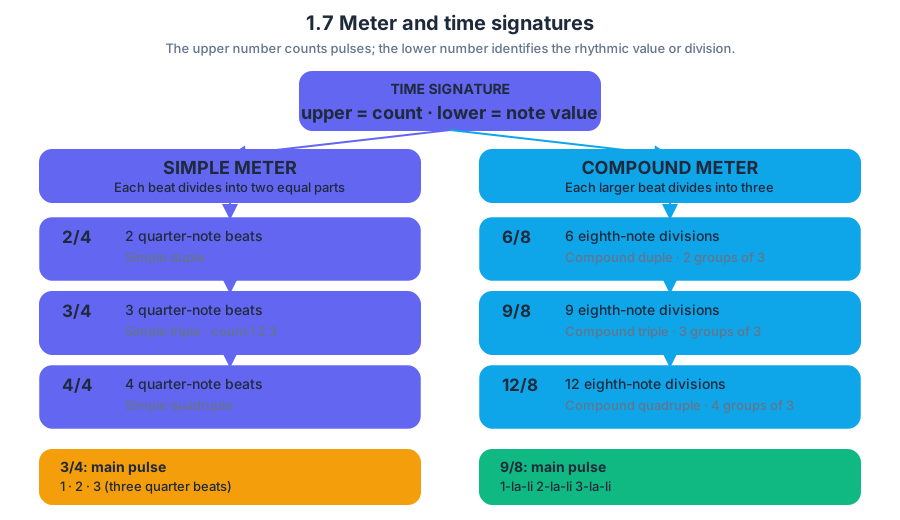
In a simple meter, the lower number represents the rhythmic value of the beat. Thus, in $\frac{3}{4}$, the $4$ indicates quarter-note beats, and the $3$ indicates three such beats in each measure. The meter is therefore simple triple meter: simple because each beat divides naturally into two equal parts, and triple because three beats form the measure.
In a compound meter, the lower number represents the rhythmic value of the division rather than the larger beat. The upper number counts those smaller pulse levels and signals the larger grouping:
| Time signature | Pulse divisions | Larger beats | Meter |
|---|---|---|---|
| $\frac{2}{4}$ | 2 quarter-note beats | 2 | Simple duple |
| $\frac{3}{4}$ | 3 quarter-note beats | 3 | Simple triple |
| $\frac{4}{4}$ | 4 quarter-note beats | 4 | Simple quadruple |
| $\frac{6}{8}$ | 6 eighth-note divisions | 2 groups of 3 | Compound duple |
| $\frac{9}{8}$ | 9 eighth-note divisions | 3 groups of 3 | Compound triple |
| $\frac{12}{8}$ | 12 eighth-note divisions | 4 groups of 3 | Compound quadruple |
The key visual distinction is the location of the main pulse. In $\frac{3}{4}$, count three quarter-note beats: $1\ 2\ 3$. In $\frac{9}{8}$, count three larger beats, each containing three eighth-note divisions: $1\text{-la-li}\ 2\text{-la-li}\ 3\text{-la-li}$. The nine eighth notes are not normally nine equally strong beats.
Symmetrical, asymmetrical, and mixed meter
Symmetrical meter organizes the measure into regularly spaced beats or pulse groups. Common simple meters such as $\frac{2}{4}$, $\frac{3}{4}$, and $\frac{4}{4}$, along with compound meters such as $\frac{6}{8}$, $\frac{9}{8}$, and $\frac{12}{8}$, provide predictable accent patterns. The listener can usually anticipate where the larger pulses and recurring accents will occur.
Asymmetrical or irregular meter contains unequal beat groupings within a measure. In $\frac{5}{8}$, the five eighth-note divisions can be grouped as $3+2$ or $2+3$:
$$ \frac{5}{8}=3+2 \qquad\text{or}\qquad \frac{5}{8}=2+3 $$
For $3+2$, the first beat contains three eighth-note divisions and the second contains two. For $2+3$, the order reverses. Although both patterns use five eighth notes, they produce different accent shapes; the grouping must be heard or shown in the notation rather than guessed from the fraction alone.
Changing or mixed meter occurs when the time signature shifts between measures. For example, a passage may contain one measure of $\frac{3}{4}$ followed by one measure of $\frac{4}{4}$:
$$ \left|\frac{3}{4}\right|\ \left|\frac{4}{4}\right|\ \left|\frac{3}{4}\right|\ \left|\frac{4}{4}\right| $$
This differs from asymmetrical meter. A measure of $\frac{5}{8}$ may have unequal internal groupings but retain one time signature; mixed meter changes the time signature itself from measure to measure.
Worked interpretation: $\frac{5}{8}$
Suppose a performed passage accents its eighth notes in the pattern strong–weak–weak–strong–weak. Divide the five pulse divisions into $3+2$:
$$ \underbrace{1\ 2\ 3}{\text{larger beat}}\ \underbrace{4\ 5}{\text{larger beat}} $$
The upper number $5$ tells us that five eighth-note divisions fill the measure, and the lower number $8$ identifies the eighth note as the division value. Because the larger beats contain unequal numbers of divisions, the passage is asymmetrical or irregular meter—not compound triple meter and not simply “five equal beats.”
Listening and notation checks
RHY-1.D requires identifying meter in both performed music and notated music. While listening, locate recurring accents and test possible groupings by tapping the larger pulse. While reading, inspect the time signature, beam groupings, accent marks, and bar lines; notation often makes a $3+2$ or $2+3$ pattern visible.
These observations exercise Skill 1: Analyze performed music and Skill 2: Analyze notated music. They can also involve Skill 3: Convert between performed and notated music when you hear a grouping and represent it with bar lines or rhythmic notation.
Misconception check: The upper number does not always equal the number of large beats. In $\frac{9}{8}$ it counts nine eighth-note pulse divisions, normally organized into three larger beats. In $\frac{5}{8}$ it counts five divisions that may be grouped unequally.
Retrieval check: Classify each passage.
- $\frac{9}{8}$ grouped $3+3+3$
- $\frac{5}{8}$ grouped $2+3$
- One measure of $\frac{3}{4}$ followed by one measure of $\frac{4}{4}$
Answers: $1$ is symmetrical compound triple meter; $2$ is asymmetrical or irregular meter; $3$ is changing or mixed meter.