From the free course AP Music Theory on Lykke
8.3 Common formal sections
Key concepts: Musical form · Hierarchy of constituent parts in composition · Relationships among musical parts · Contrast and development as formal processes · Formal types and functions · Established melodic-harmonic patterns · Phrase relationships · Modes · Common formal sections · Form as the structural aspect of music
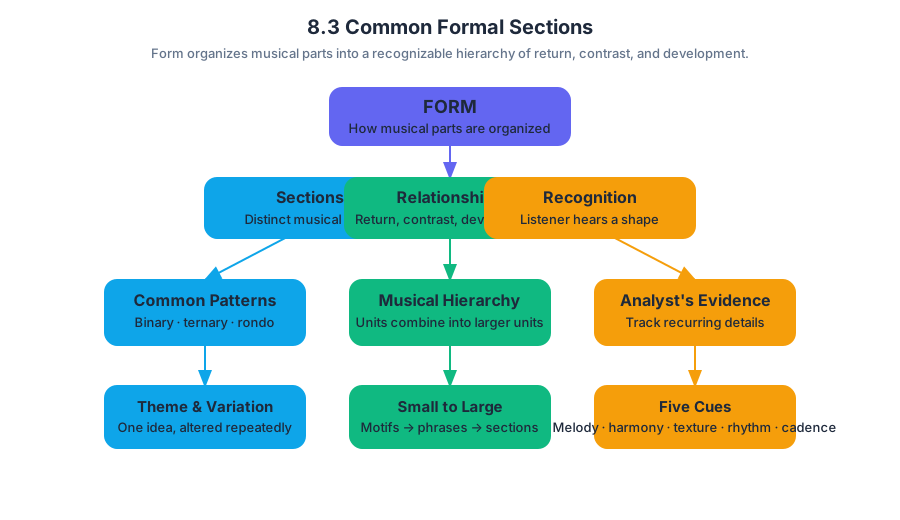
Form is the structural organization of a musical composition: the way its parts are arranged, related, contrasted, and developed. Like language, music has hierarchy—small units combine into larger units, and those larger units create the composition’s recognizable shape.
8.3 Common Formal Sections
Form is the structural organization of a musical composition: the way its parts are arranged, related, contrasted, and developed. Like language, music has hierarchy—small units combine into larger units, and those larger units create the composition’s recognizable shape.
A listener may hear a return, a contrast, or a new section before knowing its name. A score analyst makes that intuition precise by tracking recurring melody, harmony, texture, rhythm, and cadence.
Formal hierarchy: music as structure
A composition can be understood as nested levels:
- Motives combine into phrases.
- Phrases combine into larger sections.
- Sections form a complete composition.
- Larger works may organize several complete movements or parts into an even broader structure.
The individual profile of a piece comes from the relationships among these parts. A section may be repeated, contrasted, or developed. Repetition creates stability and recognition; contrast creates variety; development transforms earlier material so that it produces motion or new meaning.
FOR-1: Form is a hierarchy of constituent parts whose relationships, contrasts, development, and established roles create the unique profile of a composition.
Formal types can be recognized in two complementary ways. Some depend on established melodic-harmonic patterns—for example, a return to opening material after a contrasting passage. Others depend on formal function, meaning the role a part performs in the larger structure: beginning, transition, continuation, climax, return, or closure.
Modes: identity through pitch organization
A mode is a scale pattern with a characteristic arrangement of whole steps, half steps, and altered scale degrees. Modes can give a passage a distinctive sound, and that sound can help distinguish one formal section from another.
Using a common tonic as a reference, the seven diatonic modes are:
| Mode | Scale-degree pattern above its tonic | Characteristic difference |
|---|---|---|
| Ionian | $1\ 2\ 3\ 4\ 5\ 6\ 7$ | Major-scale collection |
| Dorian | $1\ 2\ \flat3\ 4\ 5\ 6\ \flat7$ | Minor third with raised sixth |
| Phrygian | $1\ \flat2\ \flat3\ 4\ 5\ \flat6\ \flat7$ | Minor quality with lowered second |
| Lydian | $1\ 2\ 3\ \sharp4\ 5\ 6\ 7$ | Major quality with raised fourth |
| Mixolydian | $1\ 2\ 3\ 4\ 5\ 6\ \flat7$ | Major quality with lowered seventh |
| Aeolian | $1\ 2\ \flat3\ 4\ 5\ \flat6\ \flat7$ | Natural minor collection |
| Locrian | $1\ \flat2\ \flat3\ 4\ \flat5\ \flat6\ \flat7$ | Minor quality with lowered second and fifth |
For example, a melody centered on $D$ using the notes of $D$ Dorian—$D$, $E$, $F$, $G$, $A$, $B$, and $C$—sounds different from one centered on $D$ Aeolian, which uses $B\flat$ instead of $B$. If a composition moves from a Dorian opening to a contrasting Aeolian section, the change in scale-degree $6$ can help mark the formal boundary even when the instrumentation remains unchanged.
Misconception check: a mode is not merely “starting a major scale on a different note.” A mode has its own tonal center, and its characteristic scale-degree pattern must be heard or analyzed in relation to that center.
Common formal sections and their functions
The CED identifies common sections in both performed and notated music through FOR-1.E, “Identify common sections in—performed music [and] notated music.” Essential Knowledge FOR-1.E.1 names the following terms:
| Section | Typical function |
|---|---|
| Introduction | Establishes a work’s sound, mood, meter, key, or thematic material before the principal section |
| Verse | Presents successive stanzas, often with changing text and recurring musical design |
| Refrain | Returns with the same or similar text and music after contrasting material |
| Chorus | A recurring, often especially prominent section, frequently carrying the central text or hook |
| Bridge | Connects or contrasts larger sections, often supplying new melodic or harmonic material |
| Interlude | Provides instrumental or transitional material between principal sections |
| Coda | A closing passage that extends or confirms the ending |
| Codetta | A smaller closing unit, often completing a phrase or subsection |
These labels describe what a passage does within a structure, not just what it sounds like in isolation. A bridge, for instance, is identified by its connective or contrasting role; a coda follows the main structural close and reinforces finality.
Exam boundary: The terms in FOR-1.E.1 may identify sections within a musical excerpt and orient a response to a multiple-choice question. Students are not asked to invent section labels independently as the sole task.
Representative formal types
A formal type is a recurring large-scale arrangement of sections. The letters show relationships: identical letters indicate related or repeated material, while different letters indicate contrast.
- Binary form: $AB$ — one section is followed by a contrasting or complementary section. The first part often moves away from the opening tonal area, while the second provides continuation and eventual closure.
- Ternary form: $ABA$ — an opening section returns after a contrasting middle section. The return creates formal balance and makes the middle section function as contrast.
- Rondo form: $ABACA$ or a longer pattern such as $ABACADA$ — a recurring principal section alternates with contrasting episodes. The recurring $A$ material provides continuity while the episodes provide variety and development.
- Strophic form: $AAA\ldots$ — successive stanzas use the same or nearly the same music. Changing text supplies variation while musical repetition creates unity.
A short instrumental example might begin with an $A$ theme in a stable tonic, move to a contrasting $B$ passage with new melodic and harmonic material, and then return to $A$. That pattern is ternary only if the returning material functions as a recognizable restatement; merely ending in the opening key does not prove that the opening section has returned.
Worked analysis: from sound to formal diagram
Imagine a performed piece with the following events: an eight-measure instrumental opening, a vocal verse, a recurring chorus, a contrasting bridge, a return of the chorus, and a short closing extension.
- The instrumental opening is the introduction.
- The verse establishes the first principal section.
- The chorus returns with the central musical idea, functioning as a refrain or chorus.
- The bridge introduces contrast and connects toward the return.
- The final extension is a coda.
A useful diagram is:
$$ \text{Introduction} - A - B - C - B - \text{Coda} $$
The exact label depends on evidence from the music. If $B$ is the same chorus each time, the design resembles a refrain-based or rondo-like structure; if the verse and chorus alternate repeatedly, the large-scale pattern may be described as verse–chorus form. The analyst should identify audible or notated relationships first, then choose the most defensible formal description.
Retrieval check
A passage begins in Dorian, introduces a contrasting section in Aeolian, returns to the original melody, and ends with a short confirming extension. Name the most likely large-scale type and two formal functions.
Answer: The design is most consistent with ternary form, $ABA$: the opening and return provide repetition and structural balance, the Aeolian middle provides contrast, and the final extension functions as a coda if it follows the actual structural return.