From the free course AP Music Theory on Lykke
8.2 Phrase relationships
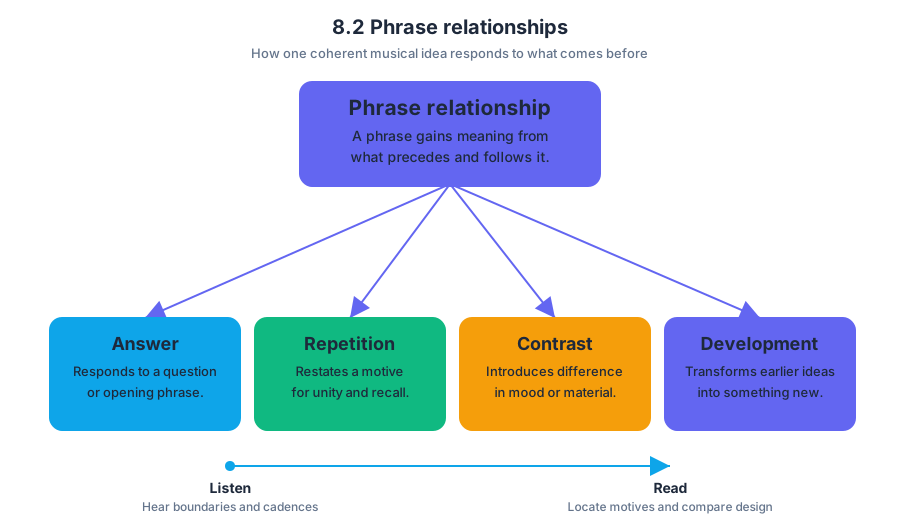
A phrase is a coherent musical idea that usually ends with a cadence, and a phrase relationship describes how one phrase answers, repeats, contrasts with, or develops another.
8.2 Phrase relationships
A phrase is a coherent musical idea that usually ends with a cadence, and a phrase relationship describes how one phrase answers, repeats, contrasts with, or develops another. Like a spoken exchange—“Are we leaving?” followed by “Yes, after dinner”—phrases gain meaning from what comes before and after them.
CED alignment: Topic 8.2 Phrase Relationships; AP Skills 1.F, Analyze Performed Music, and 2.F, Analyze Notated Music. The topic belongs to the Musical Design and Form ideas emphasized in Unit 8. In performance, you listen for phrase boundaries and relationships; in notation, you locate cadences, compare motives, and diagram the design.
Hearing the phrase as a musical sentence
A phrase often has a beginning, a continuation, and a point of temporary or final arrival. Its boundary may be marked by a cadence, a rest, a long note, a change of texture, or a change in melodic and rhythmic activity. No single clue is always decisive: a breath mark can help, but the harmony and melodic shape must also support the interpretation.
Two phrases may be related in several ways:
| Relationship | What changes? | Typical musical effect |
|---|---|---|
| Parallel | The phrases begin similarly but continue differently. | Recognition followed by variation |
| Contrasting | Their melodies, rhythms, or contours differ substantially. | Question-and-answer contrast |
| Antecedent–consequent | The first phrase sounds incomplete; the second answers it more conclusively. | Musical question followed by answer |
| Repeated | The musical idea returns with little or no change. | Emphasis, stability, or formal clarity |
The antecedent–consequent pair
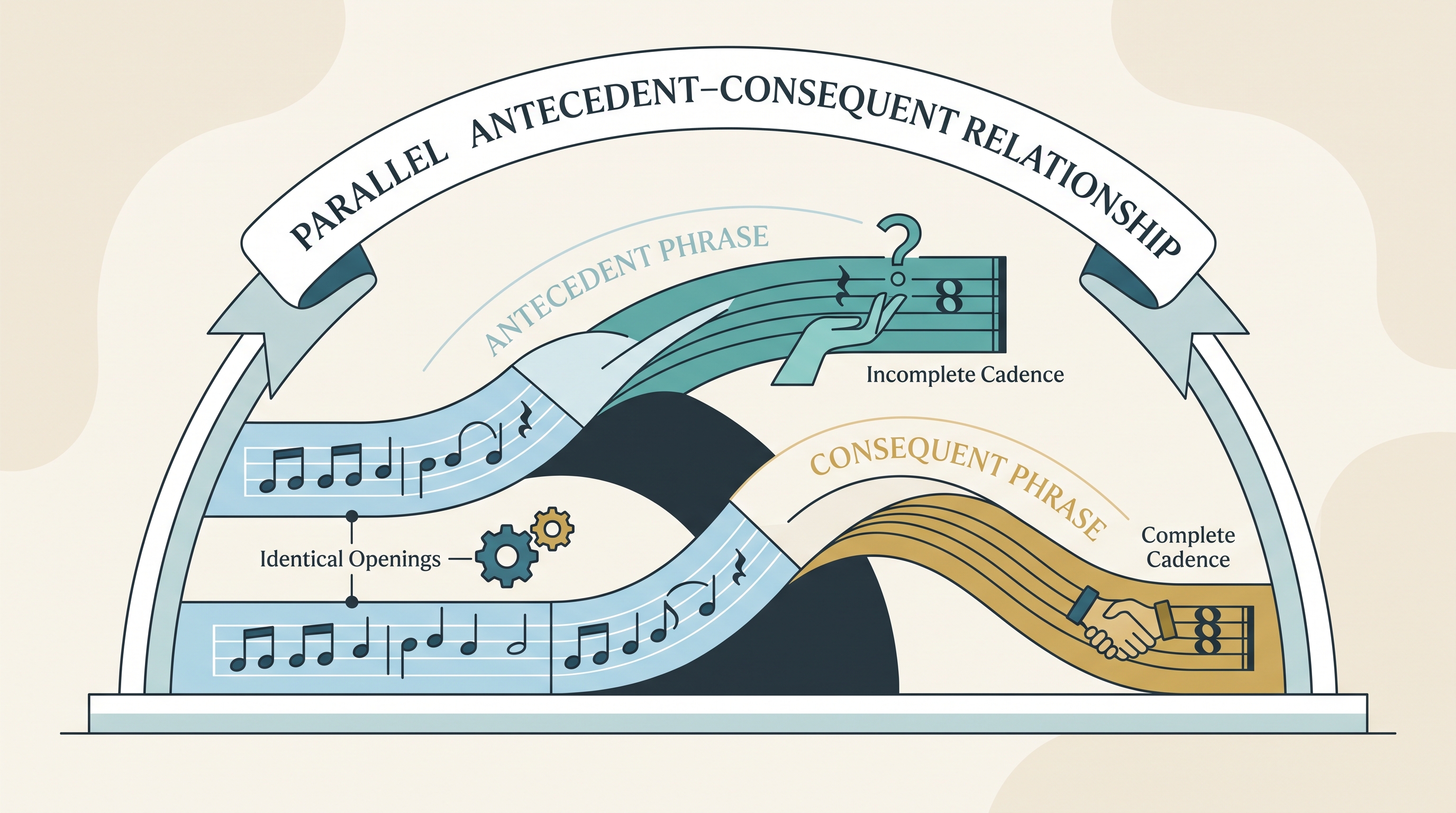
An antecedent phrase is the opening “question” of a phrase pair. It commonly ends with a cadence that sounds unfinished, such as a half cadence, while the consequent phrase responds and more often ends with an authentic cadence. The relationship is functional rather than merely visual: the second phrase must sound like a response to the first.
Imagine a melody in $C$ major. Phrase $1$ begins with the motive $C-D-E$ and ends on the dominant harmony, $V$, producing a half cadence. Phrase $2$ begins again with $C-D-E$, but then changes direction, reaches the tonic harmony, $I$, and closes with an authentic cadence. Because the opening is shared but the endings differ, the pair is parallel antecedent–consequent.
The same opening does not automatically create an antecedent–consequent relationship. If both phrases end with equally conclusive cadences, the first may function as a repeated or parallel phrase rather than an antecedent. Always listen for the larger question-and-answer arc.
Parallel and contrasting phrases
A parallel phrase relationship is recognized by shared material at the beginning of two phrases. The later material may be transposed, rhythmically altered, or redirected toward a different cadence. For example, a phrase beginning with an ascending third followed by stepwise motion might return with the same contour but end on a different pitch and harmony.
A contrasting phrase relationship begins with substantially different musical material. Contrast can involve melodic contour, rhythmic density, register, articulation, or harmonic direction. A quiet, stepwise first phrase followed by a more active phrase with larger leaps is contrasting even if both phrases occupy the same number of measures.
Worked analysis: identifying the relationship
Suppose a notated melody contains two four-measure units:
- Phrase $1$: begins with $G-A-B$, repeats the opening rhythm, and ends on $D$ with dominant harmony.
- Phrase $2$: begins with $G-A-B$, changes the final two measures, and ends on $C$ with tonic harmony.
Reasoning:
- The two phrases share their opening motive, so they are parallel.
- Phrase $1$ ends on dominant harmony, so it behaves like an antecedent.
- Phrase $2$ ends on tonic harmony, so it behaves like a consequent.
- The complete description is therefore a parallel antecedent–consequent relationship.
Misconception check
Misconception: “A phrase is always four measures long.” Four measures is common, but phrase length depends on musical syntax, not a fixed measurement. A phrase may last two, four, eight, or an irregular number of measures if its melodic and harmonic motion creates a convincing unit.
Misconception: “A repeated rhythm means the phrases are identical.” Phrase identity depends on the whole musical idea. A phrase can repeat its rhythm while changing pitch contour, harmony, register, or cadence; those changes may create a parallel or contrasting relationship.
Skill application and retrieval check
For 1.F, Analyze Performed Music, listen for where a phrase seems to breathe, where its harmony pauses, and whether the next phrase confirms or challenges the first. For 2.F, Analyze Notated Music, mark phrase boundaries, label cadence types, compare opening motives, and describe the relationship using precise terms such as parallel, contrasting, antecedent, and consequent.
Retrieval check: Two phrases share their first two measures. The first ends with a half cadence, and the second ends with an authentic cadence. What phrase relationship is most precise? Answer: a parallel antecedent–consequent relationship. The shared opening makes it parallel; the incomplete-to-complete cadence pattern makes it antecedent–consequent.