From the free course AP Music Theory on Lykke
5.3 Predominant seventh chords
Key concepts: common-practice techniques · converting between performed and another representation
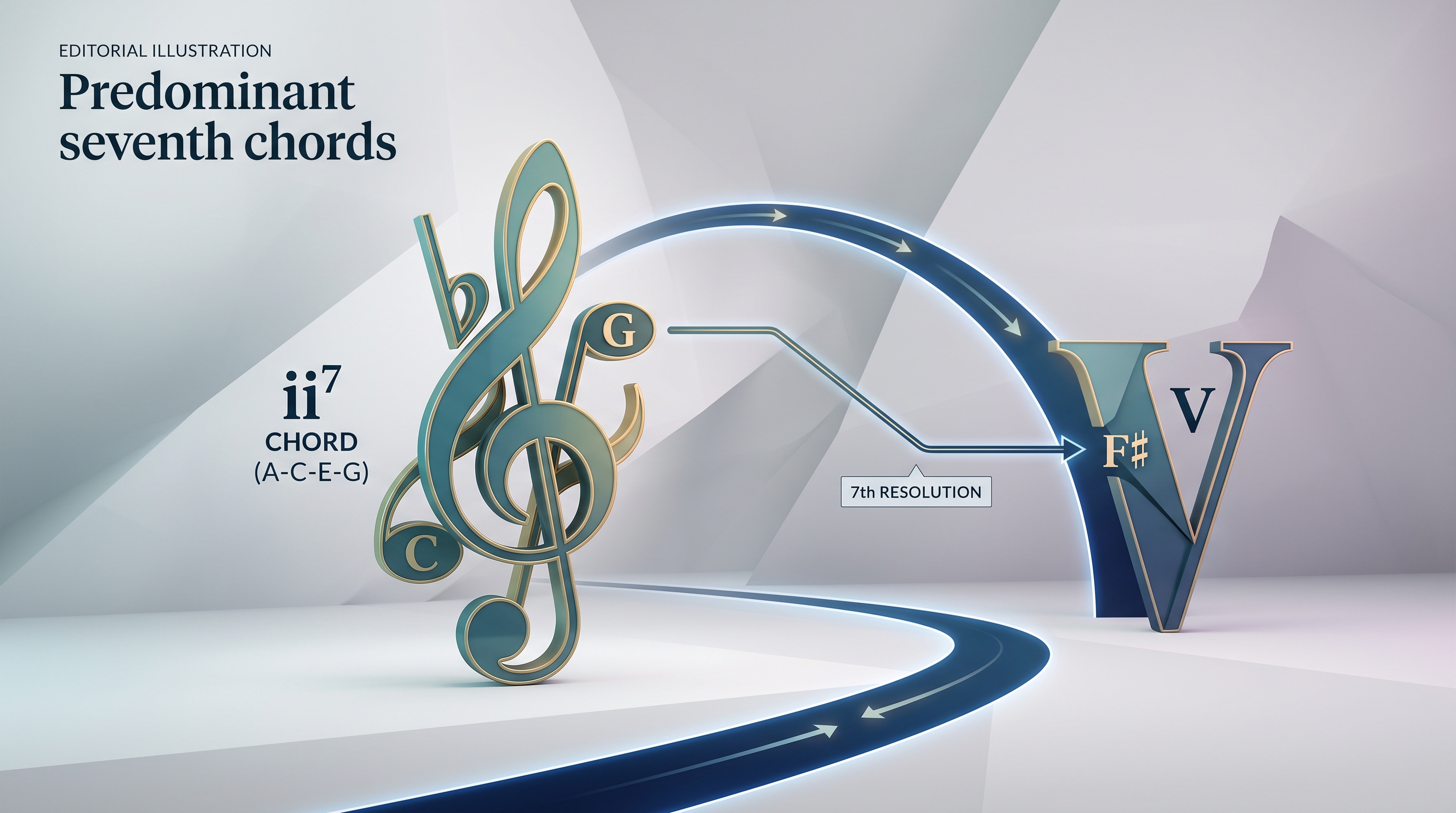
A predominant seventh chord prepares the dominant by adding a fourth chord member to a predominant triad, creating a stronger directed motion toward $V$ or $V^7$.
5.3 Predominant Seventh Chords
A predominant seventh chord prepares the dominant by adding a fourth chord member to a predominant triad, creating a stronger directed motion toward $V$ or $V^7$. In the familiar harmonic route
$$ \text{tonic} \rightarrow \text{predominant} \rightarrow \text{dominant} \rightarrow \text{tonic}, $$
the predominant seventh chord is the “launch platform” that gives the dominant arrival extra momentum.
Key idea: Predominant seventh chords usually move toward dominant-function chords, not directly to tonic.
The principal predominant seventh chords
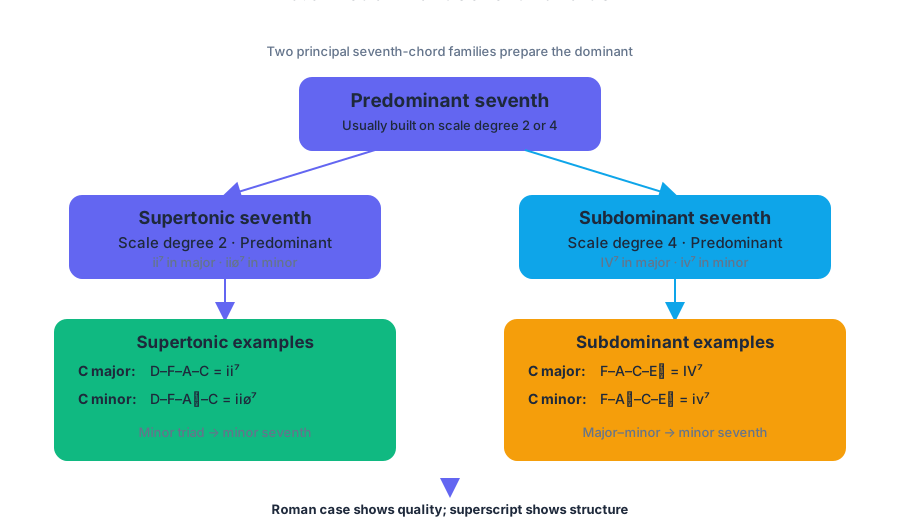
In common-practice harmony, the most important predominant seventh chords are built on scale degree $2$ and scale degree $4$.
| Chord | Major-key form | Minor-key form | Typical function |
|---|---|---|---|
| Supertonic seventh | $ii^7$ | $ii^{ø7}$ | Predominant |
| Subdominant seventh | $IV^7$ | $iv^7$ | Predominant |
The $ii^7$ chord in a major key contains the notes of the minor triad on scale degree $2$ plus a minor seventh above its root. In C major:
$$ ii^7 = D-F-A-C. $$
The $ii^{ø7}$ chord in a minor key is a diminished triad with a minor seventh. In C minor:
$$ ii^{ø7} = D-F-A\flat-C. $$
The subdominant seventh has a major-minor seventh quality in major:
$$ IV^7 \text{ in C major} = F-A-C-E\flat, $$
and a minor seventh quality in minor:
$$ iv^7 \text{ in C minor} = F-A\flat-C-E\flat. $$
The symbol tells you both what the chord is and how it functions: lowercase Roman numerals indicate minor or diminished quality, while the superscript identifies the seventh-chord structure.
Why the seventh matters
A seventh added above a predominant chord creates a dissonant interval that normally resolves downward by step. In $ii^7 \rightarrow V$, the chordal seventh is scale degree $1$, and it commonly descends to scale degree $7$, which is the third of the $V$ chord.
In C major:
$$ ii^7 = D-F-A-C \quad \longrightarrow \quad V = G-B-D. $$
The note $C$, the seventh of $ii^7$, moves down to $B$, the third of $V$. This motion is especially important because it both resolves the dissonance and helps define the dominant harmony.
Other voices move to available tones of $V$ according to the voicing. Scale degree $4$ often moves to a chord tone such as scale degree $5$ rather than being described as rising to the leading tone. The leading tone, scale degree $7$, generally rises to scale degree $1$ when the progression continues from $V$ to $I$.
Worked example: hearing and notating $ii^7 \rightarrow V^7 \rightarrow I$
Suppose a performed passage in C major sounds like four sustained harmonic events:
$$ D-F-A-C \rightarrow G-B-D-F \rightarrow C-E-G. $$
Identify it in three stages:
- The first chord has root $D$ and the pitch collection of $ii^7$: label it $ii^7$.
- The second chord is built on scale degree $5$ and contains $G$, $B$, $D$, and $F$: label it $V^7$.
- The final chord is the tonic triad: label it $I$.
The complete progression is therefore
$$ ii^7 \rightarrow V^7 \rightarrow I. $$
If the music is heard rather than seen, listen for the characteristic pull of the seventh downward and the leading tone upward. If the music is notated, inspect the key, identify the chord root, stack the chord members by thirds, and determine the Roman numeral. This is the conversion between performed and notated music required by Skill 3: Convert between performed and notated music, especially 3.E: Apply knowledge of musical symbols and terms to detect discrepancies in pitch and rhythm when comparing notated and performed music in one or more parts.
Common-practice voice leading
When writing a predominant seventh chord, preserve the chordal seventh’s tendency to descend by step whenever possible. For $ii^7 \rightarrow V$, scale degree $1$ descends to scale degree $7$; the leading tone in the arriving $V$ chord then normally resolves upward to tonic in the following $I$ chord.
A common mistake is to treat every chord member as if it must move by the same interval or in the same direction. Voice leading is controlled by several interacting principles: resolve tendency tones, avoid forbidden parallels, keep individual parts singable, and complete the destination chord. The correct motion depends on the inversion and the specific voice that contains each chord member.
Misconception check: Scale degree $4$ is not the chordal seventh of $ii^7$ in a major key. The seventh of $ii^7$ is scale degree $1$; scale degree $4$ is the root of $IV$ and the third of $ii^7$.
Retrieval check
In G major, identify the chord $A-C-E-G$, explain its function, and name the most characteristic resolution for its seventh. The answer is $ii^7$, a predominant seventh chord; it normally moves toward $V$ or $V^7$, and its seventh, $G$, commonly descends by step to $F\sharp$, the third of $V$.