From the free course AP Music Theory on Lykke
5.6 Cadential six-four chords
Key concepts: Cadential six-four chord as a second-inversion tonic triad · Dominant function of the cadential 6/4 despite its tonic-triad pitches · Resolution of the cadential 6/4 to V · Strong-beat placement and phrase-final cadential context · Voice-leading retardations: 6–5 and 4–3 above the bass · Distinction between cadential, passing, pedal, neighboring, and arpeggiated 6/4 chords · Bass motion and stability in identifying six-four chord types · Alternative analysis of a cadential 6/4 as a decorated dominant chord
A cadential six-four chord contains the pitches of the tonic triad but functions as a dominant embellishment immediately before $V$.
5.6 Cadential six-four chords
A cadential six-four chord contains the pitches of the tonic triad but functions as a dominant embellishment immediately before $V$.
Learning Objective PIT-2.K: Identify the type of $^6_4$ chord used in notated music.
Essential Knowledge PIT-2.K.1–PIT-2.K.2: Second-inversion triads occur in four specific contexts—cadential, neighboring or pedal, passing, and arpeggiated—and their identity depends on context, metric placement, bass motion, and resolution.
The sound and function of the cadential $^6_4$
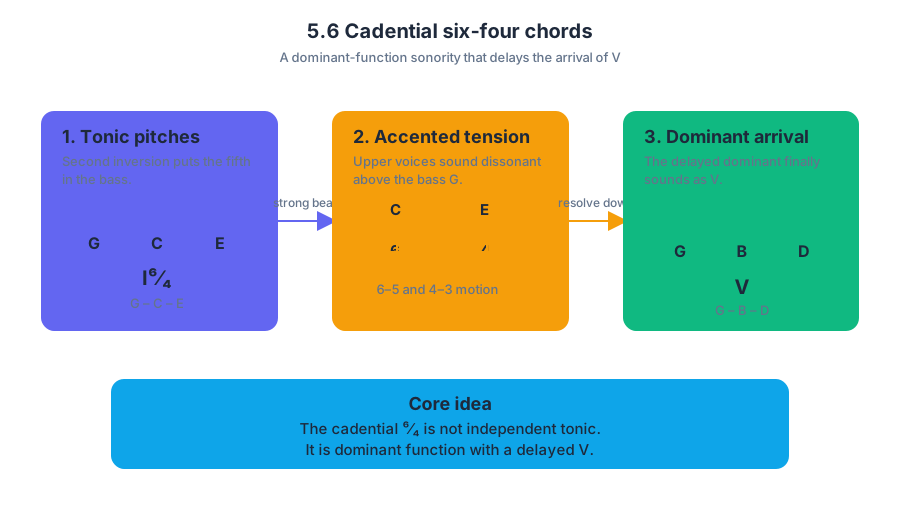
In a $^6_4$ chord, the fifth of the triad is in the bass. A tonic triad in C major, for example, contains C, E, and G. Its second inversion places G in the bass:
$$ I^{6/4} = G\text{–}C\text{–}E $$
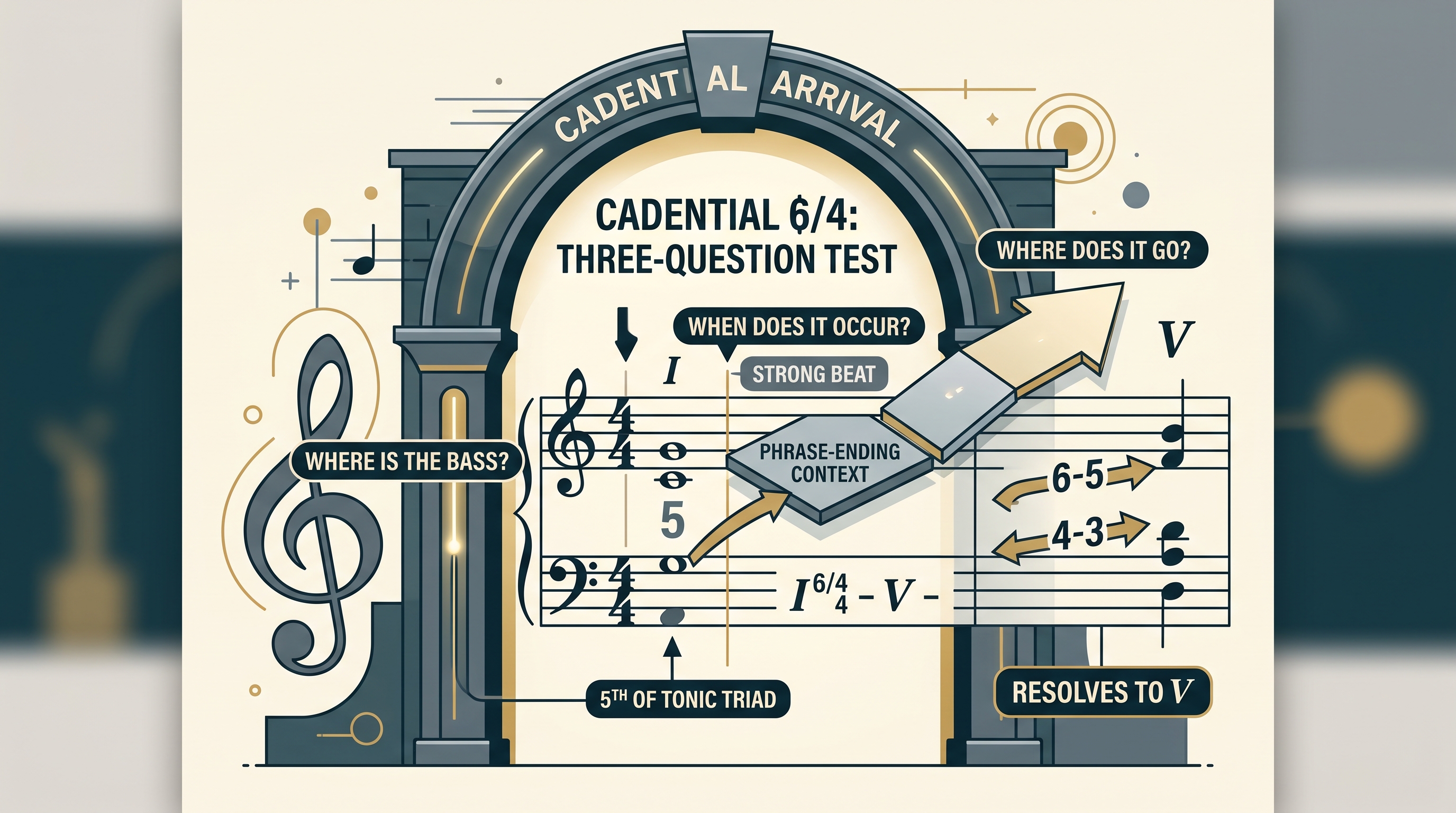
Although these are tonic-triad pitches, the chord does not behave like $I$. On a strong beat near the end of a phrase, the upper voices create two accented dissonances above the bass. They then resolve downward into the dominant:
$$ I^{6/4} \longrightarrow V $$
In C major:
$$ G\text{–}C\text{–}E \longrightarrow G\text{–}B\text{–}D $$
The C above the bass G descends to B, creating the characteristic $6-5$ motion. The E descends to D, creating $4-3$ motion.
Core idea: the cadential $^6_4$ is not an independent tonic-function chord. It is a dominant-function sonority whose upper voices temporarily delay the arrival of $V$.
Worked example: locating the cadential $^6_4$
Suppose the final harmony of a phrase in G major is written as follows:
$$ \text{Bass: } D \qquad \text{Upper voices: } G,\ B $$
The notes are D–G–B, the pitches of $I^{6/4}$ in G major. To determine whether this is cadential, inspect three clues:
- Bass position: D is the fifth scale degree, so the tonic triad is in second inversion.
- Metric placement: the sonority occurs on a strong beat, giving the upper voices accented emphasis.
- Resolution: G moves down to F-sharp and B moves down to A, producing $6-5$ and $4-3$ above the bass D.
The analysis is therefore:
$$ I^{6/4} \longrightarrow V \longrightarrow I $$
or, in an alternative dominant-centered analysis:
$$ V^{6/4-5/3} \longrightarrow I $$
The second analysis emphasizes that the entire event belongs to dominant function, with the $^6_4$ pitches acting like moving figures over the dominant bass.
Misconception check: “It contains the tonic triad, so it must be tonic harmony.”
Correction: harmonic function comes from context, not from pitch collection alone. Strong-beat placement, phrase-final location, and resolution to $V$ identify this sonority as cadential dominant embellishment.
Four kinds of $^6_4$ chords
The bass and the surrounding voices distinguish the cadential type from other second-inversion triads.
| Type | Typical context | Identifying motion |
|---|---|---|
| Cadential $^6_4$ | Strong beat near a phrase ending | Resolves to $V$; upper voices show $6-5$ and $4-3$ |
| Passing $^6_4$ | Bass moves by step through a scale fragment | Bass continues upward or downward between harmonies |
| Neighboring or pedal $^6_4$ | Upper voices move while the bass remains stationary | Bass acts as a sustained pedal point |
| Arpeggiated $^6_4$ | Bass outlines a triad | Bass arpeggiates between root and fifth or through the complete triad |
A passing $^6_4$ is noncadential because its bass participates in stepwise motion. A pedal $^6_4$ is noncadential because the upper voices move against a stationary bass. An arpeggiated $^6_4$ results from bass arpeggiation, often producing the flowing bass patterns associated with waltzes or marches.
Analysis workflow
Three-question test:
Where is the bass? Is it the fifth of a tonic triad?
When does it occur? Is it on a strong beat in a phrase-ending context?
Where does it go? Does it resolve to $V$ with $6-5$ and $4-3$ motions?
If all three answers point toward the dominant arrival, label the chord $I^{6/4}-V$ or use the dominant-centered reading $V^{6/4-5/3}$. Do not label every second-inversion tonic triad as cadential.
Retrieval check: A second-inversion tonic triad appears on a weak beat while the bass moves stepwise from scale degree $4$ to $5$. Is it cadential, passing, pedal, or arpeggiated? Answer: passing, because the bass is part of a stepwise connecting motion rather than a phrase-final $I^{6/4}-V$ resolution.

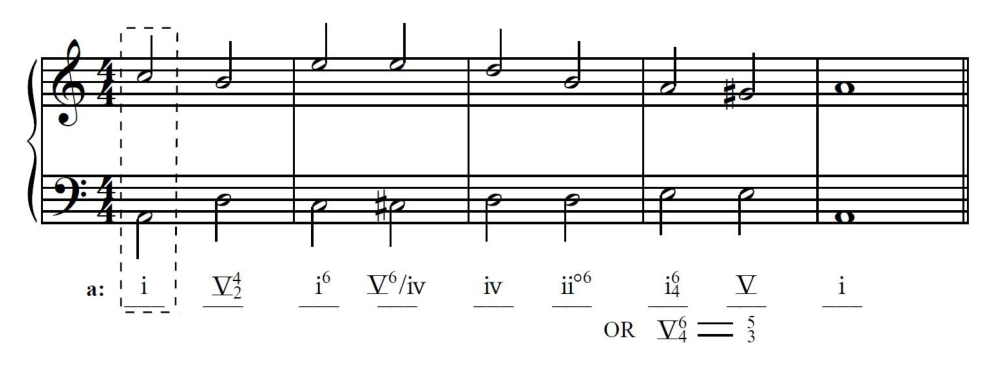
Source Materials
- Learn More (.pdf)
- AP Music Theory Course and Exam Description
- AP Music Theory Course Overview
- AP Music Theory Course at a Glance
- AP Music Theory Course at a Glance Poster
- Adopt AP Music Theory
- AP Music Theory
- AP Music Theory
- About the Advanced Placement Program ® (AP ®)
- D. Before giving a final score of 0 or 3, first consider the cadence. 1. Award at least 1 point for the phrase if its cadence (i.e., its final two chords considered by
- Figure — Sample Responses Q4 (p. 2)
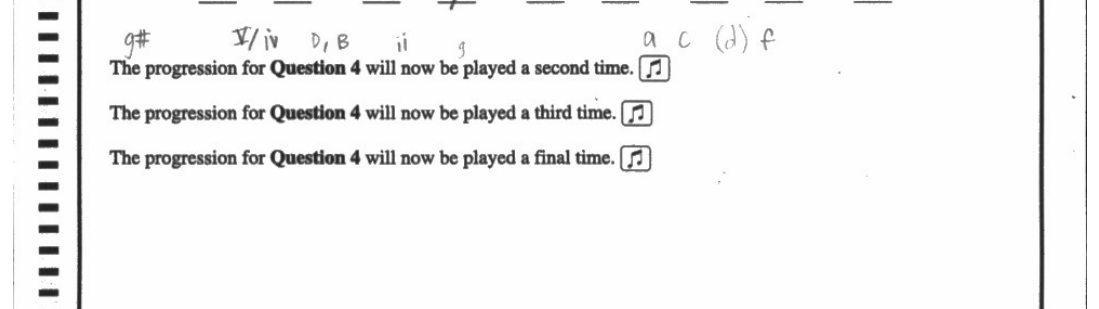
- Figure — Sample Responses Q4 (p. 3)