From the free course AP Music Theory on Lykke
2.8 Timbre
Two instruments can play the same pitch at the same loudness and still sound unmistakably different because timbre is the quality of sound that lets us identify its source.
2.8 Timbre
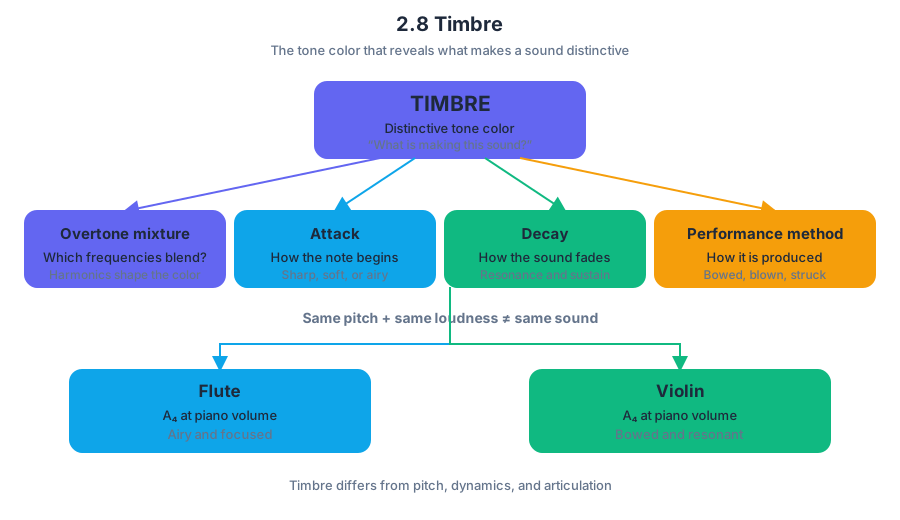
Two instruments can play the same pitch at the same loudness and still sound unmistakably different because timbre is the quality of sound that lets us identify its source. A flute and a violin may both perform the note $A_4$ at piano volume, yet the flute sounds airy and focused while the violin sounds bowed, resonant, and complex.
Timbre is the distinctive tone color of a sound, shaped by its overtone mixture, attack, decay, and performance method.
Timbre answers the listening question, “What is making this sound, and how is it being produced?” It is therefore different from pitch, which describes perceived highness or lowness; dynamics, which describes loudness; and articulation, which describes how a note begins, connects, or ends.
The sound’s identity: four listening clues
A useful way to hear timbre is to separate the sound into four interacting clues:
- Overtone content: A musical tone normally contains a fundamental frequency plus additional frequencies called overtones. The relative strength of those overtones gives a sound its characteristic color.
- Attack: The attack is the beginning of the sound. A piano hammer creates a sharp attack; a bowed string can enter more gradually; a breathy flute may begin with an audible burst of air.
- Decay and sustain: Some sounds fade quickly after the attack, while others can be sustained or shaped continuously.
- Performance method: Bowing, plucking, striking, blowing, singing, muting, and electronic processing can all change the same instrument’s timbre.
These clues work together rather than independently. A trumpet played with a mute is still a trumpet, but its altered attack and overtone profile may make it sound distant, nasal, or veiled. Likewise, a violin played pizzicato has a shorter, more percussive timbre than the same violin played arco.
Timbre is not the same as instrumentation
Instrumentation names the instruments or voices present; timbre describes the sound qualities those sources produce. Saying “the excerpt uses clarinet and strings” identifies instrumentation. Saying “the clarinet has a rounded, woody tone above a bright, lightly bowed string layer” analyzes timbre.
This distinction matters in performed-music analysis. A listener may hear a single melody twice and recognize that the second statement has changed even when the pitch and rhythm remain constant. If the melody moves from oboe to trumpet, the musical identity changes through timbre rather than through melody.
Worked listening example: a film-score excerpt
In the opening-credits music from Aladdin, create a “musical map” that records more than melody and harmony. First identify the sound sources you hear: perhaps a solo voice, percussion, strings, winds, or electronic layers. Then describe how their tone colors enter, combine, and change the character of the passage.
A strong analysis might proceed like this:
- The opening sound has a prominent vocal or instrumental color that immediately establishes the atmosphere.
- Percussive attacks add immediacy because they begin sharply and may decay quickly.
- Sustained instrumental layers create a contrasting background whose timbre is smoother and less sharply articulated.
- When the opening motive returns, a changed instrument or vocal color can make the repetition feel larger, brighter, darker, or more intense even if the pitch pattern is unchanged.
- The result is a change in musical design—the Unit 2 map identifies timbre under DES (Musical Design)—rather than merely a change in notes.
The exact instrument label should be evidence-based. If you cannot identify an instrument confidently, describe what you can hear: “a nasal reed-like tone,” “a bright brass attack,” “a breathy high register,” or “a dense string sonority.” A precise sonic description is better than an unsupported guess.
AP skill connection
Topic 2.8 Timbre is mapped to DES and Skill 1: Analyze performed music. In practice, this means listening for audible evidence and explaining how sound color contributes to musical meaning, contrast, continuity, or emphasis.
Do not treat timbre as a label-hunt. The strongest analysis connects a heard color to its function: a solo timbre may bring a melody forward; a darker timbre may signal a change in atmosphere; a newly added instrumental color may mark a return or intensification; and contrasting colors may help listeners distinguish musical layers.
Misconception check
Misconception: “Timbre means which instrument is playing.” Instrument identity is one clue, but timbre also changes with register, dynamics, articulation, playing technique, and recording treatment. A softly sung note, a shouted note, and a whispered note may come from the same performer but possess very different timbres.
Misconception: “Higher means brighter, and lower means darker.” Register can influence perceived color, but pitch and timbre are separate properties. A low flute and a low cello can share a register while remaining clearly distinguishable by their overtone patterns and attacks.
Retrieval check
A recording presents the same four-note melody twice. The second statement uses a trumpet instead of a clarinet, with no change in pitch, rhythm, or loudness. What changed, and what evidence would you cite?
Answer: The timbre changed. The evidence is the different tone color—especially the trumpet’s more prominent attack and brass-like overtone character compared with the clarinet’s reed-based, rounded sound.