From the free course AP Music Theory on Lykke
AP Practice 3
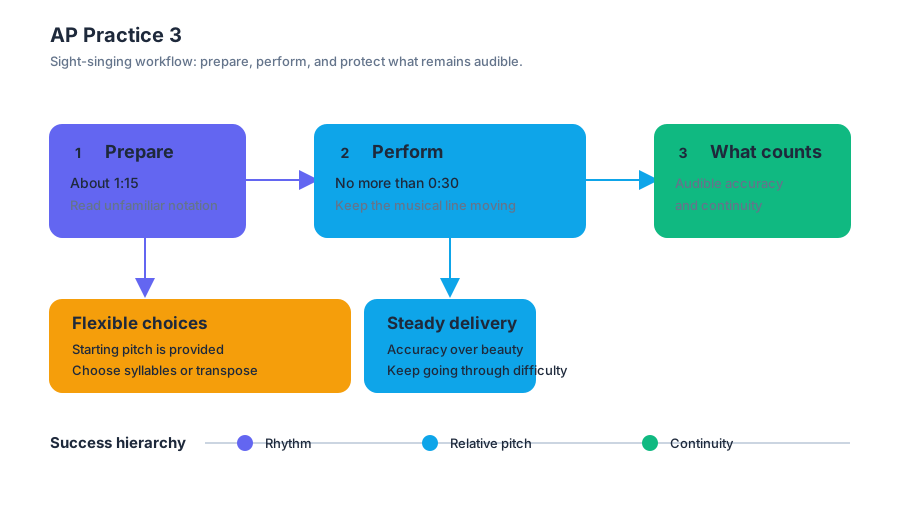
A sight-singing response is judged by what remains audible when the melody becomes difficult: rhythmic accuracy, relative pitch accuracy, and continuity. The task is not to sing with a beautiful operatic tone; it is to keep the musical line moving accurately and steadily while reading unfamiliar notation.
For each melody, the current procedure allows approximately $1$ minute and $15$ seconds of preparation followed by a performance of no more than $30$ seconds. A starting pitch is provided, but you may sing with note names, solfège, scale-degree numbers, or a neutral syllable, and you may transpose the melody to a comfortable key.
Original practice task: a compound-meter melody
Preparation time: $1$ minute and $15$ seconds.
Performance time: $30$ seconds.
Suggested setting: $6/8$ meter, key signature of $G$ major, beginning on scale degree $1$.
Because plain text cannot display the complete staff notation, use the following equivalent reading model for an original melody. Each bar contains two beats, and each beat divides into three eighth-note pulses:
| Measure | Beat 1 | Beat 2 |
|---|---|---|
| $1$ | $G$ quarter note, $A$ eighth note | $B$ dotted quarter note |
| $2$ | $A$ quarter note, $G$ eighth note | $E$ dotted quarter note |
| $3$ | $F^\sharp$ quarter note, $G$ eighth note | $A$ dotted quarter note |
| $4$ | $B$ quarter note, $A$ eighth note | $G$ dotted quarter note |
The melody therefore has the solfège pattern:
$$ \text{do–re–mi};|;\text{re–do–la};|;\text{ti–do–re};|;\text{mi–re–do} $$
Before singing, identify three anchors: the tonic $G$ as do, the dominant $D$ as a likely destination, and the final $G$ as do. Notice also that every measure contains the same rhythmic shape: a quarter note followed by an eighth note, then a dotted quarter note. Recognizing that repeated pattern prevents the rhythm from becoming a separate problem in every measure.
Worked reasoning under exam conditions
First pass: scan the structure. Confirm the key signature, meter, starting pitch, phrase length, and final pitch. In $6/8$, do not count six equal strong beats; hear two larger beats, each divided into three eighth-note pulses:
$$ \text{ONE-la-li TWO-la-li} $$
Second pass: speak the rhythm. Before adding pitch, say a neutral syllable through the four measures. The first beat of measure $1$ occupies three eighth-note pulses: the quarter note uses pulses $1$ and $2$, while the eighth note arrives on pulse $3$. The dotted quarter note fills the entire second beat.
Third pass: locate the scale degrees. In $G$ major, the notes are:
$$ G=\text{do},\quad A=\text{re},\quad B=\text{mi},\quad E=\text{la},\quad F^\sharp=\text{ti}. $$
The most important interval is the step from $F^\sharp$ to $G$: ti resolves upward by a half step to do. Do not treat $F^\sharp$ as an isolated chromatic note; it is the leading tone of the key and points strongly toward $G$.
Fourth pass: perform without stopping. If one pitch is missed, preserve the pulse and re-enter at the next recognizable anchor. For this melody, those anchors are the beginning of each measure and the final $G$. A brief imperfect note with continuous rhythm is generally less damaging than stopping, restarting, and losing the phrase.
What earns the available credit
A strong response demonstrates the three assessed dimensions:
| Criterion | What the examiner can hear | Practical decision |
|---|---|---|
| Rhythmic accuracy | Notes enter and sustain for their intended durations | Feel $6/8$ as two beats per measure |
| Relative pitch accuracy | Melodic distances and scale-degree relationships are correct | Hear $F^\sharp$ as ti resolving to do |
| Continuity | The performance continues at a steady tempo | Recover at the next anchor instead of stopping |
The response does not require an ornate vocal style. A clear, steady neutral syllable can be safer than solfège if syllable changes disrupt the rhythm. Conversely, solfège can strengthen pitch memory when scale-degree relationships are secure.
Misconception check: “The provided starting pitch fixes my key”
It does not. The starting pitch establishes the reference for the printed melody, but the procedure permits transposition to a comfortable key. If the written range is uncomfortable, preserve the interval relationships and rhythm while singing in another key. Transposition is a performance choice, not permission to alter the melody’s contour or meter.
Retrieval check
Without looking back, answer aloud: In the original melody, what scale degree is $F^\sharp$ in $G$ major, what pitch does it tend toward, and what should you do if you miss it during performance?
Answer: $F^\sharp$ is scale degree $7$, or ti; it tends upward to $G$, or do; keep the pulse and re-enter at the next reliable anchor rather than stopping.
Error-review routine
After performing, label each error as R for rhythm, P for relative pitch, or C for continuity. Perform the melody again while correcting only the most frequent category. Then perform it once more without speaking the analysis aloud. This separates a temporary reading mistake from a recurring skill weakness and mirrors the task’s actual scoring priorities.

Source Materials
- Learn More (.pdf)
- AP Music Theory Course and Exam Description
- AP Music Theory Course Overview
- AP Music Theory Course at a Glance
- AP Music Theory Course at a Glance Poster
- Adopt AP Music Theory
- AP Music Theory
- AP Music Theory
- AP Music Theory-AP Students-College Board
- AP Music Theory-Unit Study Guides
- AP Music Theory-Raidar Choir
- Everything you need to know to get a 5 on AP Music Theory