From the free course AP Music Theory on Lykke
6.1 Passing tones and neighbor tones
Key concepts: Embellishing tones · Nonharmonic tones · Passing tones · Accented passing tones · Unaccented passing tones · Neighbor tones · Upper neighbor tones · Lower neighbor tones · Identifying passing and neighbor tones · Writing passing and neighbor tones
A melody can become expressive without changing its underlying harmony: a note may briefly step away from a chord tone, create motion, and return or continue smoothly.
6.1 Passing tones and neighbor tones
A melody can become expressive without changing its underlying harmony: a note may briefly step away from a chord tone, create motion, and return or continue smoothly. These temporary notes are nonharmonic tones, also called embellishing tones, because they decorate an essential melodic or bass framework rather than functioning as stable members of the chord.
Essential Knowledge — PIT-2.M.3: Common classifications of nonharmonic tones include passing tones, both accented and unaccented, and neighbor tones, including lower and upper neighbor tones.
The two motion patterns
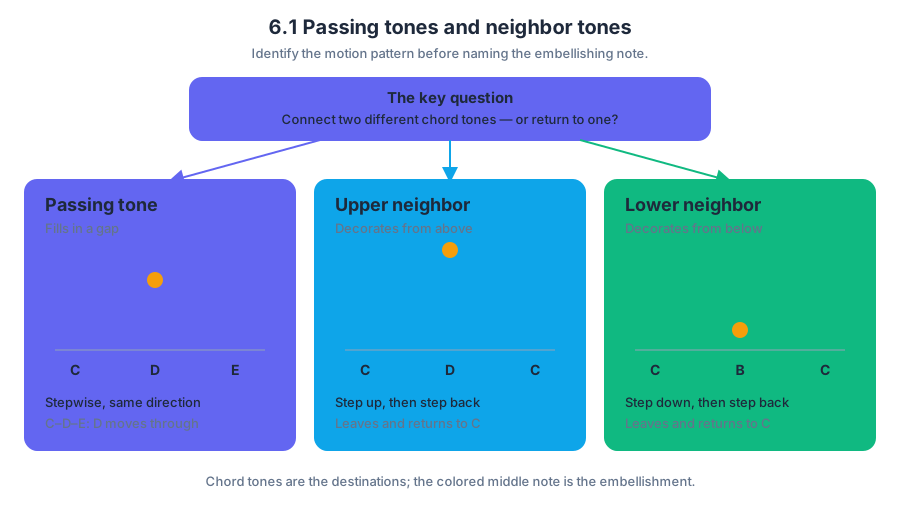
The most useful first question is: Does the embellishing note connect two different chord tones, or does it leave one chord tone and return to it?
| Type | Motion pattern | Musical effect |
|---|---|---|
| Passing tone | Stepwise motion in the same direction between two different chord tones | Fills in a gap |
| Upper neighbor tone | Step up, then step back to the original pitch | Decorates from above |
| Lower neighbor tone | Step down, then step back to the original pitch | Decorates from below |
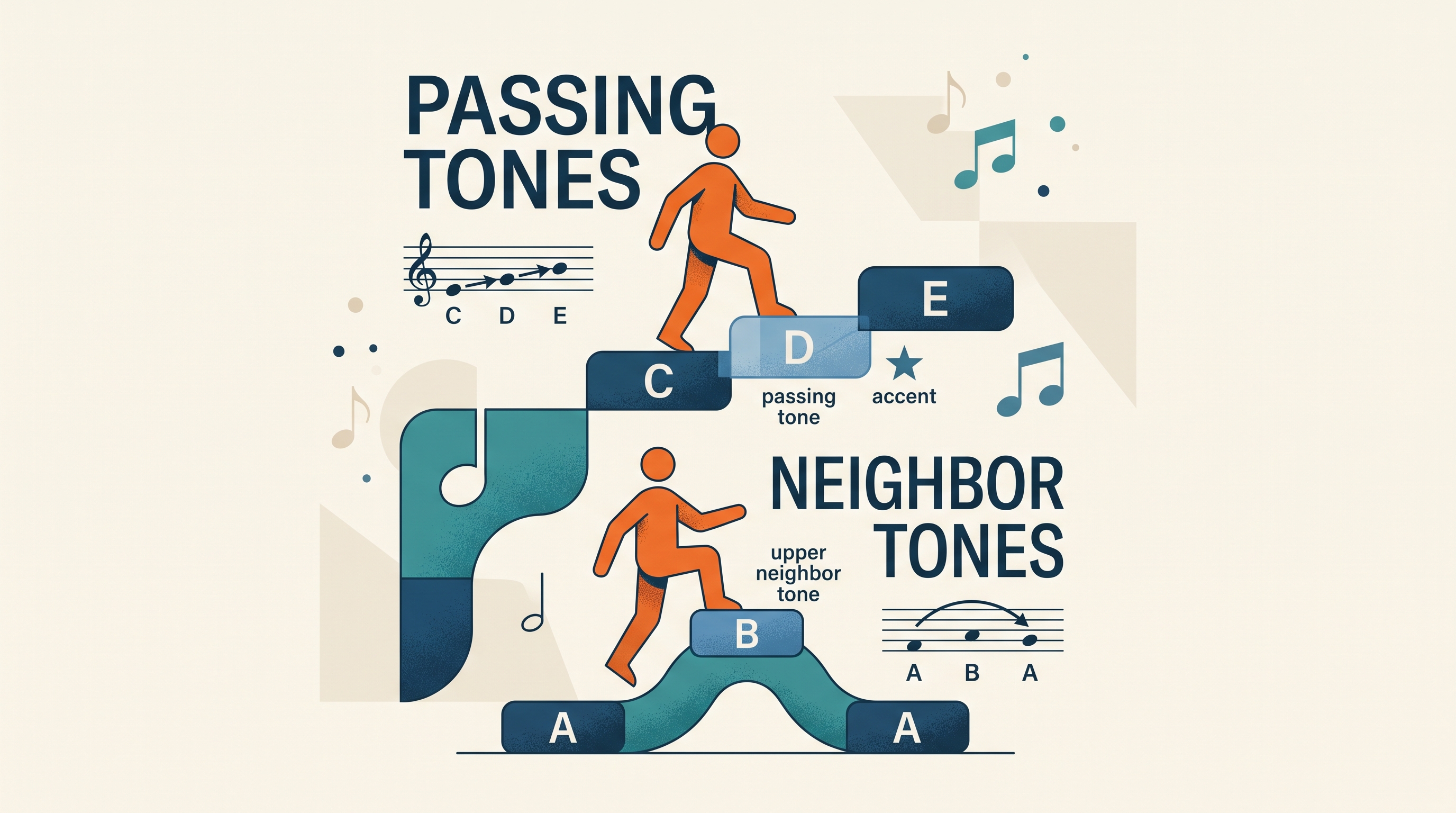
A passing tone connects two chord tones by stepwise motion in the same direction. In a C-major context, the line C–D–E contains D as a passing tone if C and E belong to the surrounding harmony while D does not. The melody moves through D toward a new goal.
A neighbor tone moves away from a chord tone by step and then returns to that same chord tone. In the pattern E–F–E, F is an upper neighbor tone. In E–D–E, D is a lower neighbor tone. The middle note temporarily ornaments a single pitch rather than connecting two different structural pitches.
Worked identification example
Suppose a bass line over a sustained harmony contains the following patterns:
$$ \text{C–D–E} \qquad \text{G–F–G} \qquad \text{E–F–G} $$
Analyze each middle note by tracing its approach and departure:
- In C–D–E, D is approached by step from C and leaves by step toward E. Because the line continues in the same direction toward a different chord tone, D is a passing tone.
- In G–F–G, F is approached by step and returns to G. Because the original pitch is restored, F is a lower neighbor tone.
- In E–F–G, F is again a passing tone, provided E and G are the surrounding chord tones.
The decisive evidence is not simply whether a note is dissonant. Follow the melodic contour: same direction toward a new pitch indicates passing; away and back to the starting pitch indicates neighbor.
Accented and unaccented passing tones
Passing tones may be accented or unaccented. An unaccented passing tone occurs on a metrically weaker position, such as an offbeat or the second part of a beat. An accented passing tone occurs on a metrically stronger position, often receiving emphasis through its placement, duration, or attack.
Consider a quarter-note framework in which the essential tones are C and E. If D appears as a shorter note between them on a weak subdivision, it is an unaccented passing tone. If D receives the stronger beat before the line continues to E, it remains a passing tone by its melodic motion, but it is now an accented passing tone.
Important distinction: “Accented” does not mean “harmonic,” and “unaccented” does not mean “unimportant.” These labels describe rhythmic or metric position, not whether the note belongs to the chord.
Chorale-style application
In an 18th-century chorale-style bass line, the essential framework may consist of quarter notes outlining the harmony. When the task specifically permits nonharmonic tones, that framework can be enlivened by carefully placed eighth-note motion, especially unaccented passing tones and unaccented neighbor tones.
For example, a bass might move from C to E while using the eighth-note pattern C–D–E, or it might decorate G with G–F–G. Such motion can create a desirable relationship with the soprano: two bass eighth notes may complement a stationary soprano quarter note, the voices may move in parallel thirds or sixths, or they may exchange registral material.
Common misconception — “Any chromatic or dissonant note is a passing tone.” A passing tone is identified by its specific approach-and-resolution pattern: step in, step out, and continue in the same direction between two different structural tones. A note that returns to its starting pitch is a neighbor tone; other patterns belong to other nonharmonic-tone classifications.
Listening and score-reading connection
The same analysis works in a written score, a sung melody, or a pop recording. A pop vocal line may briefly rise from a stable chord tone and return as an upper neighbor, or move stepwise through an intervening pitch as a passing tone. Listen for the underlying sustained or repeated pitch framework, then label the decorative motion rather than judging the note in isolation.
AP skills: This topic most directly engages Skill 1: Analyze performed music, Skill 2: Analyze notated music, and Skill 3: Convert between performed and notated music. On an exam-style task, you may need to hear or see the line, determine the approach and resolution, and identify the embellishing tone accurately.
Retrieval check
Classify the middle note in each pattern:
- C–D–E
- A–B–A
- E–D–C
Answers: D is a passing tone; B is an upper neighbor tone; D is a passing tone. Then ask one final question: if the middle note in C–D–E falls on a strong beat, what changes? Its classification remains passing tone, but its metric label changes from unaccented to accented.
Source Materials
- Learn More (.pdf)
- AP Music Theory Course and Exam Description
- AP Music Theory Course Overview
- AP Music Theory Course at a Glance
- AP Music Theory Course at a Glance Poster
- Adopt AP Music Theory
- AP Music Theory
- AP Music Theory
- AP Music Theory-AP Students-College Board
- AP Music Theory-Unit Study Guides
- AP Music Theory-Raidar Choir
- Everything you need to know to get a 5 on AP Music Theory